
Bottom Line Up Front
The United States is entering a generation long rebuild of its roads, bridges, dams, water systems, and public facilities, and precast concrete sits at the center of it. The demand is national, it is funded, and it runs across local, state, and federal buyers at the same time. For a precast producer that wants to scale, this is the opening of a lifetime.
The producers that capture this work will not necessarily be the ones with the best concrete. They will be the ones government buyers and construction primes can find, verify, and trust before a single call is made. That verification now happens online, which means a precast firm’s website and its messaging decide whether it is screened in or screened out of the largest public work in decades.
This guide lays out the whole picture: the scale of the need, why precast is built for it, where the work concentrates across the country, who buys it, who the leading producers are, what certification and compliance require, how firms scale through teaming and subcontracting, how federal work is actually won, and why a credible federal contractor website is the piece most precast firms are missing. Read it as a playbook for reshaping your firm to win.
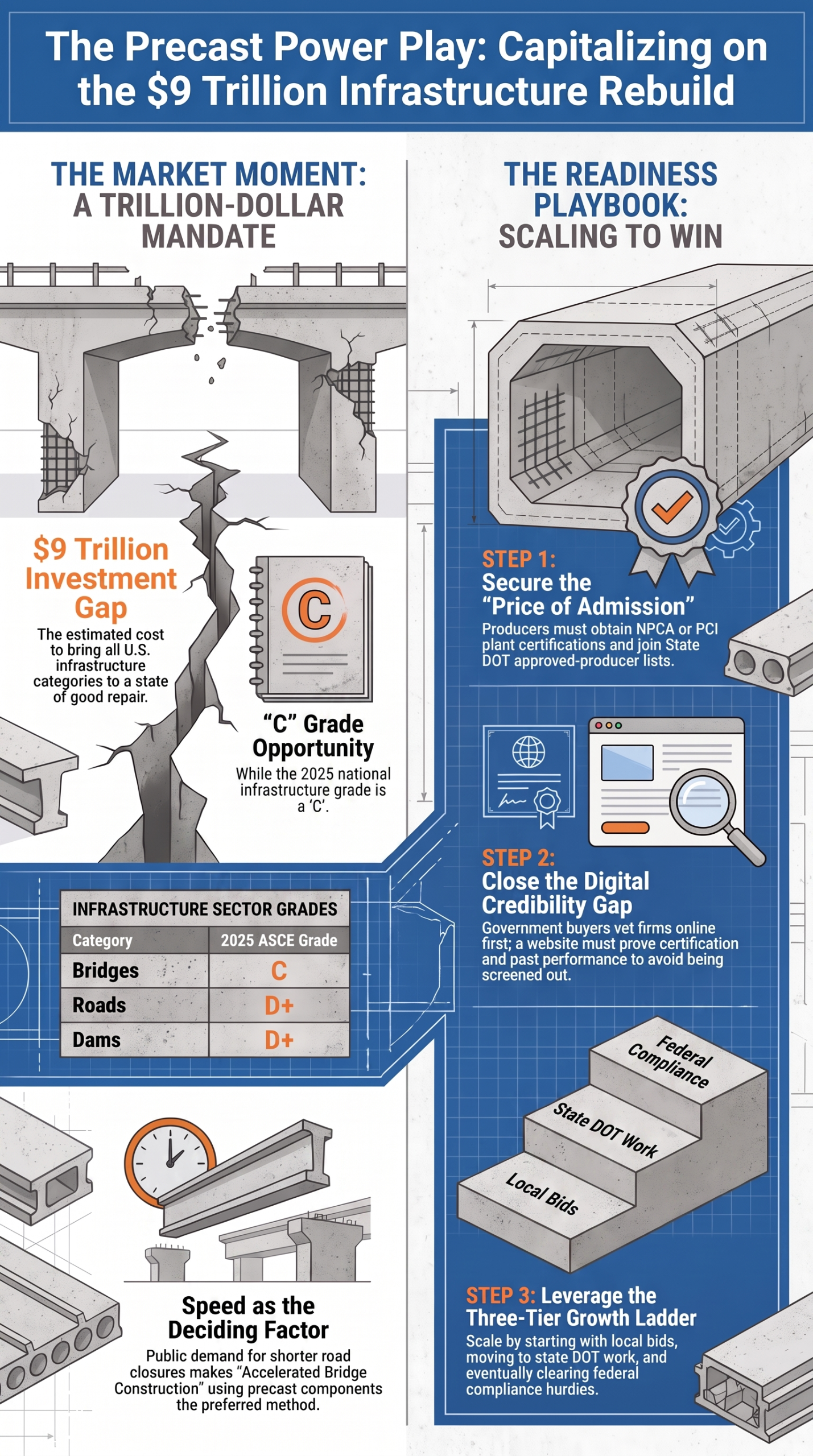
Table of Contents
- The Infrastructure Imperative: Why America Must Rebuild
- Why Precast Concrete Is Built for This Moment
- The National Map: Where the Work Concentrates
- Who Buys Precast: Local, State, and Federal
- The Major Players: Leading Precast Producers
- Certification and Compliance: The Price of Admission
- Teaming, Subcontracting, and the Path to Prime Work
- Winning Federal Work: Registration, Set Asides, and the Federal Buyer
- The Digital Credibility Gap: Why Your Website Decides Whether You Scale
- The Rebuild Playbook: Reshaping Your Site and Messaging to Win
I spent thirty years inside the federal government, across the Navy, the FBI, the Department of Homeland Security, and the National Security Agency, and I watched capable American companies leave enormous public work on the table for one reason: government buyers could not tell they were ready. The product was there. The proof was not. Nowhere is that gap more costly right now than in precast concrete, an industry whose moment has arrived and whose firms are, for the most part, still presenting themselves the way they did when their only customers were private.
What follows is written for the precast producer that wants to grow, to move from local jobs into state and federal work, and to do it deliberately rather than by luck. It covers the demand, the market, the competition, the requirements, and the one piece that ties it all together and that most firms neglect. Let me walk through all of it.
Chapter 1. The Infrastructure Imperative: Why America Must Rebuild
The condition of American infrastructure is not a matter of opinion. Every four years the American Society of Civil Engineers grades it, and in 2025 the country earned an overall C, the highest mark since the report began in 1998 and an improvement over the C minus of 2021. That sounds like progress, and it is, but read past the headline and the picture is sobering. Bridges hold a C. Roads sit at D plus. Dams sit at D plus. Half of the eighteen graded categories scored a D plus or a D. The engineers who assess this work estimate that bringing all of it to good repair would take on the order of nine trillion dollars of investment, a figure I cite as an approximation drawn from the 2025 assessment and one worth confirming against the source directly.
The improvement that did occur was not an accident. It traces largely to the Infrastructure Investment and Jobs Act of 2021, the largest federal infrastructure commitment in generations, and to the wave of state and local spending that followed it. Industry analysts count trillions of dollars in infrastructure funding planned across the second half of this decade. This is the rare case where a vast national need and a vast pool of committed money exist at the same time, and where the work will run for years rather than months.
For a builder, the meaning is direct. The country has to rebuild aging bridges before more of them slip from fair condition into failure. It has to shore up dams and levees that protect communities. It has to rebuild roads, water and stormwater systems, transit, and the public facilities that decades of deferral left behind. That work is physical, it is durable, and a great deal of it is made of concrete cast in advance and set in place. The demand behind construction and infrastructure work is not a forecast. It is already here, written into law and into budgets across every level of government.
Chapter 2. Why Precast Concrete Is Built for This Moment
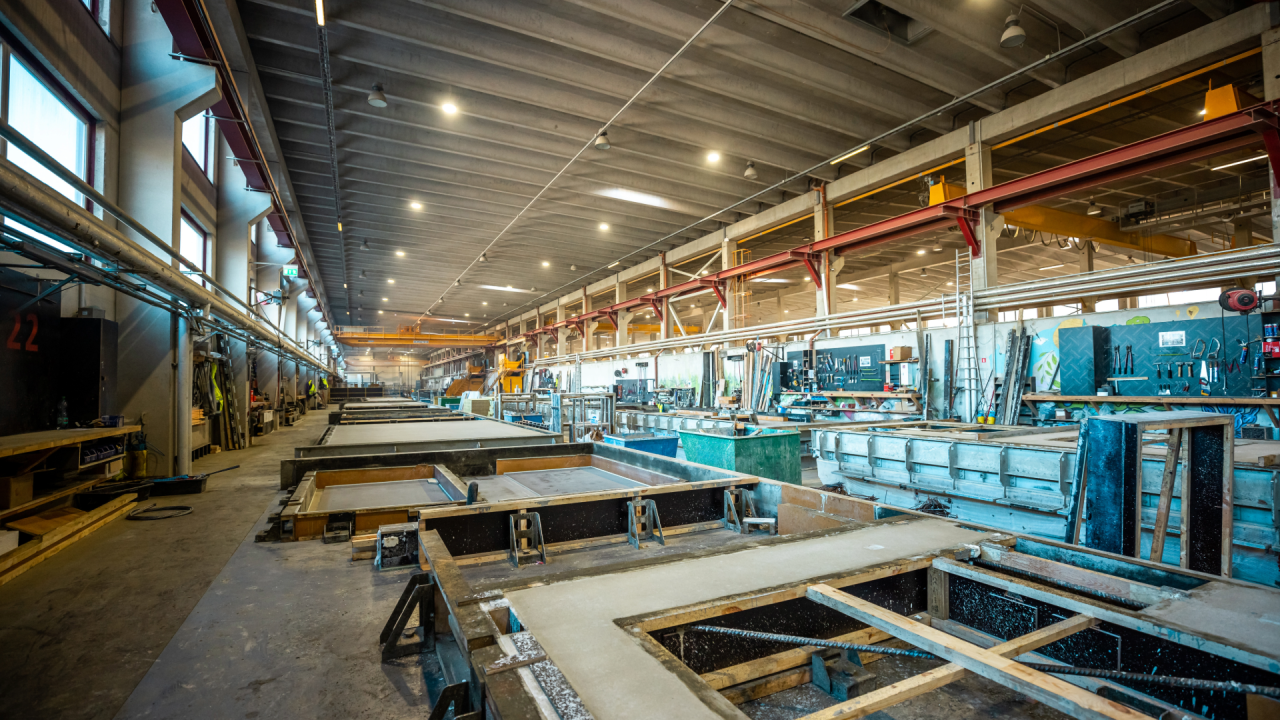
Precast concrete is uniquely suited to the rebuild the country faces, for reasons that are practical rather than promotional. Because the components are cast and cured in a controlled plant rather than formed in the field, they are stronger, more consistent, and more durable than concrete poured on site, and they can be produced while other work proceeds and then set in place quickly. In an era when the public will not tolerate a bridge or a highway closed for months, that speed is not a convenience. It is often the deciding factor.
The Products the Rebuild Needs
The catalog of a precast producer reads like a parts list for the nation’s infrastructure. Box culverts and three sided culverts carry water under roads. Bridge girders, beams, and deck panels form the spans themselves. Sound walls line highways. Retaining walls hold back earth. Manholes, utility vaults, and pipe carry water, stormwater, and utilities underground. Barriers and paving units surface the roads. When an agency rebuilds a bridge, replaces a culvert, or hardens a water system, precast is frequently what it installs.
Speed, Resilience, and Accelerated Bridge Construction
The clearest expression of precast’s advantage is accelerated bridge construction, the practice of fabricating bridge elements in advance and assembling them on site in days rather than rebuilding a bridge in place over a season. State transportation departments have embraced the method precisely because it shortens the closures that frustrate the public, and precast is what makes it possible. Resilience adds to the case: as the engineers who grade the nation’s infrastructure keep stressing, aging systems are increasingly exposed to extreme weather, and durable precast components that last for decades are exactly the kind of resilient construction the moment calls for. For a producer, this is the good news underneath the whole guide. The thing you make is the thing the country most needs to build.
Chapter 3. The National Map: Where the Work Concentrates
Infrastructure demand is national, but it clusters, and a producer that wants to scale should understand where. What follows is a sweep across the major markets of the country. It is a survey rather than a full catalog, and the fuller set of regional markets, including the federal and defense hubs where public spending concentrates, is laid out across the regional market pages for a firm that wants to study its own territory in depth.
The Northeast and New England
The Northeast carries some of the oldest infrastructure in the country and some of the densest. Boston and New England run aging bridges, water systems, and the Amtrak Northeast Corridor, and the region is home to PCI Northeast, the regional body that works with state transportation departments on precast bridge components and accelerated bridge construction. The result is a market where the buyers, the standards, and the technical community all sit close together.
New York, New Jersey, and the Mid Atlantic
The New York and New Jersey metro is one of the largest infrastructure markets on earth, from the Gateway rail program and the Hudson River crossings to the turnpikes, bridges, and tunnels that move the region. The Capital Region that surrounds Washington adds a dense federal presence across the District, Northern Virginia, and Maryland, along with the transit, water, and facility work of a major metropolitan area.
The Southeast
The Southeast is where population growth is driving new construction fastest, across Atlanta, the Carolinas, Tennessee, and Florida, where coastal and hurricane resilience add constant demand. It is also a defense and aerospace heartland, anchored by Huntsville and Redstone Arsenal in Alabama and by Florida’s Space Coast around Kennedy Space Center and Cape Canaveral. Two of the country’s leading precast producers, Tindall and Metromont, are based in South Carolina, a sign of how much precast capacity the region has drawn.
The Gulf Coast
The Gulf Coast pairs heavy freight and energy infrastructure with a demanding resilience mission. Houston, New Orleans, Mobile, Beaumont, and Corpus Christi anchor one of the nation’s great port and logistics and transportation regions, the Mississippi River system threads through it, and the levees and coastal works that protect these communities are a continuing source of heavy civil construction.
The Great Lakes and Midwest
The industrial Midwest, from Chicago and Detroit through Ohio, Indiana, Wisconsin, and Minnesota, runs aging bridges, the locks and dams of the inland waterway system, and a dense freight and rail network. The Upper Midwest is also home to major structural precast producers, reflecting the region’s long industrial base and its steady infrastructure demand.
The Plains and Mountain West
Across the Plains and into the Mountain West, the interstate corridors, river systems, and water infrastructure of a vast region create steady public demand, with growing metros such as Denver and Salt Lake City and a significant federal footprint around Colorado Springs. Dams and water works managed for a dry region make heavy civil construction a constant.
The Southwest and the West Coast
The Southwest, from Phoenix and Las Vegas to El Paso and Albuquerque, combines fast growth with acute water infrastructure needs tied to the Colorado River and a heavy defense and national laboratory presence. On the West Coast, California is a market unto itself, where seismic design drives constant bridge and structure work through the state transportation department, and the ports of Los Angeles and Long Beach anchor enormous freight infrastructure. Leading West Coast precast producers have built their business around exactly this seismic and structural demand.
The Pacific Northwest, Alaska, and Hawaii
The Pacific Northwest around Seattle and Portland pairs seismic risk with major port, transit, and naval infrastructure. Alaska builds for a harsh climate and a strategic mission, and Hawaii anchors the nation’s presence in the Pacific. Across all of these regions the pattern holds: aging systems, resilience demands, and a public and federal buyer base that never stops building.
Chapter 4. Who Buys Precast: Local, State, and Federal
Public precast work runs across three tiers of government, and a producer that understands all three has three streams of work rather than one. Knowing how each tier buys is the difference between a firm that waits for jobs to appear and one that pursues them deliberately across the sector directory of public construction.
The Local Tier
Cities, counties, towns, and their utility and water districts buy culverts, manholes, pipe, utility structures, and small bridge components for the roads and systems they own. Local work often runs through straightforward competitive bids with lower thresholds, which makes it the most accessible entry point for a smaller plant and a natural place to build a public track record.
The State Tier
State departments of transportation are the largest and most consistent buyers of structural precast, awarding bridge and highway work through formal competitive processes. The state tier has a gate that catches many firms off guard: approved product lists and prequalified producer lists that a plant must get onto before it can supply the work at all. Earning a place on a state’s approved producer list is one of the most valuable moves a scaling precast firm can make, because it unlocks the steadiest volume of structural work in the market.
The Federal Tier
Federal buyers add a third stream that many competitors never pursue. The military services build and maintain their own installations. The United States Army Corps of Engineers builds and maintains a vast portfolio of water, flood control, and civil works. Federal civilian agencies construct and maintain their own facilities. This work carries registration and compliance requirements that deter unprepared firms, which is precisely why the producers that master those requirements face less competition for it. The federal tier is not harder because the concrete is different. It is harder because the paperwork and the trust threshold are higher, and that barrier is an opportunity for the firm willing to clear it.
Chapter 5. The Major Players: Leading Precast Producers
A producer that wants to scale should know the field it is competing and teaming in. The figures below are drawn from public and third party sources and reflect the picture at the time of writing. Company details, especially revenue, change, and any specific number should be confirmed against the company directly before it is relied upon.
The National Scale Producers
Oldcastle Infrastructure, headquartered in Atlanta and part of the international building materials group CRH, is among the largest precast concrete producers in North America and one of the continent’s largest building materials suppliers, with a product line spanning stormwater, water, utility, and structural precast. The former Forterra, long one of the country’s major water and drainage precast manufacturers, is now Rinker Materials, a Quikrete company, following its acquisition, a reminder of how quickly ownership in this field can shift. CEMEX, the global cement and building materials producer, runs its United States operations from Houston and competes across the concrete market.
The Established Structural and Regional Leaders
Tindall Corporation, founded in 1932 and based in Spartanburg, South Carolina, is one of the most experienced engineered precast and prestressed producers in the country, operating manufacturing plants across South Carolina, Virginia, Georgia, Mississippi, and Texas. Metromont, based in Greenville, South Carolina, is roughly a century old and marked its hundredth anniversary in 2025, and third party business data has placed its annual revenue in the range of six hundred million dollars, a figure I flag as an external estimate rather than a company reported number. Metromont also announced late in 2025 a plan to acquire a Texas producer, part of a broader pattern of consolidation. Alongside these sit strong structural and architectural producers such as Coreslab Structures, Wells, Clark Pacific on the West Coast, and Fabcon, which helped pioneer structural precast panels.
What the Leaders Have in Common
Look past the names and a pattern emerges. The producers that lead this field pair genuine manufacturing and supply capability with certified quality, long records on demanding projects, and a clear public presence that lets a buyer or a prime confirm all of it quickly. Their scale did not come only from making more product. It came from being the producer a buyer could trust and verify, at the moment the buyer was looking. That is a lesson a smaller firm can act on long before it reaches their size.
Chapter 6. Certification and Compliance: The Price of Admission
Public precast work runs on proof, and proof in this industry means certification. A producer that wants to scale invests in the credentials that let it bid the work it wants, because without them the door does not open regardless of how good the concrete is.
Plant and Product Certification
Two industry certifications carry the most weight. The National Precast Concrete Association operates a plant certification program that most state transportation departments recognize, and for structural and bridge work the Precast Prestressed Concrete Institute certification is the recognized standard. These certifications, together with the design specifications published by the American Association of State Highway and Transportation Officials and the material standards of bodies such as ASTM, define whether a plant is qualified to supply a given piece of work. Earning and displaying them is the baseline for serious public work.
State Prequalification
Beyond industry certification, most states maintain their own approved producer and prequalified supplier lists, and a plant has to earn its place on them before it can supply state work. Getting through engineering and environmental review and onto those lists is a distinct effort from industry certification, and a scaling producer pursues both.
Federal Compliance
Federal work adds its own requirements. A producer pursuing federal contracts registers in the government’s systems, and depending on the work it may face security and information requirements that flow down from the agency. Firms that handle certain federal information encounter the standards built on the National Institute of Standards and Technology security requirements, and defense work increasingly carries the Cybersecurity Maturity Model Certification, which became enforceable in Department of Defense contracts in late 2025 and, beginning in November 2026, will require independent assessment for most contractors that handle controlled unclassified information. Most precast producers will sit at the lighter end of these requirements, but the principle holds across every tier: the firm that can prove it meets the standard wins the work, and the firm that cannot does not.
Chapter 7. Teaming, Subcontracting, and the Path to Prime Work
Few precast producers win the largest public work by holding the prime contract themselves. The biggest bridge and highway jobs go to general contractors and construction primes, and a producer’s path to that work runs through teaming and subcontracting. Understanding this is what turns a good plant into a growing business.
Teaming
A teaming arrangement worked out before a bid gives both sides an advantage. The construction prime locks in a qualified precast supplier, and the producer locks in the work if the team wins. The producers that get onto these teams are the ones the primes and the design engineers already know and trust, which is why relationships across the construction community matter as much as price. Teaming is not a favor. It is a decision a prime makes because a known, certified producer makes the prime’s bid stronger and its delivery safer.
Subcontracting as the Growth Ladder
Subcontracting is how most producers both enter public work and climb within it. As a supplier or subcontractor to a prime, a plant can perform on large state and federal jobs without holding the prime contract, which lowers the barrier and lets a newer producer build a public record one job at a time. There is a ladder built into it. A producer often starts a tier or two below the prime, delivering product against a purchase order, then takes on larger and more complex components as it proves reliable, moves closer to the prime, and on the right jobs begins to hold contracts directly. Each completed job becomes the proof that qualifies the plant for the next, larger one. Scaling this way lets a firm grow its capability and its reputation in step, rather than betting the plant on a single award it is not yet ready to manage.
Chapter 8. Winning Federal Work: Registration, Set Asides, and the Federal Buyer
The federal tier intimidates many precast firms, and that intimidation is an advantage for the ones who push past it, because it thins the competition. Federal work is not mysterious. It is procedural, and the procedures can be learned.
Getting Registered
A firm pursuing federal work registers in the government’s System for Award Management, obtains the unique entity identifier and the commercial and government entity code that tag it across federal records, and identifies the industry codes that classify what it produces. This is administrative work, not a transformation of the business, and it is the entry ticket to the federal market.
Set Asides and Small Business Standing
The government sets aside a share of its work for small businesses and for firms holding particular certifications, administered through the Small Business Administration, such as the programs for small disadvantaged businesses, firms in historically underutilized business zones, women owned firms, and service disabled veteran owned firms. A producer that genuinely qualifies for one of these can compete for work set aside for that status, against a smaller field. These certifications are not required to bid, and a firm should pursue one only when it truly qualifies, but for the firm that does, they open a real lane. A current point worth knowing is that these program set asides now require formal certification through the Small Business Administration rather than self certification.
How Federal Precast Work Flows
Much federal construction reaches a precast producer the same way large state work does, through the construction prime holding the contract. So a producer’s federal strategy is usually twofold: register and qualify so it can supply federal work directly where it makes sense, and position itself as a known, certified supplier to the primes executing federal construction on installations and civil works. Public spending data is a matter of record, and a firm can study where federal construction dollars flow through public sources rather than guessing. The federal buyer rewards the producer that shows up registered, certified, and visibly ready.
Chapter 9. The Digital Credibility Gap: Why Your Website Decides Whether You Scale
Here is the piece most precast firms are missing, and it is the reason capable producers stay smaller than they should. Every buyer and every prime described in this guide now does the same thing before they engage a firm: they look it up online. A state engineer vetting a producer for an approved list, a construction prime searching for a precast supplier for a bridge bid, a federal contracting officer or a prime’s supply chain team checking a firm, all of them form their first and often decisive judgment from what they find on a screen, before any conversation happens.
What the Verification Looks For
That check is specific. Is this a real, substantial producer. Is it certified, through the recognized industry programs, to the standard this work requires. Does it hold the state prequalifications. Can it show completed projects like the one in front of the buyer. Does it understand the standards the work is built to. A firm that answers those questions clearly and quickly gets shortlisted. A firm that is hard to find, or thin on proof, or that still presents itself as a purely local commercial supplier, gets passed over, and it usually never learns that it was in the running at all.
The Messaging Problem
The deeper issue is messaging. Most precast firms describe themselves the way they did when their customers were private developers and local contractors. That message does not speak to a government buyer or a federal prime, who are looking for signals of certification, capacity, past performance, and readiness to work within public and federal requirements. The producer has the substance. It is simply telling the wrong story to the wrong audience. Closing that gap is what a purpose built federal contractor website does: it presents the certifications, the prequalifications, the projects, and the readiness that public buyers and primes verify first, in the language they are actually reading for. The concrete was never the problem. The proof, and where it lives, is.
Chapter 10. The Rebuild Playbook: Reshaping Your Site and Messaging to Win
Pulling it together, here is what a precast producer that wants to scale into public and federal work should do, and where the digital piece fits.
Reshape the Message
Shift the firm’s public story from a local commercial supplier to a qualified public works producer. Lead with the certifications, the prequalifications, and the standards command that a state engineer or a federal prime checks first. Speak to the buyer you want, not only the buyer you have. This is a reshaping of messaging, not a reinvention of the company, and it is the highest return move most precast firms have available.
Prove the Substance
Make the proof visible and easy to verify: plant and product certifications, state approved producer standing, completed projects with the components and specifications a buyer will recognize, and the capacity that shows a plant can deliver at scale. Every claim a buyer would otherwise have to ask about should be answered before they ask.
Build for the Whole Ladder
Present the firm so that a local buyer, a state transportation engineer, a construction prime, and a federal contracting team each find what they need. The same site that wins a local culvert order should also tell a bridge prime that this producer can supply the girders, because scaling means serving every tier at once.
Start Now
The rebuild of American infrastructure is underway, funded, and running across every level of government. The precast producers that scale during it will be the ones buyers and primes can find, verify, and trust, and that trust is built on a credible federal contractor website that proves the firm is ready. The concrete is being poured somewhere right now. The work is making sure the people awarding it can see that your plant belongs in the running.
I help precast producers reshape their message and rebuild their web presence so that state engineers, construction primes, and federal buyers can see, at a glance, that the firm is certified, capable, and ready to scale. If you are ready to pursue public and federal work, this is where it starts.
Authoritative Sources
The following sources inform the facts and figures in this guide. Web addresses were current at the time of writing and should be verified for the latest information, since program terms, grades, and company details change over time.
American Association of State Highway and Transportation Officials. (n.d.). LRFD bridge design specifications. https://www.transportation.org/
American Society of Civil Engineers. (2025). 2025 report card for America’s infrastructure. https://infrastructurereportcard.org/
American Society of Civil Engineers. (2025, March 25). ASCE report card gives U.S. infrastructure highest ever C grade. https://www.asce.org/
ASTM International. (n.d.). Standards for precast concrete products. https://www.astm.org/
Federal Highway Administration. (n.d.). Bridges and structures. U.S. Department of Transportation. https://www.fhwa.dot.gov/
National Institute of Standards and Technology. (2020). Protecting controlled unclassified information in nonfederal systems and organizations (NIST Special Publication 800-171, Rev. 2). U.S. Department of Commerce. https://csrc.nist.gov/
National Precast Concrete Association. (n.d.). NPCA plant certification. https://precast.org/
Precast/Prestressed Concrete Institute. (n.d.). PCI certification. https://www.pci.org/
U.S. Congress. (2021). Infrastructure Investment and Jobs Act (Public Law 117-58). https://www.congress.gov/
U.S. Department of Defense, Office of the Chief Information Officer. (n.d.). Cybersecurity Maturity Model Certification (CMMC). https://dodcio.defense.gov/CMMC/
U.S. General Services Administration. (n.d.). System for Award Management. https://sam.gov/
U.S. Small Business Administration. (n.d.). Contracting assistance programs. https://www.sba.gov/
U.S. Department of the Treasury. (n.d.). USAspending.gov. https://www.usaspending.gov/
U.S. Census Bureau. (n.d.). Census of Governments. https://www.census.gov/
Explore your field in the sector directory, or browse the regional market pages to see where government buyers concentrate across the country.