

Bottom Line Up Front
The federal government is the largest single energy consumer in the country, and the way it buys energy work is unlike almost anything in the commercial world. Much of it runs on a performance model, where a contractor designs and finances the improvements, then guarantees the savings that pay for the project over years. It is a resilience mission with an attached financing model, and the stakes are rising as the grid comes under new strain.
That strain is not abstract. After years of flat demand, the rise of artificial intelligence and the data centers that power it is driving electricity demand upward at a pace the grid was not built for, which makes the ability of federal facilities to keep their critical missions running through a disruption more important than ever. An agency committing to a long term energy partnership is trusting a contractor with its mission and its budget at once, which is why it weighs your technical capability, your project performance, and your ability to guarantee savings before it commits.
This guide covers how the federal energy and utilities market works, who buys, and how a contractor proves the capability, performance, and guarantee that buyers demand. A credible federal contractor website is where an agency confirms that a firm can power and protect its mission, before it commits to a partnership that may run for decades. Read it as a playbook for earning that trust.
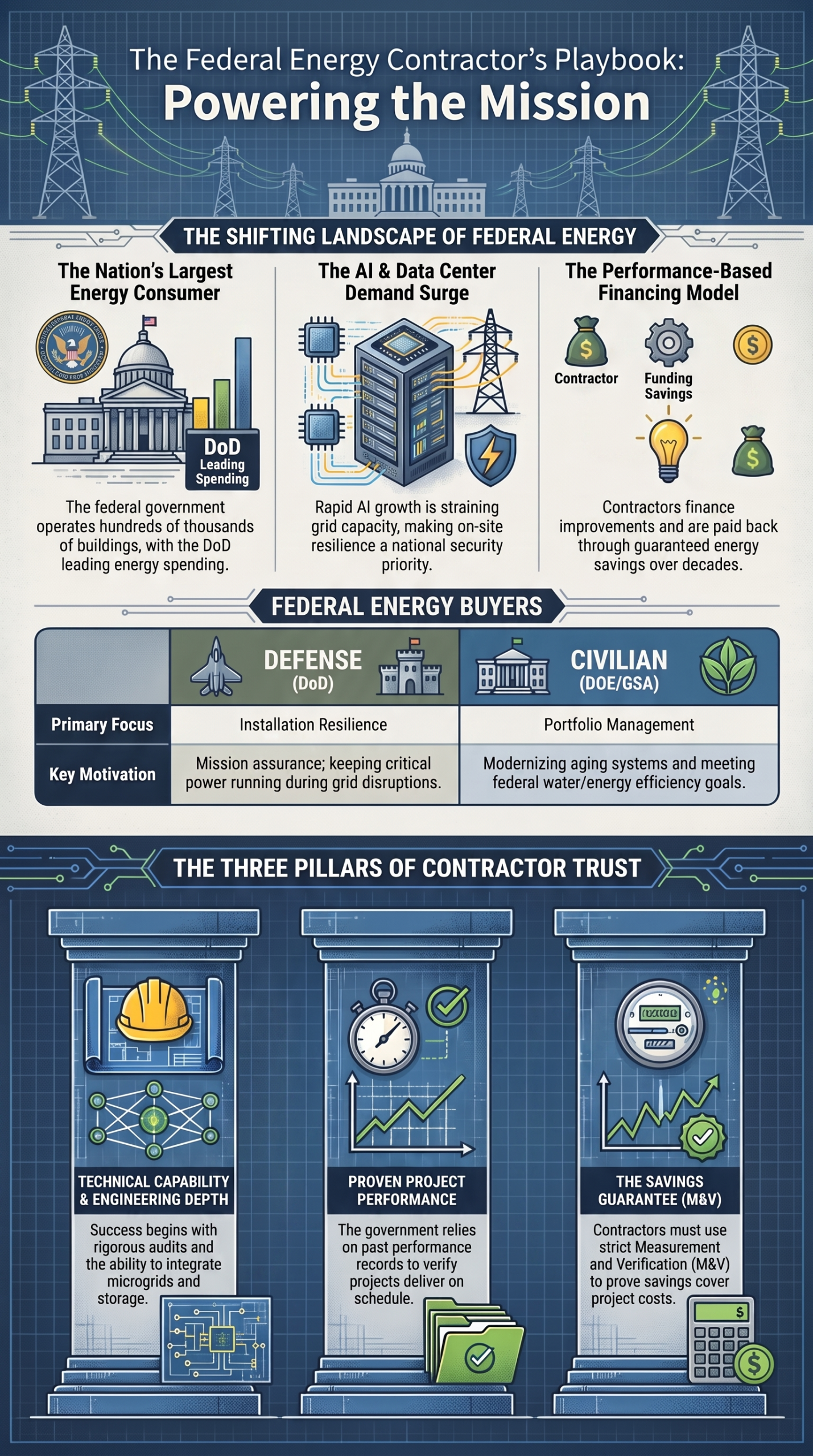
Table of Contents
- The Federal Energy and Utilities Market
- Who Buys: The Federal Energy Agencies
- What Federal Energy and Utility Contractors Provide
- How the Work Is Bought: Performance Contracts, Utility Contracts, and Set Asides
- Technical Capability: The Engineering Behind Federal Energy Projects
- Project Performance: Delivering Energy Projects That Work
- The Guarantee: Measurement, Verification, and Standing Behind Savings
- Energy Resilience and the New Demand: Powering the Mission in the Age of AI
- The Digital Credibility Gap: Why Your Website Decides Who an Agency Trusts With Its Power
- The Energy and Utility Contractor’s Playbook: Putting Capability, Performance, and the Guarantee on Display
I spent thirty years inside the federal government, across the Navy, the FBI, the Department of Homeland Security, and the National Security Agency, and I saw what it means when the power goes out at a place that cannot afford to go dark. Energy is not a back-office concern on a federal installation. It is mission assurance, and the people who buy energy work treat it that way. I also watched capable energy and utility firms lose federal work they could clearly have delivered. They did not lose because their engineering was weak. They lost because they could not prove, in a form an agency could verify, the three things that decide a long-term energy partnership: that they have the technical capability, that their projects perform, and that they can stand behind a savings guarantee. Committing to an energy partner is a matter of trust, and that trust must be earned before the commitment.
What follows is written for the energy service company, the engineering and controls firm, the renewables developer, the microgrid integrator, or the utility services provider that wants to grow into federal work, or to move from commercial clients into powering the government’s mission. It covers how the market works, who buys, and the one thing that puts your technical capability, project performance, and ability to guarantee savings in front of the people who decide. Let me walk through all of it.
Chapter 1. The Federal Energy and Utilities Market
The federal government uses more energy than any other organization in the country, and it is rethinking how it powers and protects itself at a moment when the ground is shifting under the entire grid.
The scale alone is enormous. The government operates hundreds of thousands of buildings and a vast portfolio of installations, all of which have to be lit, heated, cooled, and kept running, and much of that portfolio belongs to the Defense Department, where power is tied directly to mission. The government spends heavily on energy every year, with the general scale of that spending visible at public reporting sites like USASpending.gov. What sets this market apart is not only the size but the way the work is bought, much of it through a performance model in which a contractor finances the improvements and guarantees the savings, so the project pays for itself over time.
Two forces are raising the stakes. The first is resilience: more frequent and severe weather, along with growing threats to the grid, has made the ability to keep critical missions running through an outage a national security concern rather than a facilities preference. The second is demand. After years in which electricity use in the country barely grew, the rise of artificial intelligence and the data centers that power it is pushing demand upward quickly, straining a grid that was not designed for that kind of load. For an energy contractor, the takeaway is that this is a large, durable market whose importance is climbing, and it rewards firms that can prove they deliver.
It is worth sitting with how unusual the buying model is, because it shapes everything that follows. In most markets, a customer pays for work and hopes it performs. In federal energy, the customer often pays nothing upfront and holds the contractor to a guaranteed result instead, with the savings themselves funding the project. That arrangement lets an agency modernize aging systems it could never afford to fund directly, and it puts the burden of proof on the contractor. A firm that grasps this inversion, and can speak to it, is already thinking the way a federal buyer does.
Chapter 2. Who Buys: The Federal Energy Agencies
Federal energy spending runs through a set of major buyers, and knowing which one a firm is pursuing shapes how it should present itself.
The Defense Side
The Defense Department is the largest energy buyer in the government, and for it energy is inseparable from mission. Each service runs energy programs focused on installation energy and resilience, and installations increasingly pursue on site generation, microgrids, and distributed energy to protect the missions they support. Because a loss of power at a fixed installation is not treated as a local inconvenience but as a potential hit to national defense, the defense side is where the resilience mission is felt most sharply, and where much of the demand for energy work now concentrates.
The Civilian Side
On the civilian side, the Department of Energy’s Federal Energy Management Program is the hub for federal energy management, and it runs the performance contracting vehicles that agencies across the government use. The General Services Administration manages a large share of federal buildings and the facilities and installation support that keeps them running, and it pursues energy projects across that portfolio. The Department of Veterans Affairs, with its large medical footprint, and many other agencies with facilities of their own, all buy energy work. And the serving utilities themselves are partners in a whole class of federal energy contracts. Knowing the buyer, and how it funds and values energy work, shapes the pursuit.
Chapter 3. What Federal Energy and Utility Contractors Provide
Federal energy buyers procure a wide range of work, and a firm should understand where it fits.
Efficiency, Generation, and Resilience
The largest single category is energy efficiency: the audits, lighting, heating and cooling upgrades, controls, and building improvements that cut energy use, which is the work most performance contracts are built around. Close beside it is generation, the solar, distributed energy, and other on site power that a growing number of federal sites are adding, often paired with the construction and infrastructure work that installing it requires. A third and fast growing category is resilience: the microgrids, energy storage, and backup systems that let a site keep its critical loads running when the grid goes down.
Controls, Water, and Utility Services
Beyond those, firms provide the controls and building systems that tie energy use together and make it visible, the water conservation that federal goals increasingly demand, and the utility services delivered by the serving utilities under their own contracts. A firm may specialize in one of these or span several, but in every case a buyer is asking the same underlying question: can this contractor deliver the capability, back it with performance, and, where the model calls for it, guarantee the result.
Chapter 4. How the Work Is Bought: Performance Contracts, Utility Contracts, and Set Asides
Federal energy work is bought through vehicles that are unusual, and understanding them is the price of entry.
Performance Contracts and Utility Contracts
The signature federal energy vehicle is the energy savings performance contract. Under it, an energy service company designs, installs, finances, and maintains energy improvements at a federal site, and the agency pays the company back over the term of the contract out of the energy savings the project produces, with no upfront capital cost and no special appropriation from Congress. The company guarantees that the savings will be enough to cover the payments, and if they fall short, the company is responsible for the difference. The Department of Energy awards a set of governmentwide contracts to qualified energy service companies, and agencies place task orders against them, so a firm in that pool can be tasked directly. A related model, the utility energy service contract, delivers efficiency work through the serving utility, and a power purchase style approach lets an agency buy the output of an on site energy project while the developer owns and operates it. Contract terms can run many years, in some cases up to a quarter century.
The length of these contracts is part of what makes them serious. A partnership that runs for a decade or more is not a transaction; it is a relationship an agency has to be confident in before it signs, because it will live with the result for years. The contractor will design the project, finance it, install it, and then operate and maintain it across the full term, standing behind the savings the whole way. That is why an agency scrutinizes a firm so closely before committing, and why the firm’s record and standing matter as much as its price.
How Firms Enter
Not all of this work is out of reach for smaller firms. There are streamlined performance contracting paths for smaller projects, and the set aside programs, the ones for firms owned by socially and economically disadvantaged individuals, for service disabled veteran owned firms, for women owned firms, and others, apply across energy work, provided a firm holds the matching certification. Because energy projects blend engineering, financing, and specialized trades, teaming is common, a controls specialist joining an energy service company, or a small firm partnering to reach a larger program. Firms across the sector directory of federal work find their way in through the vehicle, the certifications, and the partnerships that fit them.
Chapter 5. Technical Capability: The Engineering Behind Federal Energy Projects
This is the first thing the hero of this whole effort names, and in federal energy work it is not a marketing line. The whole model rests on getting the engineering right.
The Breadth the Work Demands
A federal energy project usually begins with a detailed energy audit, an engineering study of how a site uses energy and where it is wasted, and moves from there into the design of the measures that will fix it. That can span lighting and controls, heating and cooling systems, building envelope, on site generation, energy storage, microgrids, and water, often bundled together in a single project. Doing it well calls on real engineering and environmental depth, because the savings a firm will later guarantee depend entirely on the quality of the analysis and design behind them. A firm that overestimates savings at the design stage is committing to a shortfall it will have to cover.
Showing the Capability
Technical capability is also something a buyer wants to see clearly established. The engineering disciplines a firm holds, the kinds of measures it has designed and installed, the systems it can integrate, and the credentials of its people are what tell an agency the firm can actually do the work. A firm that can show the depth and range of its technical capability gives a buyer confidence that the project will be sound from the start, while a firm that describes itself only in general terms leaves the agency to wonder whether the engineering behind the promise is really there.
Chapter 6. Project Performance: Delivering Energy Projects That Work
The second thing the hero names is performance, and in a field where projects run for years and carry a guarantee, the record matters enormously.
A Record That Follows You
Federal energy projects are large, long, and closely watched. An agency handing a firm a project that will reshape how a site is powered, and that the firm will operate and maintain for years, wants evidence that the firm has done it before and done it well. Performance shows in projects delivered on schedule and on budget, in savings that materialized as promised, and in systems that kept working long after installation. The government records how contractors perform through its past performance systems, which means a strong track record becomes an asset a firm carries into every future competition, and a weak one becomes a liability that follows it just as far.
Proof Over Promises
Because every energy service company promises results, proof of past results is what separates the credible from the hopeful. Completed projects, the savings they achieved, the years they have run, and the clients who would vouch for them are the evidence that a firm delivers. A firm that can show that record answers the performance question before it is asked, and it stands apart in a field where confident promises are common and demonstrated results are not. In federal energy work, a proven history of delivery is among the most persuasive things a firm can put in front of a buyer.
Chapter 7. The Guarantee: Measurement, Verification, and Standing Behind Savings
The third thing the hero names is the guarantee, and it is the feature that defines federal energy contracting. This is the financing model attached to the resilience mission, and it is built on a discipline commercial work rarely demands.
Why the Guarantee Is Real
In a federal performance contract, the savings guarantee is not a marketing claim. It is a contractual obligation, backed by law, that assigns the risk to the contractor. The savings have to exceed the payments in each year of the contract, and if a project does not deliver the guaranteed savings, the contractor is responsible for making the agency whole. That is a serious commitment, and it is the reason an agency can undertake a major energy project with no money down: the contractor, not the taxpayer, carries the risk that the numbers were wrong.
Measurement and Verification
Standing behind a guarantee requires proving the savings are real, and that is the discipline of measurement and verification. Rather than relying on a utility bill, a firm follows an agreed measurement and verification plan, built on recognized protocols, to demonstrate year after year that the promised savings actually occurred. The federal program treats measurement and verification as mandatory, precisely because the guarantee only means something if the savings can be proven. A firm that runs a rigorous measurement and verification practice, and can show that it stands behind its guarantees with real data, offers a buyer the one assurance this model is built to provide, that the savings the agency is counting on will be there.
There is a discipline behind this that outsiders often underestimate. Measurement and verification is its own field, with recognized protocols and a body of practice, and doing it credibly takes expertise separate from the engineering that produced the savings in the first place. A firm that treats it as an afterthought will struggle to defend its guarantee when a number is questioned. A firm that treats it as a core competence, and can show the rigor of its approach, gives an agency confidence that the guarantee is more than a promise on paper.
Chapter 8. Energy Resilience and the New Demand: Powering the Mission in the Age of AI
The hero calls federal energy a resilience mission, and that mission has never been more pressing than it is now, as a surge in electricity demand collides with a grid already under stress.
The Resilience Mission
Most federal sites draw their primary power from the commercial grid and lean on building generators for backup, an arrangement that was adequate when outages were rare and brief. It is adequate no longer. The Defense Department now defines energy resilience as the ability to prepare for and recover from energy disruptions that affect mission assurance, and the requirement to build it is written into defense policy and law. The answer, increasingly, is the microgrid: a local network of generation, storage, and controls that can disconnect from the grid and keep a site’s critical loads powered on its own, sometimes for days, until commercial power returns. Building that resilience, and doing it to demanding standards, is now among the most sought after capabilities in federal energy work.
The New Demand From AI and Data Centers
At the same time, the demand side of the equation is changing faster than it has in a generation. After years in which electricity use in the country was nearly flat, the rise of artificial intelligence, and the enormous, power hungry data centers that train and run it, is driving demand upward sharply, with national forecasts pointing to record electricity use and a rising share of it consumed by computing. The exact figures are moving quickly and carry real uncertainty, but the direction is clear, and it strains a grid whose capacity and transmission were not built for that kind of growth. This matters to federal energy work in two ways. It makes resilience more urgent, because a grid under strain is a grid more likely to fail the missions that depend on it. And it opens new work, in the power and cooling that computing infrastructure demands, in the on site generation and storage that ease the load, and in the information technology and cybersecurity that protects the energy systems and the computing they serve. A firm that understands where resilience and this new demand meet is positioned at the center of where federal energy is heading.
None of this is settled, and a firm should be honest about that. Forecasts for how much power computing will draw vary widely and keep changing, the pace of new generation is uncertain, and policy is still catching up to the demand. But uncertainty is not the same as doubt about the direction. Electricity demand is rising, resilience requirements are firm and written into law, and federal sites will keep investing to protect their missions. A firm that positions itself for that future, rather than the flat demand of the past decade, is reading the market correctly.
Chapter 9. The Digital Credibility Gap: Why Your Website Decides Who an Agency Trusts With Its Power
Here is the piece most energy and utility firms are missing, and it is exactly what the hero of this whole effort turns on. An agency committing to a long term energy partnership is making a serious trust decision, and before it does, it checks whether the firm can be trusted with its mission and its budget.
What a Buyer Looks For
Increasingly, the first place a buyer checks is the firm’s website. It looks for the same things it weighs in a source selection: technical capability, the engineering depth and the range of measures the firm can deliver; project performance, the record of energy projects delivered and savings achieved; and the ability to guarantee savings, the measurement and verification discipline that stands behind the promise. A firm whose website presents all of that reassures a buyer that it can carry a partnership that may run for decades. A firm whose site is thin, generic, or silent on performance and the guarantee leaves a buyer to doubt the very things this model depends on, and no agency will put its mission and its budget behind a firm it cannot verify.
The Messaging Problem
The deeper issue is messaging. Most energy firms present themselves to commercial and utility clients, leading with the language that market expects. A federal agency is reading for something else entirely: proof of technical capability, project performance, and a guarantee it can rely on, against a mission that cannot afford to go dark. The firm often has all of it, the engineering, the completed projects, the measurement and verification record, and simply never presents it to the audience that decides. Closing that gap is what a purpose built federal contractor website does: it presents a firm’s capability, performance, and guarantee the way an agency evaluates a long term energy partner. The capability was never the question. Whether a buyer can confirm it, before committing to a partnership that may last for decades, is.
Chapter 10. The Energy and Utility Contractor’s Playbook: Putting Capability, Performance, and the Guarantee on Display
Pulling it together, here is what an energy or utility firm that wants to win federal work should do, and where the digital piece fits.
Present Capability and Performance
Lead with your technical capability. Present the engineering disciplines you hold, the measures you have designed and installed, and the systems you can integrate, so a buyer sees you can do the work. Then present your project performance, the projects you have completed, the savings they achieved, and the years they have run, so a buyer sees your work delivers. These are the first things a federal energy buyer needs to trust, and they should be impossible to miss.
Present the Guarantee and Organize It the Buyer’s Way
Show that you can stand behind a guarantee, your measurement and verification discipline and your record of delivering the savings you promised, so a buyer sees the assurance this model is built on. Then organize all of it, along with your resilience capability, the way an agency evaluates a long term energy partner, so a buyer researching you finds exactly what it needs to place its trust. Shift the message from commercial client to federal agency.
Start Now
The government is investing in its energy future every day, and every partnership goes to a firm an agency has decided to trust with its mission. A firm that pairs genuine energy and utility capability with a presence that proves its technical capability, project performance, and ability to guarantee savings is positioned to earn that trust and win the work. Agencies are choosing their long term energy partners right now, at a moment when resilience and demand have never mattered more, and a credible federal contractor website is what makes sure your firm shows the capability, performance, and guarantee that decision turns on. The market where government buyers concentrate is mapped across the regional market pages.
I help energy service, engineering, renewables, and resilience firms present their technical capability, project performance, and ability to guarantee savings the way federal agencies evaluate a partner they are trusting with the mission. If you are ready to compete for federal energy work, this is where it starts.
Authoritative Sources
The following sources inform the facts in this guide. Web addresses were current at the time of writing and should be verified for the latest information, since programs, standards, energy requirements, and demand forecasts change quickly.
Efficiency Valuation Organization. (n.d.). International Performance Measurement and Verification Protocol. https://www.evo-world.org/
U.S. Department of Defense. (n.d.). Installation energy resilience. https://www.defense.gov/
U.S. Department of Energy, Federal Energy Management Program. (n.d.). Energy savings performance contracts and measurement and verification. https://www.energy.gov/femp
U.S. Department of Veterans Affairs. (n.d.). Energy management. https://www.va.gov/
U.S. Energy Information Administration. (n.d.). Electricity data and energy outlook. https://www.eia.gov/
U.S. Environmental Protection Agency. (n.d.). ENERGY STAR. https://www.energystar.gov/
U.S. General Services Administration. (n.d.). Facilities and energy management. https://www.gsa.gov/
U.S. Government Publishing Office. (n.d.). National Energy Conservation Policy Act, 42 U.S.C. 8287. https://www.congress.gov/
ASHRAE. (n.d.). Energy audit standards for buildings. https://www.ashrae.org/
System for Award Management. (n.d.). SAM.gov. https://sam.gov/
Contractor Performance Assessment Reporting System. (n.d.). CPARS. https://www.cpars.gov/
U.S. Department of the Treasury. (n.d.). USAspending.gov. https://www.usaspending.gov/
Explore your field in the sector directory, or browse the regional market pages to see where government buyers concentrate across the country.