

Bottom Line Up Front
The federal government is the largest buyer of professional judgment on earth. Consulting, program support, acquisition, financial management, and human capital firms all sell the same raw material: expertise, and expertise has a problem no other product has: nobody can inspect it. A buyer can walk a warehouse or test a device. A buyer cannot open a firm and look at its judgment.
I bought and evaluated that judgment for years from the government side, and the pattern never changed. The firms that won made their expertise inspectable. The firms that lost asked buyers to take them at their word. Most of this market is competitive, which means incumbency and relationships carry a firm only so far, and the government is consolidating its buying into fewer large vehicles, which raises the value of every position a firm holds and every proof point behind it.
This guide covers how the federal professional services market works, who buys, how the work is bought now that one vehicle sits at the center of it, and how a firm proves its expertise, its people, and its past performance. When the product is your people, the proof has to live online, because that is where agencies and primes go to decide whether the expertise is real. A credible federal contractor website is where invisible judgment becomes visible evidence. Read it as a playbook for making that conversion.
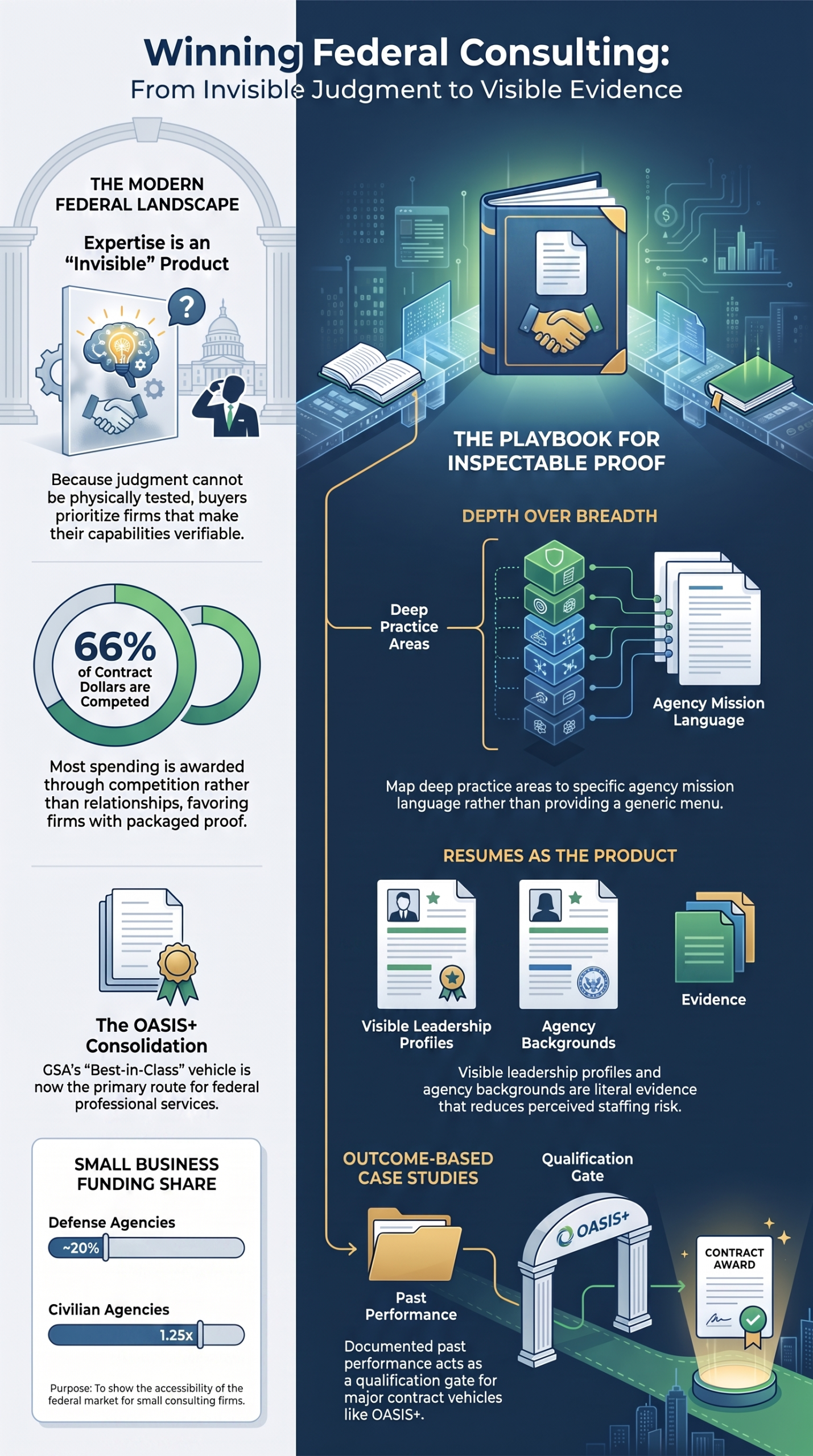
Table of Contents
- The Federal Professional Services Market
- Who Buys: The Federal Buyers of Expertise
- What Federal Professional Services Contractors Provide
- How the Work Is Bought: One Vehicle at the Center
- Expertise: Making Judgment Inspectable
- People: When the Resumes Are the Product
- Past Performance: The Record That Qualifies You
- Set Asides, Certifications, Conflicts, and Teaming
- The Digital Credibility Gap: Expertise Is Invisible Until You Package It
- The Professional Services Firm’s Playbook: Putting Expertise, People, and Performance on Display
I spent thirty years inside the federal government, across the Navy, the FBI, the Department of Homeland Security, and the National Security Agency, and for much of it I sat on the buying side of the table. I watched consulting and support firms pitch, win, and lose, and the difference was rarely raw talent. Plenty of firms with excellent people lost to firms with comparable people who had simply done the work of making their capability verifiable. A skeptical government professional cannot award work on the strength of a confident paragraph. They need something they can check.
What follows is written for the management consultancy, the program support firm, the acquisition or financial management shop, the human capital provider, or the specialized advisory practice that wants to grow into federal work or to move from commercial clients into serving agencies. It covers how the market works, who buys, how the buying has consolidated, and the one thing that packages your expertise, your people, and your past performance so a stranger can evaluate them before the first call. Let me walk through all of it.
Chapter 1. The Federal Professional Services Market
Professional services are one of the largest categories of federal contracting, and they differ from the others in ways that shape everything about how a firm should compete.
The government buys enormous quantities of expertise: strategy and management consulting, program and project support, acquisition and financial management, human capital, policy analysis, and specialized advisory work of every kind. Professional support services have ranked as the leading services category purchased by defense agencies in recent federal reporting, and civilian agencies buy expertise at a comparable scale. The government spends heavily here every year, with the general scale of that spending visible at public reporting sites like USASpending.gov.
Two structural facts matter more than the totals. First, most of this money is competed rather than awarded on relationships. Recent federal reporting puts the overall competition rate at roughly two thirds of contract dollars, with civilian agencies competing a far higher share of theirs, which means a firm whose capability is packaged for evaluation holds a real advantage over a firm relying on being known. Second, small businesses receive a substantial portion of federal obligations, roughly a fifth of defense dollars and close to a quarter of civilian dollars in recent reporting, which makes this one of the more genuinely accessible markets in government contracting for a focused firm. What decides outcomes is not size. It is whether a buyer can verify what a firm claims.
There is one more feature worth naming, because it shapes how a firm should think about growth. Demand in this market renews rather than completes. An agency that needs program support this year will need it next year, and the underlying government functions that generate the work, running programs, managing money, hiring and developing people, buying goods and services, never finish. That makes a position in federal services durable once it is earned. It also means the competition for those positions is continuous, and a firm that stops proving itself does not hold ground for long.
Chapter 2. Who Buys: The Federal Buyers of Expertise
Federal spending on professional services runs through nearly every agency, but the two sides of government buy somewhat differently.
The Defense Side
The Defense Department is the largest single buyer of professional support services. It buys program management for major acquisition programs, acquisition and contracting support, financial management and audit readiness, logistics and supply chain analysis, engineering and technical support, and workforce services across a vast enterprise. That work sits alongside the broader defense and aerospace market and often supports the same programs, which is why firms with genuine mission understanding hold an advantage that generalists cannot manufacture. Defense buying also tends to run through large program offices with structured source selections, so evaluation discipline matters.
The Civilian Side
On the civilian side, nearly every department buys expertise, and it spends a higher share of its dollars than defense does. The large departments run substantial advisory and support programs, from modernization and organizational reform to grants management, policy analysis, and citizen-facing service improvement. The General Services Administration matters twice over here, both as a buyer and as the operator of the vehicles much of the government buys services through. Each agency has its own mission language, its own priorities, and its own way of describing what it needs, which is why agency-specific experience is worth far more in this market than general industry experience.
Knowing which side you are selling to should change how you present the same capability. A defense program office focused on financial management wants to assess audit readiness, program budgeting, and familiarity with how defense funds move. A civilian department reading about that same discipline wants to see grants, appropriations, and citizen-facing accountability. The underlying skill may be identical, but the words that signal competence are not, and a firm that writes for both audiences at once often persuades neither.
Chapter 3. What Federal Professional Services Contractors Provide
The category is broad, and a firm should be precise about which part of it it occupies.
Consulting, Program Support, and Business Operations
At the center sits management consulting and program support: strategy, organizational improvement, business process work, and the program and project management that keeps large government efforts moving. Around it cluster the business operations disciplines, acquisition and procurement support, financial management, budget and audit readiness, and human capital work covering workforce planning, staffing, and personnel programs. These are the disciplines most agencies cannot staff entirely in house, and they generate steady, renewing demand because the underlying government functions never stop.
Specialized Advisory Work
Beyond the core sit the specialized practices. Policy and regulatory analysis. Communications, outreach, and public engagement, which overlaps directly with communications and marketing work. Instructional and workforce development, which shades into education and training. Logistics analysis, environmental and engineering support, and social program services. One boundary is worth understanding clearly, because it determines which vehicles apply: the government generally separates professional services from information technology services, and a firm that sells both needs to know which side of that line a given requirement falls on, since information technology and cybersecurity work is bought through its own set of contracts.
Chapter 4. How the Work Is Bought: One Vehicle at the Center
The way the government buys services has changed materially in the past two years, and a firm that has not adjusted to it is competing on outdated assumptions.
The Consolidation Into One Vehicle
The General Services Administration’s One Acquisition Solution for Integrated Services Plus, generally called OASIS+, has become the primary governmentwide route for professional services outside information technology. It is a multiple-award contract family carrying a best-in-class designation, which means agencies are actively encouraged to use it, and it replaced and absorbed a set of older vehicles, including the original OASIS and the human capital and training contracts that preceded it. In December 2025 the agency announced a major expansion, and in January 2026 it reopened the solicitations, growing the vehicle from eight service domains to thirteen. The five added domains were business administration, financial services, human capital, marketing and public relations, and social services, which widened the vehicle to cover much of the services market that previously sat outside it.
Continuous On Ramps and What They Change
The structural change that matters most to a firm is that the solicitations are continuously open. There is no single deadline and no waiting for a recompete window. A firm submits when it is ready; the agency evaluates submissions as they arrive, and awards are made on a rolling basis, so a firm that missed the first round is not locked out for years. Six separate pools run in parallel, an unrestricted pool and dedicated pools for small business, for firms in the business development program for socially and economically disadvantaged owners, for women owned firms, for service disabled veteran owned firms, and for firms in historically underutilized business zones. Qualification is scored against published criteria for each domain, and the scoring rests heavily on demonstrated past performance in that specific domain. A firm does not need an existing schedule contract or prior federal experience to compete for a position, but it does need relevant past performance for each domain it pursues. Once on the vehicle, agencies issue task orders to qualified holders under fair opportunity procedures, which is where the actual competition happens. Alongside all of this, the agency’s Multiple Award Schedule still carries professional services categories, and individual agencies still run their own contracts, but the direction of travel is consolidation, and consolidation raises the value of every position a firm holds.
The practical consequence is that vehicle strategy is now a core business decision rather than an administrative task. A position on the central vehicle determines which task orders a firm can even see competed, and each domain a firm qualifies for widens that field. Because the on ramps stay open, the question is no longer whether a firm caught the window. It is whether the firm has assembled the qualifying record for the domains it wants, which puts the work of documenting past performance squarely on the path to growth.
Chapter 5. Expertise: Making Judgment Inspectable
This is the first thing the hero of this whole effort names, and it is the problem at the heart of selling professional services. Your firm’s value is knowledge, and knowledge does not photograph.
Depth Over Breadth
The first move is to name your practice areas with genuine depth rather than presenting a menu of everything for everyone. A firm that claims twelve capabilities is asking a buyer to believe it is excellent at all of them, and no experienced evaluator believes that. A firm that claims three and demonstrates real command of each is far easier to trust and far easier to place. Depth also has to be mapped to the buyer’s language, because buyers search by their problem, not by your organizational chart. Work described the way your firm organizes itself internally often never reaches the evaluator who needed exactly that capability, simply because it was labeled in your terms rather than theirs.
Methodology and Demonstrated Thinking
The second move is to document how you actually deliver. Your delivery framework, your quality controls, your staffing discipline, and the way you manage an engagement are what separate a professional firm from a group of capable individuals. When methodology is not documented anywhere a buyer can see it, the buyer does not assume you have one, they assume you improvise, and improvisation scores poorly in every source selection. The third move is to demonstrate thinking rather than declare it. Substantive writing that answers the questions your buyers actually face is the only expertise claim evaluators genuinely trust, because it lets them assess the quality of your judgment directly instead of taking a claim about it on faith.
Chapter 6. People: When the Resumes Are the Product
The second thing the hero names is people, and in services procurement that is not a figure of speech. The people are literally what the government is buying.
The Bench Is Evaluated
In a services competition, proposed staff are named, their qualifications are evaluated, and commitments about key personnel can carry contractual weight. Evaluators and prime contractors routinely check whether the leadership and the bench a firm claims actually exist, and a firm whose senior people are invisible online invites the assumption that the bench is thinner than the proposal suggests. Staffing risk is the primary risk a buyer assigns to a services firm, because the government has watched firms win on strong resumes and then staff the work with whoever was available. Visible, current, substantive profiles of your leaders and senior practitioners, with their credentials, their agency backgrounds, and their clearances where those are releasable, directly reduce that perceived risk.
Agency Background as Credential
There is a particular kind of credential that carries unusual weight here, which is genuine experience inside the agencies a firm serves. Someone who has run a program office, managed an acquisition, or worked inside the mission understands constraints that cannot be learned from the outside, and a buyer recognizes that instantly. Putting that history on the record is not vanity, it is evidence. It also works in a second direction that firms often overlook: in a market where talent is the product, the same profiles that persuade a buyer also attract the practitioners a firm needs to recruit, which means the investment pays twice.
A caution belongs here as well. Personnel pages that go stale do active harm, because a buyer who finds a leadership team that left two years ago draws exactly the wrong conclusion about how the firm is run. The same applies to profiles that list titles without substance. What persuades is specificity: what this person has actually done, for whom, and at what scale. A short profile with real detail outperforms a long one built from adjectives, and keeping those pages current is a small discipline with an outsized return.
Chapter 7. Past Performance: The Record That Qualifies You
The third thing the hero names is past performance, and in this market it does more than support a proposal. It determines what a firm is even allowed to compete for.
Performance as a Qualification Gate
Position on the major services vehicle is scored on demonstrated past performance within each specific domain a firm pursues, which means the record is not merely persuasive, it is the entry requirement. A firm without documented relevant work in a domain cannot qualify for it regardless of how capable its people are. Alongside that sits the formal record the government keeps of how contractors perform on their contracts, which follows a firm from one competition to the next, so strong performance compounds into an asset and weak performance becomes a liability that trails the firm for years. Relevance matters more than volume here. Work similar in scope, size, and complexity to what an agency is buying counts for far more than a longer list of loosely related engagements.
Case Studies Written for Evaluation
The practical form all of this takes is the engagement case study, and most firms write them badly. A case study that persuades a government evaluator states the problem the client faced, the approach the firm took, and the outcome it produced, with enough specificity that a reader can judge whether the work resembles their own requirement. Vague summaries that describe activity without result are decoration. Written properly, with a consistent structure across engagements, case studies become material an evaluator can lift directly into their notes and a prime can use when assembling a team. The discipline that makes this possible is capturing outcomes as engagements close rather than reconstructing them years later, when the people who ran the work have moved on and the numbers are gone.
It is worth saying plainly that this is where most firms lose ground they never had to lose. The work was done well, the client was satisfied, and nothing was written down while the details were fresh. Years later the firm needs a qualifying record for a domain and can produce only a client name and a rough description. Treating outcome capture as part of closing an engagement, rather than as marketing to be done someday, is the difference between a record that qualifies a firm and one that merely reassures it.
Chapter 8. Set Asides, Certifications, Conflicts, and Teaming
Several structural features of this market shape which opportunities a firm can pursue, and one of them is unique to advisory work.
Certifications and the Small Business Pools
Small business participation runs deep in federal services, and the major vehicle carries dedicated pools for each certification category, which means a certified firm competes inside a much smaller field than the open market. The programs for firms owned by socially and economically disadvantaged individuals, for service disabled veteran owned firms, for women owned firms, and for firms in historically underutilized business zones all open real doors here, provided the certification is genuinely held. For a smaller firm, the combination of a set aside pool and a clearly defined specialty is the most reliable route into this market.
Organizational Conflicts and Teaming
The feature unique to advisory work is the organizational conflict of interest. When a firm helps an agency shape a requirement, evaluate proposals, or oversee another contractor, that involvement can bar it from competing for related work, because the government will not let a firm write the rules and then play the game. Conflicts of this kind are managed under the acquisition regulations and have to be identified and mitigated deliberately, which means a firm’s business development strategy and its delivery portfolio are connected in ways that do not apply in most sectors. Teaming matters just as much, since large services programs blend disciplines few firms hold entirely, and primes are constantly assembling teams from specialists they can quickly understand and verify. Firms across the sector directory of federal work find their way in through the certifications, the pools, and the partnerships that fit them.
Chapter 9. The Digital Credibility Gap: Expertise Is Invisible Until You Package It
Here is the piece most services firms are missing, and it follows directly from everything above. A firm that sells judgment is asking buyers to trust something they cannot see, and trust at that level is not granted on assertion.
What a Buyer Actually Checks
Agencies and primes research a services firm before they engage it, and they read for substance: who exactly will do the work, what those people have done before, how the firm manages delivery, and whether the claimed agency experience is specific enough to be true. A firm whose site presents named practice areas, real personnel with credentials, a documented methodology, engagement case studies with outcomes, and its vehicle positions has answered the evaluation before it started. A firm whose site offers a capabilities paragraph and a contact form has answered nothing, and the buyer moves to a firm that did the work. This is also where smaller firms hold more ground than they realize, because agencies buying expertise frequently prefer a visible specialist bench to a generalist brand, and a focused, evidence rich presence is the great equalizer against a larger competitor.
The Messaging Problem
The deeper issue is messaging. Most services firms present themselves to commercial clients, leading with the language corporate buyers reward. A federal evaluator is reading for something else: named capabilities with depth, agency experience mapped to mission and requirement types, key personnel who verifiably exist, a delivery methodology, outcomes stated plainly, and the vehicles that make purchase possible. The firm usually has all of it, sitting in proposals and resumes and closed engagements that were never turned into public evidence. Closing that gap is what a purpose built federal contractor website does: it organizes a firm of experts into a body of evidence, arranged the way government buyers evaluate. The expertise was never the question. Whether a stranger can verify it, before the first call, is.
Chapter 10. The Professional Services Firm’s Playbook: Putting Expertise, People, and Performance on Display
Pulling it together, here is what a professional services firm that wants to win federal work should do, and where the digital piece fits.
Package the Expertise and the People
Name your practice areas with real depth and map them to the language agencies use to describe their problems, rather than to your internal structure. Document your delivery methodology and quality controls, so a buyer sees discipline instead of assuming improvisation. Then put your people on the record: your leaders and senior practitioners, their credentials, their agency backgrounds, and their clearances where releasable, current and substantive enough that an evaluator checking whether your bench exists finds the answer immediately.
Prove the Record and Publish the Path to Buy
Build engagement case studies that state the problem, the approach, and the outcome, written so an evaluator can cite them and a prime can use them. Publish every vehicle position and domain you hold, along with your certifications and classification codes, so a contracting officer can see the path to award. And write substantively about the questions your buyers face, because demonstrated thinking is the expertise claim evaluators actually trust.
Start Now
The government is buying expertise every day, the buying is consolidating into fewer vehicles where each position carries more weight, and the on ramps to the central vehicle are open continuously rather than on a fixed schedule. A firm that pairs genuine professional services capability with a presence that proves its expertise, its people, and its past performance is positioned to qualify, to be shortlisted, and to be teamed with. Agencies and primes are researching services firms right now, and a credible federal contractor website is what makes sure yours reads as fact rather than claim. The regions where federal services buying concentrates are mapped across the regional market pages.
I take what your people know and structure it into practice pages, personnel profiles, case studies, and substantive writing that reads the way government evaluators think, built on a platform whose quality reflects the standard of your advice. If you are ready to compete for federal services work, this is where it starts.
Authoritative Sources
The following sources inform the facts in this guide. Web addresses were current at the time of writing and should be verified for the latest information. Contract vehicles and their domains are actively changing, so confirm any vehicle detail against the current solicitation before relying on it.
Acquisition.gov. (n.d.). Federal Acquisition Regulation, including Subpart 9.5 on organizational conflicts of interest and Part 37 on service contracting. https://www.acquisition.gov/
U.S. General Services Administration. (n.d.). OASIS+ and the Multiple Award Schedule professional services categories. https://www.gsa.gov/
U.S. Government Accountability Office. (n.d.). Federal contracting snapshots and services acquisition reporting. https://www.gao.gov/
U.S. Small Business Administration. (n.d.). Contracting assistance programs and socioeconomic certifications. https://www.sba.gov/
U.S. Department of Labor. (n.d.). Service contract labor standards and wage determinations. https://www.dol.gov/
U.S. Office of Management and Budget. (n.d.). Category management and best in class contract designations. https://www.whitehouse.gov/omb/
U.S. Office of Personnel Management. (n.d.). Federal workforce and human capital programs. https://www.opm.gov/
System for Award Management. (n.d.). SAM.gov contract opportunities and entity registration. https://sam.gov/
Contractor Performance Assessment Reporting System. (n.d.). CPARS. https://www.cpars.gov/
U.S. Department of the Treasury. (n.d.). USAspending.gov. https://www.usaspending.gov/
Explore your field in the sector directory, or browse the regional market pages to see where government buyers concentrate across the country.