

Bottom Line Up Front
The federal government is one of the largest trainers and educators in the world. It teaches millions of people: service members learning to operate complex systems, federal employees building new skills, and young workers entering the workforce. Behind that effort stands a wide field of contractors that design courses, deliver instruction, build learning technology and simulation, and develop the workforce. The demand is constant, because the government’s people always have more to learn.
But training and education are outcome businesses. An agency choosing who will teach its people is not buying seat time. It is buying a result: a workforce that can do the job, a service member ready for the mission, a learner who leaves more capable than they arrived. That is why federal buyers weigh a training contractor’s instructional rigor, its learner results, and its delivery capability before they hand over their people.
This guide covers how the federal education and training market works, who buys, and how a contractor proves the rigor, results, and delivery that buyers demand. A credible federal contractor website is where an agency confirms that a firm can teach its people well, before the first course is ever awarded. Read it as a playbook for earning that trust.
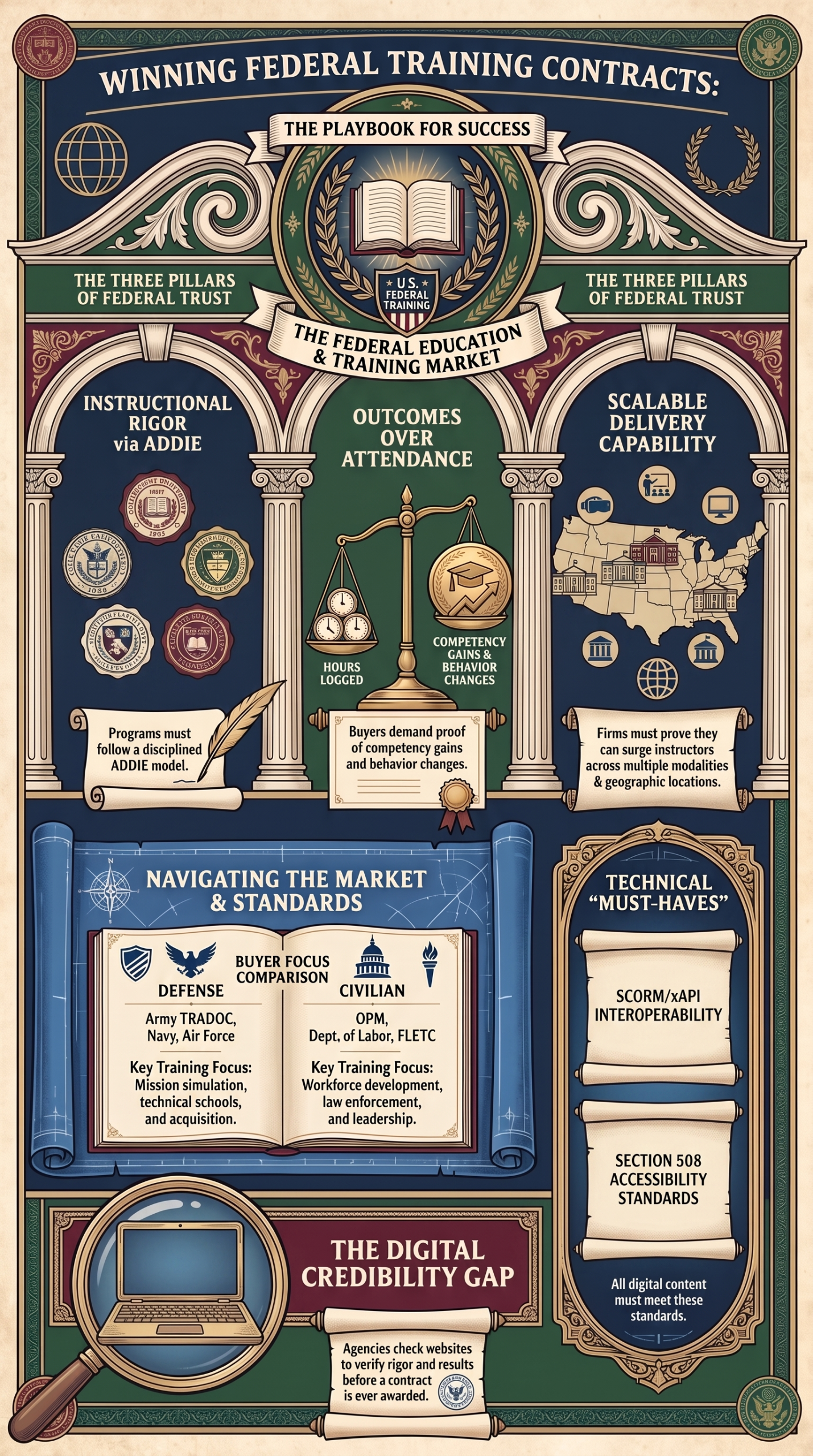
Table of Contents
- The Federal Education and Training Market
- Who Buys: The Federal Education and Training Agencies
- What Federal Education and Training Contractors Provide
- How the Work Is Bought: Schedules, Task Orders, and the Standards Content Must Meet
- Instructional Rigor: Instructional Systems Design and the Discipline Behind Good Training
- Learner Results: Proving Training Actually Works
- Delivery Capability: Training at Scale, Across Modalities, On Schedule
- Set Asides, Certifications, and Teaming
- The Digital Credibility Gap: Why Your Website Decides Who Teaches an Agency’s People
- The Education and Training Contractor’s Playbook: Putting Rigor, Results, and Delivery on Display
I spent thirty years inside the federal government, across the Navy, the FBI, the Department of Homeland Security, and the National Security Agency, and I sat through a great deal of government training along the way, some of it excellent and some of it forgettable. I learned to tell the difference, and so have the people who buy it. I also watched capable education and training firms lose federal work they could clearly have delivered. They did not lose because their instruction was weak. They lost because they could not prove, in a form an agency could verify, the three things that decide who gets to teach: that their training is built with rigor, that it produces results, and that they can deliver it. Deciding who teaches your people is a trust decision, and trust has to be earned before the award.
What follows is written for the instructor, the instructional designer, the learning technology firm, the simulation developer, or the workforce provider that wants to grow into federal work, or to move from corporate clients into teaching the government’s people. It covers how the market works, who buys, and the one thing that puts your instructional rigor, learner results, and delivery capability in front of the people who decide. Let me walk through all of it.
Chapter 1. The Federal Education and Training Market
The federal government teaches at a scale few organizations in the world can match, and it never stops teaching.
The military alone runs one of the largest education and training enterprises anywhere, from initial training through advanced technical schools that turn out people able to operate and maintain some of the most complex systems in existence. Civilian agencies train their workforces continuously, because the skills a federal job demands keep changing. And the government funds job training and workforce development to prepare people to enter and advance in the workforce. Behind all of it, agencies buy instruction, curriculum, learning technology, simulation, and workforce services from contractors, spending large sums every year, with the general scale of that spending visible at public reporting sites like USASpending.gov.
Training is also a professional service, judged on expertise and on the results it produces rather than on a product a buyer can hold. And the demand renews constantly, because every new mission, every new technology, and every wave of new hires creates something more that has to be taught. For a firm, the takeaway is that this is a large, durable market that rewards those who can prove they teach well.
The size of the enterprise is easier to grasp through a single fact: the military treats training as a continuous operation, not an event, and civilian agencies increasingly do the same. Every system fielded has to be taught, every policy change has to be trained, and every new hire has to be brought up to standard, which means the work never finishes. For a contractor, that steadiness matters as much as the size. Unlike a one time project, teaching the government’s people is a recurring need, and a firm that earns a place in it can build on that footing year after year.
Chapter 2. Who Buys: The Federal Education and Training Agencies
Federal education and training spending runs through a set of major buyers, and knowing which one a firm is pursuing shapes how it should present itself.
The Defense Side
The Defense Department is the largest buyer by far. Each service runs a training command responsible for teaching its people, the Army’s Training and Doctrine Command, the Navy’s education and training command, and the Air Force’s education and training command among them. The Defense Acquisition University trains the acquisition workforce, the Defense Language Institute teaches languages, and the service schools run without pause. Across all of it, the Defense Department buys instruction, courseware, and simulation on a scale no other buyer approaches.
The breadth on the defense side is worth pausing on. A single service may need everything from entry level instruction to advanced technical courses, from leadership development to the simulation that lets people rehearse a mission before they fly it. That range means the Defense Department buys from many kinds of providers at once, the classroom instructor, the courseware developer, the simulation engineer, and the workforce specialist. Understanding which slice of that demand a firm is built to serve, and which command or school owns it, is the starting point for positioning the firm well.
The Civilian Side
On the civilian side, the Office of Personnel Management supports training and leadership development for the federal workforce. The Department of Labor runs the workforce development system and the job training programs authorized under the Workforce Innovation and Opportunity Act. The Federal Law Enforcement Training Centers train much of the federal law enforcement community. The Department of Education and the Department of Veterans Affairs run their own programs, and nearly every agency buys employee training and learning technology of some kind. Each of these buyers trains in its own way, so a firm that knows its target buyer, and how that buyer teaches, is already ahead.
Chapter 3. What Federal Education and Training Contractors Provide
Federal buyers procure a wide range of education and training services, and a firm should understand where it fits.
Instruction, Curriculum, and Learning Technology
The most visible role is instruction and delivery: providing instructors and courses, in classrooms, in the field, and online. Close beside it is curriculum and instructional design, the development of courses, courseware, and assessments built on a disciplined design process. A third is learning technology, the learning management systems, online course development, and the platforms that deliver and track training, which draw on the same information technology and cybersecurity skills the rest of federal digital work depends on.
Simulation and Workforce Development
A large defense area is simulation and training systems: modeling and simulation, and the live, virtual, and constructive training the military relies on, along with the training devices and simulators that are themselves manufactured products and supplies and often grow directly out of research and development. Rounding out the field is workforce development, the job training and skills programs that prepare people for employment. A firm may focus on one of these roles or span several, but in every case a buyer is asking the same question: can this provider teach our people well.
Where a firm sits in that range shapes how it should present itself. A pure instructional design shop competes on method and quality of courseware. A learning technology firm competes on platforms and integration. A simulation developer competes on fidelity and engineering. A workforce provider competes on placement and outcomes. The government buys all of these, often within a single program, but it evaluates each on the terms that fit the work. A firm that knows exactly what it sells, and speaks to the standard that governs that work, is far easier for a buyer to place than one that describes itself in general terms.
Chapter 4. How the Work Is Bought: Schedules, Task Orders, and the Standards Content Must Meet
Federal training is bought through a set of vehicles, and the content itself has to meet standards most commercial training never sees.
The Vehicles
Much federal training is bought through the General Services Administration’s Multiple Award Schedule, under its professional services category, which carries lines for instructor led training, online training, course development, and learning management. Agencies place orders against those contracts through task orders and requests for quotation, so a firm on the right schedule can compete without responding to a full open solicitation every time. It is worth knowing that a place on the schedule is not a promise of work; agencies still compete their orders, but the terms and rates are already set. Larger training and simulation programs often run through their own agency contracts instead.
The ordering process itself rewards preparation. When an agency has a training need, it writes a statement of work, then issues a request for quotation to schedule holders and documents its basis for award. A firm that is easy to find, easy to evaluate, and clearly qualified for the exact category has an advantage at that moment, because the agency is choosing among providers it can already order from. The vehicle gets a firm into the room. What the firm shows about its rigor, its results, and its delivery decides whether it wins the order once it is there.
The Standards Content Must Meet
Federal training content carries requirements that set it apart. Online learning content is expected to conform to interoperability standards, the Sharable Content Object Reference Model and the Experience API, both of which came out of the Defense Department’s Advanced Distributed Learning Initiative, so that content works across different systems and a learner’s progress can be recorded and carried. On top of that, federal training content must be accessible to people with disabilities under Section 508, a requirement that shapes how courseware is designed and built. Knowing the vehicle that fits a firm, and the standards its content has to meet, is half the work of competing.
Chapter 5. Instructional Rigor: Instructional Systems Design and the Discipline Behind Good Training
This is the first thing the hero of this whole effort names, and it is what separates real training from a stack of slides. Good federal training is built on a discipline, not improvised.
Instructional Systems Design
The core method is instructional systems design, most often taught as the ADDIE model: analyze the need, design the approach, develop the materials, implement the training, and evaluate the result. The military has used systematic instructional design for decades, and federal training work is expected to follow that kind of disciplined process, one that starts from the actual performance the training is meant to produce and works backward to the content, rather than starting with content and hoping it sticks. That discipline is the difference between training that changes what a person can do and training that merely fills a day.
Building to Standard
Rigor also shows in the details. Learning objectives are tied to real tasks. Assessments measure whether those objectives were actually met. Content meets the interoperability and accessibility standards the government requires. And the subject matter expertise behind the material is real rather than borrowed. A firm that designs training this way, and can show the discipline behind it, gives a buyer confidence that the training will actually teach, which is the first thing an agency needs to believe before it trusts a provider with its people.
It helps to see why the discipline matters so much to a government buyer. A federal training requirement usually exists because people have to be able to do something specific: operate a system, follow a procedure, meet a standard. Training that is not designed backward from that performance can look polished and still fail to produce it. Instructional systems design exists precisely to keep the training tied to the outcome, and a buyer who understands that will look for evidence of the method, not just an attractive course. A firm that can show its design process speaks directly to that concern.
Chapter 6. Learner Results: Proving Training Actually Works
The second thing the hero names is results, and it is where federal buyers have grown far more demanding. Agencies no longer want to hear that training happened. They want to know that it worked.
Measuring What Matters
The most widely used approach to training evaluation measures results at several levels: whether learners were engaged, whether they actually learned, whether their behavior changed on the job, and whether the organization saw the result it needed. A training contractor that measures its work this way, and reports outcomes rather than attendance, is speaking the language a serious buyer is listening for. The federal workforce system itself has moved toward negotiated performance goals and public outcome data, which tells you how much the government now weighs results over activity.
Showing the Record
Results are also something a buyer wants to see demonstrated, not asserted. Pass rates, competency gains, learner feedback, and the performance improvement a client saw are the evidence that a firm’s training does what it promises. A firm that can show that kind of record answers the results question before it is even asked, and it stands apart from the many providers who can speak only of courses delivered and hours logged. In a field crowded with vendors who all claim to be effective, proof of outcomes is what earns a buyer’s trust.
There is a practical reason the government has moved this way. Public money spent on training is expected to produce a public return, whether that is a more capable workforce, a more ready force, or a person who finds and keeps a job. Buyers are increasingly asked to account for that return, which pushes them toward providers who can measure and report it. A firm that arrives with an evaluation approach already built in, and outcome data from past work, makes the buyer’s job easier and its own case stronger. Measurement is no longer a nicety in federal training; it is closer to a requirement.
Chapter 7. Delivery Capability: Training at Scale, Across Modalities, On Schedule
The third thing the hero names is delivery. A course that works in theory is worth nothing if the firm cannot deliver it, to the right people, in the right way, on schedule.
Modalities and Scale
Federal training happens in many forms, in person, online, self paced, and blended, and a capable firm can deliver across all of them rather than in just one. It also happens at scale and across many locations, so delivery capability means qualified instructors in sufficient numbers, the reach to train a workforce spread across the country or around the world, and the ability to surge when a new requirement lands with little warning. An agency with thousands of people to train cannot afford a provider that can only handle a classroom at a time.
Qualified People, On Schedule
Delivery rests on people. The instructors a firm can field, their qualifications and credentials, and the firm’s record of standing up training on schedule are what tell a buyer the work will actually get done. A firm that can document real delivery capability, its instructor bench, the modalities it supports, its geographic reach, and its track record of delivering on time, gives a buyer confidence that the training will happen as promised. A firm that speaks only in general terms about its size leaves that confidence unearned.
Delivery is also where many capable firms quietly fall short, which is why buyers scrutinize it. A firm may design excellent training and still struggle to field enough qualified instructors, cover the locations a program spans, or hold a schedule when a requirement grows. Because those failures are common, an agency reading a proposal is looking hard for evidence that this provider will not repeat them. A firm that can point to a real instructor bench, a history of delivering across modalities and locations, and a record of meeting its dates gives the buyer a reason to believe the plan will hold.
Chapter 8. Set Asides, Certifications, and Teaming
Federal education and training work carries channels a firm should understand, and knowing which one fits is part of competing well.
Small Business and Set Asides
A great deal of federal training and education work runs through small business. The set aside programs, the ones for firms owned by socially and economically disadvantaged individuals, for service disabled veteran owned firms, for women owned firms, and others, open real doors, provided a firm holds the matching certification. Much instruction, course development, and workforce work is sized for smaller specialized firms, which makes this one of the more accessible fields in federal contracting for a capable provider that is positioned well.
Teaming Across Disciplines
Training projects often blend disciplines, instructional design, subject matter expertise, and learning technology, and few firms hold all three at real depth. That makes teaming common: an instructional design firm pairing with a technology provider, a subject matter specialist joining a larger team, or a small firm partnering to reach the scale a program demands. Firms across the sector directory of federal work find their way in through the certifications and partnerships that fit them, and the strength a firm brings to a team, along with how clearly it presents that strength, shapes the opportunities it can pursue.
One thing worth adding is that this field rewards clarity about what a firm actually is. Because training programs so often combine instruction, technology, and subject expertise, buyers and prime contractors alike are constantly assembling teams, and they choose partners they can quickly understand. A firm that presents its role, its certifications, and its strengths plainly is easier to slot into a team than one whose capabilities are buried. In a market built on partnerships and set asides, being legible to the people assembling the work is itself a competitive advantage, and it starts with how a firm presents itself.
Chapter 9. The Digital Credibility Gap: Why Your Website Decides Who Teaches an Agency’s People
Here is the piece most training and education firms are missing, and it is exactly what the hero of this whole effort turns on. An agency deciding who will teach its people is making a trust decision, and before it makes that decision, it checks whether the firm can teach well.
What a Buyer Looks For
Increasingly, the first place a buyer checks is the firm’s website. It looks for the same things it weighs in a source selection: instructional rigor, the design methodology and the discipline behind the courses; learner results, the outcomes the firm’s training has actually produced; and delivery capability, the instructors, the modalities, and the reach. A firm whose website presents all of that reassures a buyer that it can be trusted with the mission of teaching. A firm whose site is thin, generic, or silent on outcomes leaves a buyer to wonder whether the firm can really teach, which is the one thing that matters most.
This matters more in training than in almost any other field, because the product is a claim about people. A buyer cannot inspect a course the way it inspects a physical product; it has to trust that the training will change what a learner can do. That trust is built on evidence, and evidence is exactly what a website can carry. A firm that treats its site as the place a buyer confirms its rigor, its results, and its delivery is meeting the buyer where the decision is increasingly made, well before any conversation begins.
The Messaging Problem
The deeper issue is messaging. Most training firms present themselves to corporate learning and development buyers, leading with the imagery and language that market expects. A federal agency is reading for something else entirely: proof of instructional rigor, learner results, and delivery capability against its own mission. The firm often has all of it, the methodology, the outcomes, the instructor bench, and simply never presents it to the audience that decides. Closing that gap is what a purpose built federal contractor website does: it presents a firm’s rigor, results, and delivery the way an agency evaluates who will teach its people. The capability was never the question. Whether a buyer can confirm it, before deciding who teaches its people, is.
Chapter 10. The Education and Training Contractor’s Playbook: Putting Rigor, Results, and Delivery on Display
Pulling it together, here is what an education or training firm that wants to win federal work should do, and where the digital piece fits.
Present Rigor and Results
Lead with your instructional discipline. Present your design methodology, how you build from a real performance need, and how your content meets the federal interoperability and accessibility standards, so a buyer sees your training is built to teach. Then present your learner results, your outcome data, pass rates, competency gains, and the performance improvement your clients saw, so a buyer sees your training works. These are the first two things a federal training buyer needs to trust, and they should be impossible to miss.
Present Delivery and Organize It the Buyer’s Way
Show your delivery capability, your instructor bench, the modalities you deliver, your geographic reach, and your record of standing up training on schedule, so a buyer sees you can deliver. Then organize all of it the way an agency evaluates a training provider, so a buyer researching you finds exactly what it needs to place its trust. Shift the message from corporate learning to federal agency.
Start Now
The government is training its people every day, and every award goes to a provider an agency has decided to trust with them. A firm that pairs genuine education and training capability with a presence that proves its instructional rigor, learner results, and delivery capability is positioned to earn that trust and win the work. Agencies are deciding who teaches their people right now, and a credible federal contractor website is what makes sure your firm shows the rigor, results, and delivery that decision turns on. The market where government buyers concentrate is mapped across the regional market pages.
I help instruction, curriculum, simulation, and workforce firms present their instructional rigor, learner results, and delivery capability the way federal agencies evaluate a provider they are deciding to trust with their people. If you are ready to compete for federal training and education work, this is where it starts.
Authoritative Sources
The following sources inform the facts in this guide. Web addresses were current at the time of writing and should be verified for the latest information, since programs, standards, and training requirements change over time.
Advanced Distributed Learning Initiative. (n.d.). SCORM and xAPI. https://www.adlnet.gov/
Defense Acquisition University. (n.d.). DAU. https://www.dau.edu/
Federal Law Enforcement Training Centers. (n.d.). FLETC. https://www.fletc.gov/
General Services Administration. (n.d.). Multiple Award Schedule, professional services. https://www.gsa.gov/
Office of Personnel Management. (n.d.). Training and development. https://www.opm.gov/
Section 508 accessibility program. (n.d.). Section 508 standards. https://www.section508.gov/
U.S. Army Training and Doctrine Command. (n.d.). TRADOC. https://www.army.mil/
U.S. Department of Education. (n.d.). Programs and services. https://www.ed.gov/
U.S. Department of Labor. (n.d.). Workforce Innovation and Opportunity Act. https://www.dol.gov/
U.S. Department of Veterans Affairs. (n.d.). Education and training. https://www.va.gov/
System for Award Management. (n.d.). SAM.gov. https://sam.gov/
Contractor Performance Assessment Reporting System. (n.d.). CPARS. https://www.cpars.gov/
U.S. Department of the Treasury. (n.d.). USAspending.gov. https://www.usaspending.gov/
Explore your field in the sector directory, or browse the regional market pages to see where government buyers concentrate across the country.