

Bottom Line Up Front
Federal information technology is one of the largest technology markets in the world, and it is also the most crowded corner of government contracting. Thousands of firms claim cloud, cyber, data, and modernization in nearly identical words. From my seat inside the government, I watched how technical evaluators cut through that noise: they hunt for specifics. Which environments, which frameworks, which agencies, which measurable outcomes. Firms that publish specifics get shortlisted. Firms that publish adjectives get skipped.
At the same time, the security gates have become real barriers to entry rather than paperwork. Defense work now carries certification requirements that are phasing in on a published schedule, cloud services face their own authorization regime, and primes vet the security posture of every technology subcontractor before they team. An agency, a prime, or an evaluator researching your firm is trying to answer three questions quickly: what you support, what you secure, and what you have already delivered.
This guide covers how the federal technology market works, who buys, the compliance gates that now decide eligibility, and how a firm proves all three of those things. A credible federal contractor website is where a technical evaluator confirms a firm can be mapped to a requirement, long before any conversation happens. Read it as a playbook for making that mapping effortless.
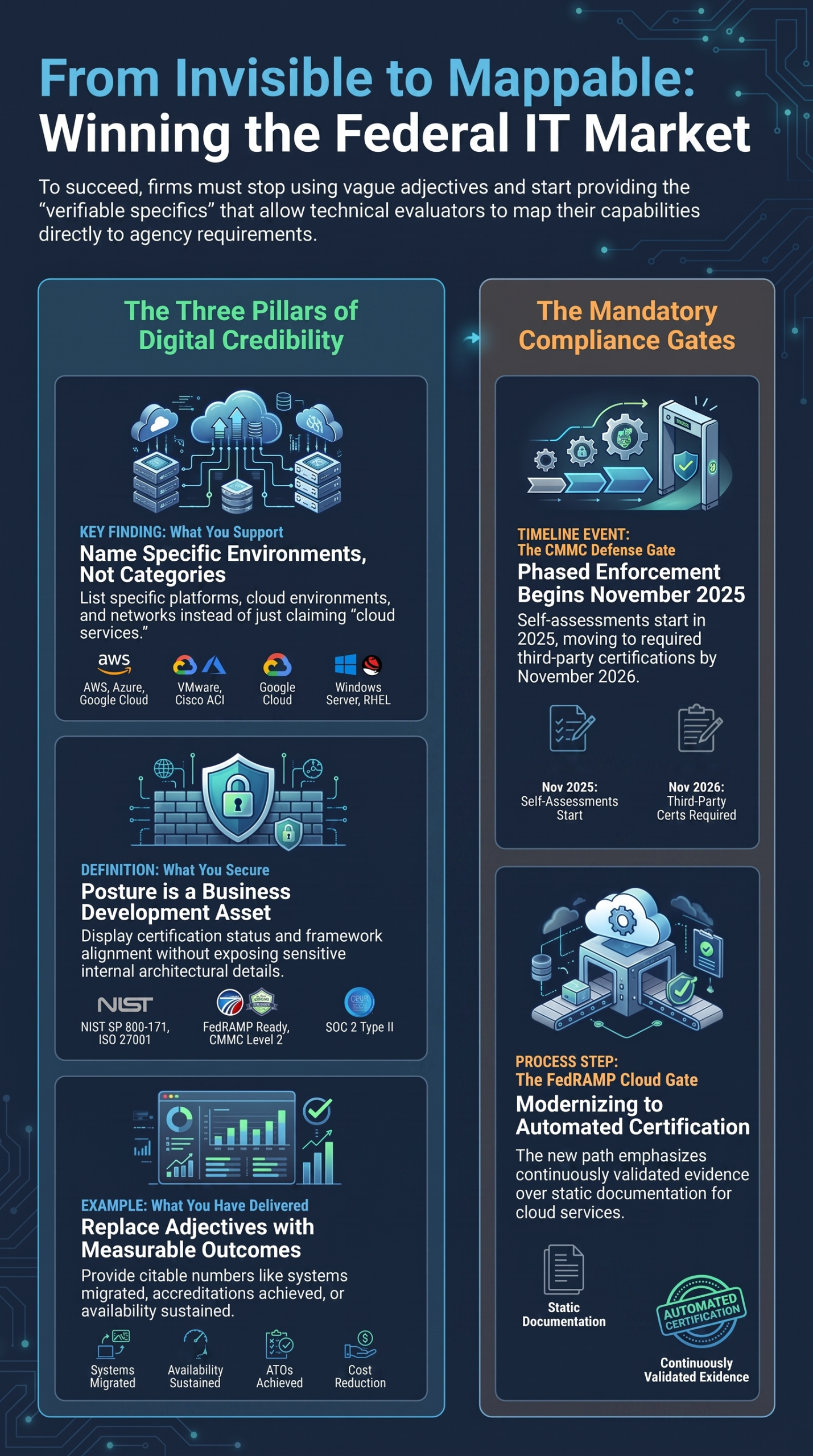
Table of Contents
- The Federal IT and Cybersecurity Market
- Who Buys: The Federal Technology Buyers
- What Federal IT and Cybersecurity Contractors Provide
- How the Work Is Bought: Schedules, Governmentwide Vehicles, and Task Orders
- What You Support: Systems, Platforms, and Environments
- What You Secure: Security Posture and the Compliance Gates
- What You Have Delivered: Technical Past Performance
- Clearances, Certifications, Set Asides, and Teaming
- The Digital Credibility Gap: Why Vague Loses in a Crowded Technical Market
- The IT and Cybersecurity Contractor’s Playbook: Putting Support, Security, and Delivery on Display
I spent thirty years inside the federal government, across the Navy, the FBI, the Department of Homeland Security, and the National Security Agency, and I came up through the signals and cyber side of it as a Navy Chief and a cryptologic technician trained by NSA. I have written and read the kind of technical material that must inform a reader without revealing anything, and I know how government technical professionals assess a vendor’s credibility. I also watched capable technology firms lose federal work they could clearly have performed. They did not lose in engineering. They lost because an evaluator could not map them to a requirement, could not confirm their security posture, and could not find a single measurable result. In the most crowded corner of federal contracting, being unclear is the same as being invisible.
What follows is written for the systems integrator, the cloud or managed services provider, the software firm, the cybersecurity company, or the data and emerging technology shop that wants to grow into federal work or to move from commercial clients into serving agencies. It covers how the market works, who buys, the compliance gates that now decide who is even eligible, and the one thing that shows agencies, primes, and evaluators exactly what you support, what you secure, and what you have already delivered. Let me walk through all of it.
Chapter 1. The Federal IT and Cybersecurity Market
The federal government runs one of the largest technology enterprises on earth, and it buys an enormous share of it from contractors.
Every agency depends on systems it did not build and cannot run alone: networks, data centers, cloud environments, enterprise software, help desks, and the security operations that defend all of it. The government spends heavily on technology every year, across both civilian agencies and defense, with the general scale of that spending visible at public reporting sites like USASpending.gov. Much of that money flows through contracts rather than federal employees, which is why the technology market is one of the deepest and most consistent opportunities in government contracting.
It is also the most competitive. Federal technology work is largely a professional service, sold on expertise rather than on a product a buyer can inspect, and thousands of firms describe that expertise in the same language. Two things are reshaping the field. Modernization keeps pushing agencies toward cloud, data, and automation, which opens work for firms that can actually deliver it. And the security gates keep rising, so that a firm’s ability to prove its own posture increasingly decides whether it is eligible to compete at all. Both trends reward the same thing: verifiable specifics.
One more feature of this market deserves attention: it is unusually open to smaller firms. Technology work is often divided into task orders sized for specialized providers, agencies frequently need niche skills a large integrator does not keep on staff, and the small business tracks built into major vehicles route real volume toward certified firms. Scale helps, but it is not the only way in. What consistently decides outcomes is whether a firm can be understood quickly and verified confidently, which is a matter of clarity rather than company size.
Chapter 2. Who Buys: The Federal Technology Buyers
Federal technology spending runs through a set of major buyers, and knowing which one a firm is pursuing changes how it should present itself.
The Defense Side
The Defense Department is the single largest technology buyer in the government. The Defense Information Systems Agency provides enterprise information technology and communications support across the department, each service runs its own technology and cyber organizations, and the combatant commands carry requirements of their own. Defense technology work sits alongside the broader defense and aerospace market, and it comes with the strictest security conditions in government, because the information involved ranges from sensitive to classified. For an IT or cyber firm, defense work offers scale and durability, but only after it clears the security bar.
The Civilian Side
On the civilian side, nearly every agency buys technology. The General Services Administration operates the contract vehicles much of the government buys through and runs the federal cloud security program. The Cybersecurity and Infrastructure Security Agency leads civilian cybersecurity and issues directives that shape what agencies must do. The large departments, among them Veterans Affairs, Homeland Security, Health and Human Services, Justice, and Treasury, run substantial technology programs, and the intelligence community buys its own. Each buyer has its own mission, its own systems, and its own way of evaluating vendors, which is why agency context is half of technical credibility in this market.
Chapter 3. What Federal IT and Cybersecurity Contractors Provide
Federal technology buyers procure a wide range of work, and a firm should be precise about where it fits.
Infrastructure, Cloud, and Software
The foundation of the market is infrastructure and operations: networks, data centers, end user support, and the managed services that keep agency systems running day to day. Cloud work sits on top of it, from migration and engineering to the ongoing operation of agency environments. Software and application work covers custom development, the modernization of aging systems that agencies have run for decades, and the integration that ties new capability to old records. Much of this is unglamorous, long running, and exactly the kind of work agencies most need done well.
Cybersecurity, Data, and Emerging Technology
Cybersecurity spans security operations centers, monitoring and incident response, vulnerability management, identity and access management, penetration testing, and the accreditation support that gets systems approved to operate. Data and emerging technology covers data engineering, analytics, and the artificial intelligence work that agencies are now pursuing in earnest, which often grows directly out of research and development. And a specialized area worth naming is the security of operational technology, the industrial control systems behind energy and utility infrastructure and other physical operations, where a compromise has consequences beyond data. A firm may focus on one of these or span several, but a buyer is always asking the same question: what exactly do you support, and how well.
Being precise about that role is worth more than it sounds. A firm that positions itself as a full service technology provider competes against every other firm making the same claim, and it does so without any distinguishing feature an evaluator can hold on to. A firm that says exactly which environments it operates, which systems it modernizes, or which security functions it performs enters a much smaller comparison set. Narrowing the claim feels like giving something up. In practice it is how a firm becomes findable, and being findable is the first requirement for being selected.
Chapter 4. How the Work Is Bought: Schedules, Governmentwide Vehicles, and Task Orders
Federal technology work is bought through a layered set of vehicles, and a firm that understands them competes on a different footing than one that does not.
The Vehicles
A great deal of technology work runs through the General Services Administration’s Multiple Award Schedule, which carries the information technology categories agencies buy from routinely. Above that sit the governmentwide acquisition contracts, large multiple award vehicles operated by agencies such as the General Services Administration, NASA, and the National Institutes of Health, which other agencies use to buy technology across the government. Individual agencies also run their own large multiple award contracts for their specific programs. What these share is a structure: a firm competes once to get on the vehicle, then competes again for each task order issued under it.
Why That Structure Matters
That two stage structure shapes everything. Being on a vehicle is not a promise of work, it is permission to compete, and the real contest happens at the task order level, often on short timelines against a small field. When a requirement appears, the agency issues a request for quotation to the firms already on the vehicle, evaluates the responses, and awards. A firm that is easy to find, easy to evaluate, and clearly qualified for the exact category has an advantage in that moment. It is also why the set aside programs matter so much here, since many vehicles carry small business tracks, and the programs for firms owned by socially and economically disadvantaged individuals, for service disabled veteran owned firms, for women owned firms, and others open real doors to technology work for firms that hold the matching certification.
Chapter 5. What You Support: Systems, Platforms, and Environments
This is the first thing the hero of this whole effort names, and it is the specific most technology firms leave out. Program offices and prime capture teams read a technology firm’s website like a capability matrix, and every specific they cannot find becomes a risk they assign to the firm.
Name the Environments, Not the Category
Saying a firm does cloud tells an evaluator almost nothing, because every competitor says it. What an evaluator needs is the level below that: which platforms, which cloud environments, which networks, which enterprise systems the firm actually supports, named plainly. The same is true of the mission side. Which agencies has the firm worked for, and which mission areas does it understand, because agency context is half of technical credibility in government work. A firm that names its environments and its agencies can be mapped to a requirement in seconds. A firm that speaks in categories cannot be mapped at all, and an evaluator working through a stack of candidates will simply move on.
Make the Path to Buy Visible
Support also means the practical mechanics of being bought. The contract vehicles a firm holds, its schedule positions, the codes that classify its work, and its registration identifiers all tell a contracting officer whether there is a path to award and how short it is. Those details feel like administrative trivia to an engineer and read as green lights to a buyer. A firm that publishes them plainly removes friction from a process that is already crowded, and it turns market research, which is where most opportunities are quietly lost, into an argument in its own favor.
Chapter 6. What You Secure: Security Posture and the Compliance Gates
The second thing the hero names is what you secure, and in this market that phrase carries two meanings at once. It means the systems a firm defends for its customers, and it means the firm’s own security posture, which has become a condition of eligibility rather than a selling point.
The Defense Gate
The most consequential change in years is the Cybersecurity Maturity Model Certification program, which applies to defense contractors that handle federal contract information or controlled unclassified information. The program itself was established by rule, and the acquisition rule that put certification requirements into defense contracts took effect on November 10, 2025, which made the requirement contractually enforceable rather than advisory. It is arriving in four annual phases. The first phase brought self assessments at the lower levels into new solicitations. The second phase, beginning November 10, 2026, brings the requirement for certification assessments performed by accredited third party assessment organizations. A third phase follows the year after, and full application to all applicable solicitations and contracts comes in the fourth. Contractors also carry an ongoing duty of annual affirmation, and primes are expected to confirm the status of their subcontractors and flow the requirements down. Because assessment capacity is limited and preparation commonly takes many months, the practical deadline for a firm is well ahead of the phase date. Any firm should confirm the specific requirement against the actual language of the solicitation it is pursuing.
The Cloud Gate and the Federal Baseline
Cloud services sold to agencies run through the federal cloud security program, which reviews a service against a defined security baseline so agencies can rely on that work rather than repeat it. That program is in the middle of a significant modernization: a newer path emphasizes automated, continuously validated evidence instead of static documentation, it no longer requires a firm to find an agency sponsor before starting, and the official label is moving from authorization to certification. One point is worth stating plainly because it is widely misunderstood: clearing the program is not a blanket approval to operate everywhere in government. An adopting agency still issues its own authority to operate for its own use of the service. Underneath all of it sits the federal information security baseline that agency systems are built and accredited against, the standard for protecting controlled unclassified information on contractor systems, the safeguarding and incident reporting duties written into defense contract clauses, and the movement toward zero trust architectures. A firm that can speak fluently to these is speaking the buyer’s language.
Signal Posture Without Exposure
Here is the balance that separates a mature technology firm from a careless one. A buyer needs to see posture: the certification status or phase, the cloud path, the frameworks the firm’s delivery aligns with, the certifications its people hold. An adversary or a competitor must not see architecture, configurations, or operational detail. Publishing status is credibility; publishing internals is exposure. That is a writing discipline more than a technical one, and getting it right signals to a security minded buyer that the firm understands the difference, which is itself part of what it is selling.
The practical reading of all this is that security posture is now a business development asset rather than an overhead cost. A firm that reaches the required status early can compete for work its unprepared competitors are simply ineligible to pursue, and it can say so publicly while they cannot. A firm that waits finds itself shut out of solicitations it would otherwise have won, with no way to catch up inside the timeline the opportunity allows. Preparation bought ahead of the requirement converts directly into competitive position.
Chapter 7. What You Have Delivered: Technical Past Performance
The third thing the hero names is delivery, and it is where technology firms most often undersell themselves. Evaluators want results they can cite, and most firms give them adjectives instead.
Outcomes an Evaluator Can Use
Technical past performance means the environment, the scale, the mission, and the measurable result. Systems migrated and how many. Accreditations achieved and how quickly. Incidents contained. Availability sustained. Records modernized. Users supported. These are the numbers a source selection team can lift into its notes, and they are the difference between a case study that persuades and one that decorates. Each engagement deserves its own treatment with a consistent structure, so an evaluator reading three of them can compare across them without effort, and so a firm’s strongest work is not buried inside a general description of what the company does.
The Record the Government Keeps
There is also a formal record. The government documents how contractors perform on their contracts, and that record follows a firm from one competition to the next, which means strong performance compounds into an asset and weak performance into a liability that trails the firm for years. Because every technology firm promises capability, demonstrated results are what separate the credible from the hopeful. All of it has to be written within disclosure limits, which is a real constraint in this market, but the constraint is workable: a firm can describe scale, outcome, and mission area accurately without naming what it cannot name, and doing that well is itself a demonstration of judgment a federal buyer notices.
It also compounds. Each documented outcome becomes evidence for the next pursuit, each strong performance record strengthens the next proposal, and each clearly written case study makes a firm easier for a prime to place on a team. Firms that treat documentation as an afterthought spend years doing excellent work that no buyer can see, then wonder why they remain unknown. Firms that capture results as they go build an asset that keeps paying, because in this market the record is the argument.
Chapter 8. Clearances, Certifications, Set Asides, and Teaming
A few assets carry outsized weight in this market, and a firm should understand which ones it holds and how to present them.
Cleared Capacity
For defense and intelligence work, cleared people are often the constraint that decides whether a firm can perform at all. A facility clearance lets a company handle classified information, personnel clearances let its people work on it, and the process for both takes time that cannot be compressed once a requirement is live. A firm with existing cleared capacity carries something a competitor cannot assemble quickly, and stating that capacity, at the level it is releasable, directly lowers the delivery risk a buyer assigns to the firm. Alongside clearances sit the organizational and individual certifications that signal process maturity and technical competence, which serve a similar function in civilian work.
Set Asides and Teaming
Small business set asides run deep in federal technology, and many large vehicles carry dedicated small business tracks, so a firm holding the right certification competes in a much smaller field than the open market. Teaming matters just as much, because few firms cover every capability a large technology program demands, and primes are constantly assembling teams. What has changed is that primes now vet the security posture of their technology subcontractors as part of that assembly, since a subcontractor that cannot meet the requirement is a risk to the prime’s own eligibility. A firm that makes its posture, its certifications, and its niche immediately legible shortens a prime’s due diligence and lengthens its own teaming list. Firms across the sector directory of federal work find their way in through the certifications and partnerships that fit them.
Chapter 9. The Digital Credibility Gap: Why Vague Loses in a Crowded Technical Market
Here is the piece most technology firms are missing, and in this sector it cuts deeper than in any other. A cybersecurity or technology vendor is judged by its own signals first.
Your Site Is Evidence, Not Marketing
Buyers and primes assume a technology firm’s website reflects its engineering standards, and that a cyber firm’s own digital presence reflects its security discipline. A slow, dated, or careless site quietly undermines the exact competence the firm is selling, before anyone reads a word of the copy. Meanwhile the substance matters just as much: market research teams verify posture and capability online before any conversation happens, and in the most crowded corner of federal contracting, the firm that is understood in ten seconds beats the firm that explains itself in ten minutes. Every specific an evaluator cannot find becomes a risk assigned to the firm, and enough of those risks end the evaluation quietly, without the firm ever knowing it was considered.
The Messaging Problem
The deeper issue is messaging. Most technology firms present themselves to commercial buyers, leading with the language that market rewards. A federal evaluator is reading for something else: which environments, which frameworks, which agencies, which measurable outcomes, and what security posture. Engineers speak architecture; evaluators score requirements, and if nobody translates between the two, the depth never gets counted. There is a business consequence as well, because when a buyer cannot see differentiation, everything collapses to price, and visible specialization is what defends a firm’s rates. Closing that gap is what a purpose built federal contractor website does: it presents what a firm supports, what it secures, and what it has delivered in the language source selection actually uses. The capability was never the question. Whether an evaluator can confirm it, quickly, is.
Chapter 10. The IT and Cybersecurity Contractor’s Playbook: Putting Support, Security, and Delivery on Display
Pulling it together, here is what a technology or cybersecurity firm that wants to win federal work should do, and where the digital piece fits.
Name What You Support
Replace categories with specifics. Publish the platforms, clouds, networks, and enterprise systems you actually support, the agencies and mission areas you understand, and the vehicles, classification codes, and identifiers that show a contracting officer the path to buy. Own a niche and prove it rather than claiming everything, because a firm that is genuinely strong in a defined area is far easier to shortlist than a firm that is plausibly adequate at all of it.
Show What You Secure and Prove What You Delivered
Present your security posture plainly and safely: your certification status or phase, your cloud path, the frameworks your delivery aligns with, and the certifications your people hold, stated without operational detail and kept current. Then prove delivery with outcome focused case studies carrying numbers an evaluator can cite, written within your disclosure limits. Add your cleared and certified capacity where it is releasable, since that is the people signal that lowers a buyer’s assessment of delivery risk.
Start Now
The government is buying technology every day, and the security gates are tightening on a published schedule that rewards firms who prepare early. A firm that pairs genuine information technology and cybersecurity capability with a presence that shows what it supports, what it secures, and what it has delivered is positioned to be found, shortlisted, and teamed with. Evaluators and prime capture teams are researching firms right now, and a credible federal contractor website is what makes sure yours is the one they can actually map to a requirement. The regions where this work concentrates are mapped across the regional market pages.
I help technology and cybersecurity firms translate engineering depth into proof that evaluators trust, structured so the right specifics are visible and the sensitive details stay protected. If you are ready to compete for federal technology work, this is where it starts.
Authoritative Sources
The following sources inform the facts in this guide. Web addresses were current at the time of writing and should be verified for the latest information. Security and certification requirements in this field are changing on published schedules, so confirm any requirement against the actual language of the solicitation you are pursuing.
Cybersecurity and Infrastructure Security Agency. (n.d.). CISA. https://www.cisa.gov/
Defense Counterintelligence and Security Agency. (n.d.). Industrial security and facility clearances. https://www.dcsa.mil/
Defense Information Systems Agency. (n.d.). DISA. https://www.disa.mil/
Federal Risk and Authorization Management Program. (n.d.). FedRAMP. https://www.fedramp.gov/
National Institute of Standards and Technology. (n.d.). Special Publication 800 series and the Risk Management Framework. https://www.nist.gov/
Office of the Department of Defense Chief Information Officer. (n.d.). Cybersecurity Maturity Model Certification program. https://dodcio.defense.gov/
U.S. General Services Administration. (n.d.). Multiple Award Schedule, information technology category. https://www.gsa.gov/
U.S. Government Publishing Office. (n.d.). Electronic Code of Federal Regulations, 32 CFR Part 170. https://www.ecfr.gov/
U.S. Office of Management and Budget. (n.d.). Federal zero trust strategy. https://www.whitehouse.gov/omb/
Acquisition.gov. (n.d.). Federal Acquisition Regulation and Defense Federal Acquisition Regulation Supplement. https://www.acquisition.gov/
U.S. Small Business Administration. (n.d.). Contracting assistance programs. https://www.sba.gov/
System for Award Management. (n.d.). SAM.gov. https://sam.gov/
Contractor Performance Assessment Reporting System. (n.d.). CPARS. https://www.cpars.gov/
U.S. Department of the Treasury. (n.d.). USAspending.gov. https://www.usaspending.gov/
Explore your field in the sector directory, or browse the regional market pages to see where government buyers concentrate across the country.