
Bottom Line Up Front
Feeding the federal government is one of the steadiest and largest missions in all of government contracting. The military alone feeds hundreds of thousands of people every day, in garrison and in the field, and agencies from the Department of Veterans Affairs to the Bureau of Prisons run their own dining and food supply operations. Behind all of it stands a supply chain of distributors, food service operators, manufacturers, and growers, and the demand never stops.
But this is a safety business as much as a supply business. A contracting officer feeding the mission is not simply buying food. They are trusting a vendor with the health of the people who eat it, which is why federal food buyers hold contractors to food safety standards and approved source rules that most commercial buyers never see. Your food safety discipline, your delivery reliability, and your capacity are what a buyer weighs before trusting you to feed anyone.
This guide covers how the federal food and agriculture market works, who buys, and how a contractor proves the food safety, reliability, and capacity that buyers demand. A credible federal contractor website is where a contracting officer confirms that a firm can feed the mission safely, before the first order is ever placed. Read it as a playbook for earning that trust.
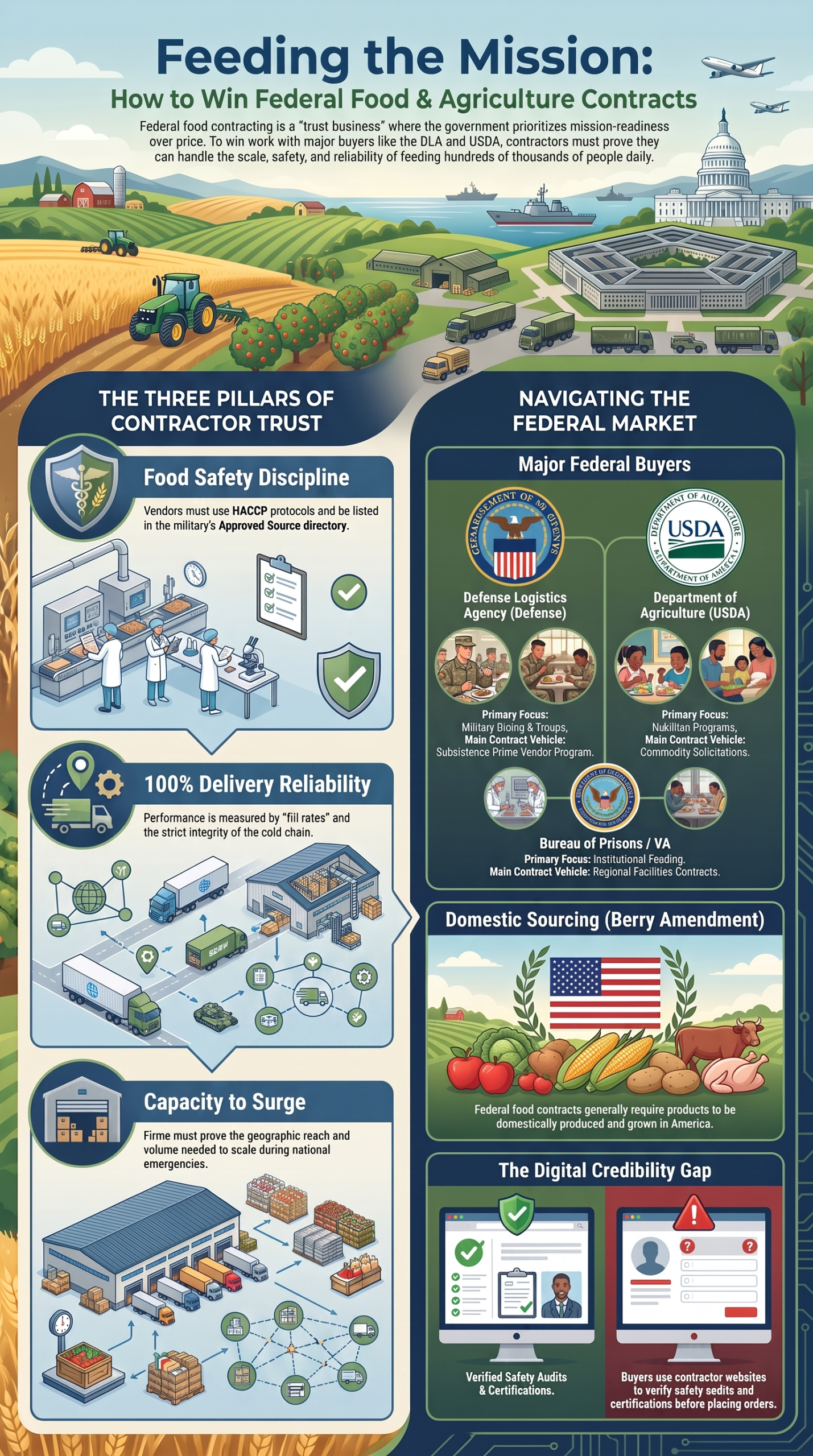
Table of Contents
- The Federal Food and Agriculture Market
- Who Buys: The Federal Food and Agriculture Agencies
- What Federal Food and Agriculture Contractors Provide
- How the Work Is Bought: Prime Vendor Contracts, Domestic Sourcing, and Task Orders
- Food Safety Discipline: HACCP, Approved Sources, and the Standards That Protect the Mission
- Delivery Reliability: Getting Safe Food There On Schedule
- Capacity: Supplying and Surging at the Scale the Mission Demands
- Set Asides, Certifications, and Teaming
- The Digital Credibility Gap: Why Your Website Decides Whether a Contracting Officer Trusts You
- The Food and Agriculture Contractor’s Playbook: Putting Safety, Reliability, and Capacity on Display
I spent thirty years inside the federal government, across the Navy, the FBI, the Department of Homeland Security, and the National Security Agency, and I saw how seriously the government takes the job of feeding its people. I also watched capable food and agriculture firms lose federal work they could clearly perform. They did not lose because their product was poor. They lost because they could not prove, in a form a contracting officer could verify, the three things that matter most in federal feeding: that their food is safe, that it arrives when it is supposed to, and that they can supply at the scale the mission demands. Feeding the federal workforce is a trust business, and trust has to be earned before the first order.
What follows is written for the distributor, the food service operator, the food manufacturer, or the grower that wants to grow into federal work, or to move from commercial accounts into feeding the government. It covers how the market works, who buys, and the one thing that puts your food safety discipline, delivery reliability, and capacity in front of the people who decide. Let me walk through all of it.
Chapter 1. The Federal Food and Agriculture Market
The federal government is one of the largest food buyers in the country, and the reason is simple: it feeds an enormous number of people, every single day, and it never stops.
The military runs dining operations worldwide, in garrison and in the field, feeding hundreds of thousands of service members. The Department of Veterans Affairs feeds patients and staff across its medical system. The Bureau of Prisons feeds a large inmate population. Federal buildings run cafeterias, and when a hurricane or another disaster strikes, agencies surge food and water to the people affected. Two federal buyers, the Defense Logistics Agency on the defense side and the Agriculture Department’s marketing service on the civilian side, stand as the largest purchasers of food, obligating billions of dollars a year, with the general scale of that spending visible at public reporting sites like USASpending.gov.
The scale is easier to grasp through who dominates it. The Defense Logistics Agency and the Agriculture Department’s marketing service together account for the overwhelming majority of the domestic food the government buys, and a large share of that spending flows to small businesses, which the government is required to use to the extent practicable even in food buying. For a firm, the takeaway is that the market is not only large but deliberately open to smaller and specialized vendors, provided they can meet the standards the government sets. The demand is also continuous rather than seasonal, since the people the government feeds have to eat every day of the year.
What gives this market its character is that it is mission work with no room for failure. People have to eat, and they have to eat safely, whether they are deployed on the far side of the world or recovering in a hospital bed. That is why the government does not buy food the way it buys ordinary supplies. It buys from vendors it has reason to trust, and it holds them to standards built to protect the people at the end of the supply chain. Understanding that is where a food or agriculture firm’s strategy has to begin.
Chapter 2. Who Buys: The Federal Food and Agriculture Agencies
Federal food and agriculture spending runs through a set of major buyers, and knowing which one a firm is pursuing shapes everything about how it should present itself.
The Defense Side
The Defense Logistics Agency, through its Troop Support element, is the Defense Department’s food supply manager and its executive agent for subsistence, responsible for supplying food to military dining worldwide. Individual installations run their own dining facilities. The Defense Commissary Agency operates the commissaries, the grocery stores that serve the military community. Together these make the Defense Department the largest single engine of federal food demand.
The commissary system alone runs a large network of grocery stores worldwide, and the same military veterinary services that clear food sources also inspect those stores and the dining facilities on base, so food safety oversight follows the food all the way to the point where it is served or sold. On the demand side, the sheer breadth matters: a vendor might supply a single installation, a region, or, through the right vehicle, customers around the world. Understanding which slice of that demand a firm is built to serve is the starting point for positioning it well.
The Civilian Side
On the civilian side, the Agriculture Department, through its marketing service, buys commodities for the nation’s nutrition programs and, through its inspection service, carries much of the responsibility for food safety. The Department of Veterans Affairs feeds patients and staff across its medical and health facilities. The Bureau of Prisons feeds those in federal custody, federal buildings run cafeterias, and in emergencies agencies surge food and water to disaster zones. Each of these buyers purchases food in its own way and on its own rules, so a firm that knows its target buyer, and how that buyer feeds its people, is already ahead.
Chapter 3. What Federal Food and Agriculture Contractors Provide
Federal food and agriculture buyers procure a wide range of products and services, and a firm should understand where it fits.
Distribution, Food Service, and Manufacturing
The largest single role is distribution: the full line food distribution that moves canned, dry, chilled, and frozen products from the source to the installation, including sourcing, warehousing, inventory management, and delivery. Another is full food service, the operation of dining facilities and cafeterias, along with catering and food preparation, often as part of the facility and installation support a base depends on. A third is food manufacturing, the production of packaged foods, operational rations, and the meals ready to eat that feed troops in the field, which sits alongside the broader world of manufacturing and supply the government buys.
Agricultural Products
Beyond prepared and packaged food, the government buys agricultural products directly: commodities, fresh produce, meat, dairy, and grains, purchased for nutrition programs and for feeding operations. A firm may specialize in one of these roles or span several, but in every case a buyer is evaluating the same underlying question. Can this vendor supply what it promises, safely and reliably, at the scale required.
Chapter 4. How the Work Is Bought: Prime Vendor Contracts, Domestic Sourcing, and Task Orders
Federal food buying runs through a set of vehicles and rules that a firm has to understand before it can compete.
Prime Vendor Contracts and Commodity Buys
The Defense Department’s main food vehicle is the subsistence prime vendor program. Regional prime vendors hold long term contracts to provide full line food distribution to the installations in their region, ordering and delivering continuously, with food often arriving within a day or two of an order. Fresh produce moves through separate market fresh contracts. The Agriculture Department buys commodities through its own solicitations for the nutrition programs it supplies. And running dining operations, as opposed to supplying the food, is competed on its own, often requiring the operator to draw its supply through the defense prime vendor system so that everything served meets federal standards.
The ordering rhythm is worth understanding, because it shapes what reliability means in practice. Under the prime vendor model, installations place orders against the contract and expect delivery within a day or two, week after week, which means the vendor is judged less on any single shipment than on sustained performance across thousands of orders. Fresh produce moves on its own track through the market fresh program. And an operator running a dining facility is usually required to draw its supply through the same prime vendor system, so the safety and quality controls built into the supply chain carry through to the tray.
The Domestic Sourcing Rule
There is one rule in federal food buying that most commercial suppliers never face, and a firm has to know it. Federal food purchasing carries a domestic sourcing requirement. On the defense side, the Berry Amendment requires the Defense Department to give preference to domestically produced and grown food, and civilian food buying carries its own domestic preferences. In practice, a firm selling food to the federal government generally has to source American product. Knowing the vehicle that fits a firm, and the rules that govern it, is half the work of competing.
Chapter 5. Food Safety Discipline: HACCP, Approved Sources, and the Standards That Protect the Mission
This is the first thing the hero of this whole effort names, and it is where federal food contracting is most unlike the commercial world. The people who buy federal food are, above all, buying safety.
Approved Sources and the Standards Behind Them
The military will not accept food from just any supplier. Food has to come from approved sources, establishments that have passed a sanitation audit and are listed in the military’s worldwide directory of sanitarily approved food establishments, meeting the Defense Department’s sanitation standard for food establishments. Military veterinary services, the Army Veterinary Corps and the Defense Health Agency’s veterinary services, conduct those audits and inspect vendors, dining facilities, and commissaries. A supplier whose facility loses its approved standing has to tell the contracting officer at once. This is a gate most commercial food buyers do not have, and clearing it is a qualification in itself.
Getting listed is a defined process, not a favor. A manufacturer or supplier requests an initial sanitation audit in writing, the establishment is examined against the sanitation standard, and it is rated acceptable or unacceptable, with any critical or major deficiencies flagged for correction. Once listed, a firm carries an ongoing duty: if a facility loses its approved standing, the supplier has to notify the contracting officer immediately. There are also audits at the receiving end, where food is checked on arrival at the installation. For a contractor, all of this is a record worth showing, because it is proof of exactly the discipline a buyer is looking for.
HACCP and the Federal Food Safety Laws
The system that underpins all of it is hazard analysis and critical control points, the food safety discipline that maps the points in a food operation where contamination can enter and builds layered controls, temperature management, secure transport, and facility sanitation, to intercept a hazard before it reaches anyone. The military uses it, and the food code the services follow, adopted from the federal food code, governs how food establishments operate. Beyond the military’s rules sit the federal food safety laws every food business must meet: the Food Safety Modernization Act, the inspection of meat, poultry, and eggs by the Agriculture Department’s inspection service, and the Food and Drug Administration’s oversight of most other food. Many buyers also expect recognized food safety audits from an outside body. A firm that runs a disciplined food safety program, and can demonstrate it, gives a buyer the one thing it needs most, which is confidence that the food is safe to serve.
It is worth being clear about how the pieces fit. Hazard analysis and critical control points is the method, the discipline of identifying where contamination could enter and controlling those points. The approved source rules and sanitation audits are how the military verifies a supplier meets that discipline before it buys. The federal food safety laws set the floor every food business operates under. And recognized outside audits give a buyer independent assurance on top of all of it. A firm that can speak to each layer, and show where it stands on each, presents itself as a serious food safety operation rather than a hopeful vendor.
Chapter 6. Delivery Reliability: Getting Safe Food There On Schedule
The second thing the hero names is reliability, and in federal feeding it is not a soft virtue. It is measured, tracked, and remembered.
How Reliability Is Measured
Feeding the mission means the food arrives, complete and on schedule, every time. Federal food distribution measures performance hard, on the fill rate, the share of an order actually delivered, on time delivery, and the integrity of the cold chain that keeps perishable food safe from the source all the way to the tray. A missed delivery is not an inconvenience in this world; it is people not fed. A broken cold chain is worse, because it can turn safe food into unsafe food. The demands of logistics and transportation are unforgiving here, because the reliability of the delivery is inseparable from the safety of what is delivered.
Why the Record Follows You
The government does not just expect reliability; it records it. A vendor’s performance on fill rates and delivery is documented and follows the firm from one contract to the next through the government’s past performance systems, which means a strong record becomes an asset and a weak one becomes a liability that trails a firm into future competitions. A firm with a proven history of high fill rates and dependable, temperature controlled delivery holds exactly the record a food buyer is looking for, and a firm that can show that record plainly is far easier to trust than one that simply asserts it.
The stakes behind the metrics are what make them matter. A stockout in an ordinary retail setting is a lost sale; a stockout in a feeding operation is a meal that does not happen for people who have no other option. That is why the fill rate is treated as a headline number and why temperature monitoring runs from the source through every transfer. A firm that has held high fill rates across a long run of orders, and kept the cold chain intact while doing it, has answered the reliability question before it is even asked, and a presence that puts that record in plain view lets a buyer confirm it quickly.
Chapter 7. Capacity: Supplying and Surging at the Scale the Mission Demands
The third thing the hero names is capacity, and federal food demand tests it in a way commercial accounts rarely do.
Volume, Reach, and the Ability to Surge
Federal food demand is large, and it does not hold steady. A prime vendor may feed an entire region. A manufacturer may be asked to supply rations for a deployment. And when a contingency or a natural disaster hits, demand can spike overnight and stay high. Capacity means the volume a firm can supply, the reach and depth of its distribution network, the geographic coverage it holds, sometimes stretching worldwide, and above all its ability to surge when the mission calls for it. The government has learned to place real weight on this, because a food supply that cannot scale fails at exactly the moment it is needed most, when people are deployed or when a disaster has put them at risk.
Proving You Can Carry the Load
Capacity is also something a buyer wants to see proven, not promised. The facilities a firm operates, the size and layout of its distribution network, the regions it can reach, and its track record of ramping up when demand surged are the evidence that it can carry the load. A firm that can document real, specific capacity gives a buyer confidence that it will not buckle under the weight of the mission, while a firm that speaks only in general terms about its size leaves a buyer to wonder whether the capability is really there.
Chapter 8. Set Asides, Certifications, and Teaming
Federal food service and food supply carry a distinctive set of channels, and knowing which one fits a firm is part of competing well.
The Channels Unique to Federal Feeding
Much federal dining and cafeteria work flows through special programs. The Randolph-Sheppard program gives vendors who are blind, through their state licensing agencies, a priority to operate cafeterias and vending on federal property. The AbilityOne program channels work to nonprofit agencies that employ people who are blind or who have significant disabilities. These two channels carry a large share of federal food service, and a firm competing for dining work has to understand where they apply. Alongside them run the standard small business set asides, the programs for firms owned by socially and economically disadvantaged individuals, for service disabled veteran owned firms, for women owned firms, and others, which apply to food distribution and commodity buying as well. The Agriculture Department’s marketing service, for one, sets aside commodity purchases for small and veteran owned vendors.
These channels are not a side note; they carry a substantial share of federal dining and cafeteria work, which is why a firm pursuing food service has to know which one governs a given opportunity before it invests in a bid. The food service category also has its own place in the government’s classification of work, and buyers such as military installations, the federal prison system, and the veterans health system all draw on it. Reading an opportunity correctly, seeing which program and which certification it runs on, is often the difference between a pursuit that fits and one that was never winnable.
Certifications and Teaming
Every program set aside requires the matching certification, held genuinely, so a firm’s real status shapes which doors are open to it. And because few firms cover every capability that federal feeding demands, teaming is common: a distributor pairing with a manufacturer, a grower joining a distribution network, or a small operator teaming with a larger firm to reach a scale neither could manage alone. Firms across the sector directory of federal work find their way in through the channel and the certifications that fit them, and the strength a firm brings to a team, along with how clearly it presents that strength, shapes the opportunities it can pursue.
Chapter 9. The Digital Credibility Gap: Why Your Website Decides Whether a Contracting Officer Trusts You
Here is the piece most food and agriculture firms are missing, and it is exactly what the hero of this whole effort turns on. Feeding the federal workforce is a safety business, and before a contracting officer trusts a vendor to feed anyone, they check whether the vendor can do it safely and reliably.
What a Buyer Looks For
Increasingly, the first place a buyer checks is the vendor’s website. They look for the same things they weigh in a source selection: food safety discipline, the certifications, the approved source standing, the audit history, and the food safety program; delivery reliability, the record of getting food there complete and on schedule; and capacity, the facilities, the network, and the reach. A firm whose website presents all of that reassures a buyer that the vendor can be trusted with the mission. A firm whose site is thin, generic, or silent on food safety leaves a buyer to assume the worst about the very thing that matters most, and a buyer feeding people cannot afford to assume the best about a vendor it cannot verify.
The Messaging Problem
The deeper issue is messaging. Most food firms present themselves to grocery buyers, restaurants, or commercial clients, leading with the imagery and language that market expects. A federal contracting officer is reading for something else entirely: proof that the vendor can feed the mission safely, deliver reliably, and supply at scale. The firm often has all of it, the certifications, the record, the capacity, and simply never presents it to the audience that decides. Closing that gap is what a purpose built federal contractor website does: it presents a firm’s food safety, delivery reliability, and capacity the way a contracting officer evaluates a food vendor. The capability was never the question. Whether a buyer can confirm it, before trusting the firm to feed anyone, is.
Chapter 10. The Food and Agriculture Contractor’s Playbook: Putting Safety, Reliability, and Capacity on Display
Pulling it together, here is what a food or agriculture firm that wants to win federal work should do, and where the digital piece fits.
Present Safety and Reliability
Lead with food safety. Present your certifications, your recognized outside audits, your approved source standing, and your food safety program, so a buyer sees at once that you can feed people safely. Then present your delivery reliability, your fill rate record, your on time performance, and the cold chain that keeps food safe in transit, so a buyer sees that you deliver. These are the first two things a federal food buyer needs to trust, and they should be impossible to miss.
Present Capacity and Organize It the Buyer’s Way
Show your capacity, the facilities you run, the distribution network you operate, the regions you reach, and your ability to surge when the mission demands it, so a buyer sees you can carry the load. Then organize all of it the way a contracting officer evaluates a food vendor, so a buyer researching you finds exactly what they need to place their trust. Shift the message from grocery or commercial buyer to federal contracting officer.
Start Now
The government is buying food every day, and every order rides on a vendor a contracting officer has decided to trust. A firm that pairs genuine agriculture and food service capability with a presence that proves its food safety, delivery reliability, and capacity is positioned to earn that trust and win the work. Contracting officers are deciding which food vendors they can rely on right now, and a credible federal contractor website is what makes sure your firm shows the safety, reliability, and capacity that decision turns on. The market where government buyers concentrate is mapped across the regional market pages.
I help food service, distribution, and agriculture firms present their food safety discipline, delivery reliability, and capacity the way federal contracting officers evaluate a vendor they are deciding to trust with the mission. If you are ready to compete for federal food work, this is where it starts.
Authoritative Sources
The following sources inform the facts in this guide. Web addresses were current at the time of writing and should be verified for the latest information, since programs, standards, and food safety requirements change over time.
Defense Commissary Agency. (n.d.). DeCA. https://www.commissaries.com/
Defense Health Agency. (n.d.). Veterinary services and food safety. https://www.health.mil/
Defense Logistics Agency. (n.d.). DLA Troop Support, Subsistence. https://www.dla.mil/
U.S. AbilityOne Commission. (n.d.). AbilityOne Program. https://www.abilityone.gov/
U.S. Congress. (n.d.). Berry Amendment (10 U.S.C. 2533a) and Randolph-Sheppard Act (20 U.S.C. 107). https://www.congress.gov/
U.S. Department of Agriculture, Agricultural Marketing Service. (n.d.). Selling food to USDA. https://www.ams.usda.gov/
U.S. Department of Agriculture, Food Safety and Inspection Service. (n.d.). FSIS. https://www.fsis.usda.gov/
U.S. Food and Drug Administration. (n.d.). Food Safety Modernization Act and the Food Code. https://www.fda.gov/
U.S. Government Accountability Office. (2024). Federal food purchases. https://www.gao.gov/
U.S. Small Business Administration. (n.d.). Contracting assistance programs. https://www.sba.gov/
Contractor Performance Assessment Reporting System. (n.d.). CPARS. https://www.cpars.gov/
U.S. General Services Administration. (n.d.). System for Award Management (SAM.gov). https://sam.gov/
U.S. Department of the Treasury. (n.d.). USAspending.gov. https://www.usaspending.gov/
Explore your field in the sector directory, or browse the regional market pages to see where government buyers concentrate across the country.