

Bottom Line Up Front
Federal architecture, engineering, and environmental work is one of the largest professional services markets in government. The agencies that build and maintain the federal built environment, and that carry the nation’s environmental obligations, depend on outside firms for design, engineering, surveying, planning, and environmental services, and the demand runs for years and reaches across the country.
But this work is chosen differently from almost everything else the government buys. Under the law that governs the selection of architect and engineer firms, a firm is ranked on its qualifications, not its price, by a selection board that reads what the firm has published about itself. Your credentials, your project portfolio, and your regulatory fluency are the competition, and a board evaluates them before price is ever discussed.
This guide covers how federal design work is really chosen, who buys it, and how a firm presents the credentials, project portfolio, and regulatory fluency that selection boards actually score. A credible federal contractor website is what puts those qualifications in front of a board in the form it evaluates them. Read it as a playbook for presenting your qualifications the way boards read them.
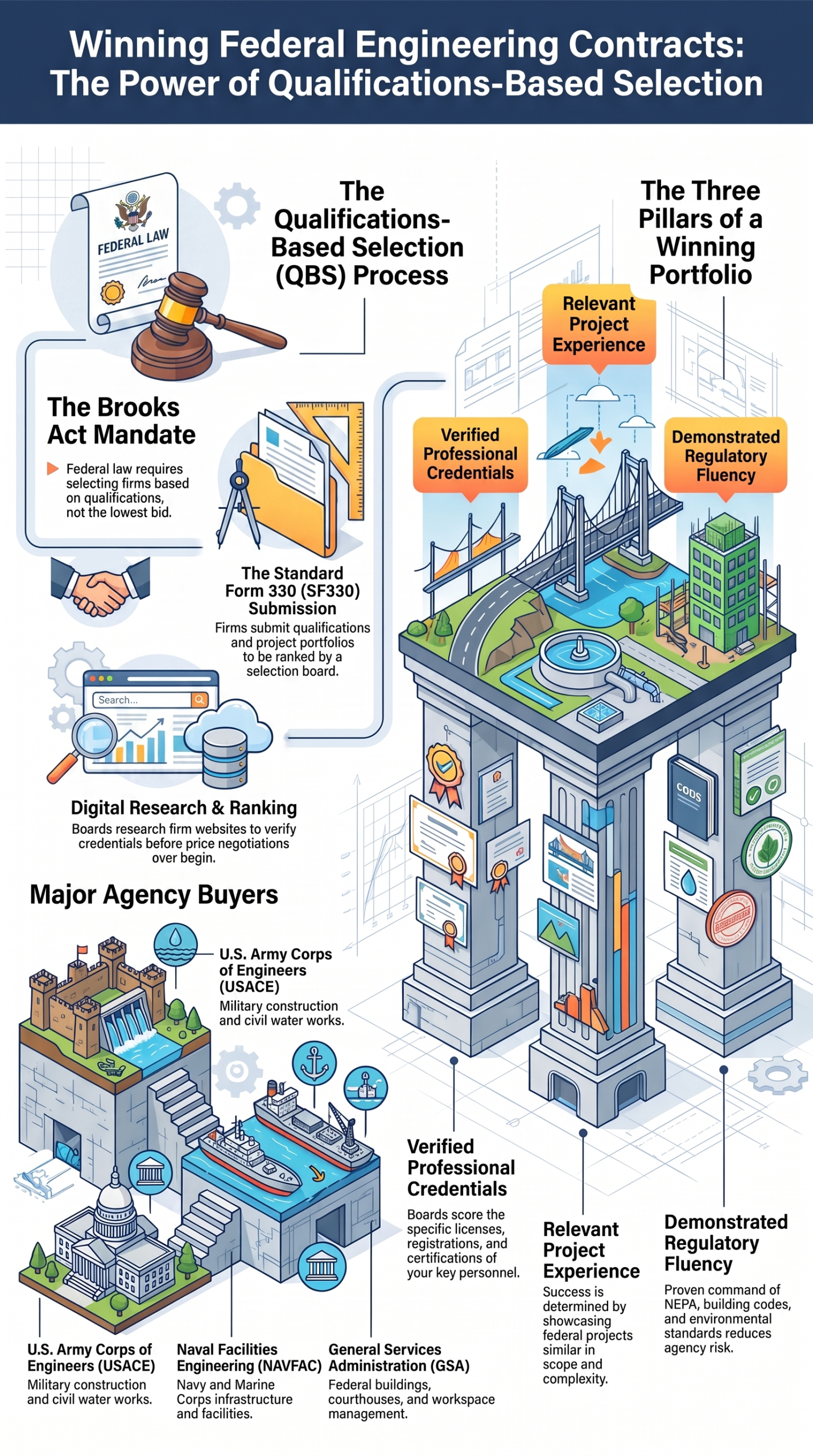
Table of Contents
- The Federal Engineering and Environmental Market
- Qualifications Based Selection: How Federal Design Work Is Really Chosen
- Who Buys: The Federal Engineering and Environmental Agencies
- The Disciplines: What Federal Engineering and Environmental Firms Provide
- Credentials: Licensure, Registrations, and the Qualifications That Count
- The Project Portfolio: Relevant Experience the Board Can Score
- Regulatory Fluency: NEPA, Environmental Law, and the Standards Firms Must Know
- Set Asides, Teaming, and the Multidisciplinary Team
- The Digital Credibility Gap: Why Your Website Is Where the Board Starts
- The Engineering Firm’s Playbook: Presenting Qualifications the Way Boards Evaluate
I spent thirty years inside the federal government, across the Navy, the FBI, the Department of Homeland Security, and the National Security Agency, and I watched capable engineering and environmental firms lose federal work they were fully able to perform. They did not lose on price, because in this field price is not how the work is won. They lost because their published qualifications did not present the way a selection board reads them, and a board that could not clearly see a firm’s credentials, its relevant experience, and its command of the rules simply ranked another firm higher. In federal architect and engineer work, the qualifications a firm publishes are the competition.
What follows is written for the architecture, engineering, or environmental firm that wants to grow, to move from private or commercial work into federal design, or to climb from subconsultant to prime. It covers how the work is really chosen, who buys it, what a selection board evaluates, and the one thing that puts a firm’s qualifications in front of the people who score them. Let me walk through all of it.
Chapter 1. The Federal Engineering and Environmental Market
The federal government owns and operates one of the largest portfolios of buildings, infrastructure, and land in the world, and it carries some of the nation’s largest environmental responsibilities. To plan, design, and steward all of it, the government relies on outside firms, because no agency staffs every discipline it needs. That reliance creates a deep and continuous market for architecture, engineering, surveying, planning, and environmental services.
The demand spans the whole field. Federal agencies need buildings and facilities designed, infrastructure engineered, sites surveyed and mapped, and installations planned, and they need the full range of environmental work, from the assessments that clear a project to proceed to the cleanup of contaminated sites. The systems they build reach from vertical buildings to energy and utility infrastructure, and the environmental obligations they carry run for decades. For an engineering or environmental firm, this is a large, durable, nationwide market.
What gives the market its character is that this is mission work with real consequences. A design that fails, an environmental review that misses something, a study that is wrong, these carry costs measured in safety, in stewardship, and in public trust, not just in dollars. That is why the government does not choose these firms the way it buys ordinary goods and services. It chooses them on proven competence, and understanding how that choice is actually made is where a firm’s strategy has to begin.
It is worth appreciating how broad the buyer base is. This is not one agency with one kind of project. It is dozens of agencies, each with its own facilities, its own infrastructure, and its own environmental obligations, buying design and environmental work continuously across the country and around the world. A firm that grasps the size and steadiness of this market treats federal work not as an occasional pursuit but as a practice area worth building deliberately, with the qualifications and the presence to compete in it seriously.
Chapter 2. Qualifications Based Selection: How Federal Design Work Is Really Chosen
This is the chapter that changes how an engineering or environmental firm should compete, because federal design work is selected by a process unlike almost anything else in government contracting.
The Brooks Act and Qualifications Based Selection
A law enacted in 1972, commonly called the Brooks Act, governs how federal agencies select architect and engineer firms, and it is implemented in Subpart 36.6 of the Federal Acquisition Regulation. Its rule is simple and consequential: agencies must select these firms on the basis of demonstrated competence and professional qualifications, not on price. This is known as qualifications based selection. Price does not enter the ranking at all. A firm is chosen for what it can do and has done, and only after it is chosen does the conversation turn to cost.
How the Process Actually Works
The process runs in a set order. The agency publicly announces its need and the criteria it will apply. Interested firms submit their qualifications on the Standard Form 330, the architect and engineer qualifications form, whose two parts cover a firm’s general qualifications and its qualifications for the specific contract. A selection board made up of professionals reviews those submissions and ranks the most highly qualified firms, generally at least three of them, against the published criteria. Only then does the agency open negotiations, starting with the highest ranked firm and moving to the next only if it cannot reach a fair and reasonable price. This is the design that federal construction agencies build from, and it means a firm’s published qualifications, not its bid, decide whether it advances. Everything else in this guide follows from that single fact.
The consequences of this design run deep. Because price is set aside during selection, a firm cannot buy its way onto a project by underbidding, and it cannot lose a project it deserves by being slightly more expensive. What it can do, and must do, is make its qualifications unmistakable. The whole contest happens on the ground of demonstrated competence, which means the quality, clarity, and relevance of what a firm presents about itself is not a marketing nicety. It is the substance of the competition, and a firm that treats it lightly is conceding the field.
Chapter 3. Who Buys: The Federal Engineering and Environmental Agencies
Federal design and environmental work is concentrated among a set of major buyers, and knowing which one a firm is pursuing shapes how it should present itself.
The Design Agencies
The U.S. Army Corps of Engineers is one of the largest buyers of architect and engineer services in the world, procuring design for military construction and for its vast civil works and water resources mission. The Naval Facilities Engineering Systems Command buys design for Navy and Marine Corps facilities, the Air Force Civil Engineer Center for Air Force infrastructure, the General Services Administration through its Public Buildings Service for federal buildings and courthouses, and the Department of Veterans Affairs for its medical facilities. Each of these agencies runs its own selection boards under the same qualifications based process.
The Environmental Buyers and the Wider Market
On the environmental side, the Environmental Protection Agency, the Department of Energy, and the environmental restoration programs of the Department of Defense drive large volumes of assessment, compliance, and cleanup work, and the Corps of Engineers carries a central regulatory role over the nation’s waters. Beyond the federal tier, state and local agencies buy these services in much the same way, since many states have adopted qualifications based selection laws that mirror the federal one. The federal and defense markets where this work concentrates are mapped across the regional market pages, and a firm that knows which agencies and boards it is pursuing can shape its qualifications to what they evaluate.
The practical value of knowing the buyer is that different agencies emphasize different things. One weighs deep experience with a particular facility type, another values knowledge of a region, a third looks hardest at a specialized technical capability. A firm that studies the agency it is pursuing, and the kind of projects that agency awards, can present the parts of its record that matter most to that board, rather than offering the same generic profile to every buyer and hoping it lands.
Chapter 4. The Disciplines: What Federal Engineering and Environmental Firms Provide
Federal buyers procure a wide range of design and environmental services, and a firm should understand where it fits in that range.
Design, Engineering, and Surveying
The work covers architecture and the full set of engineering branches, including civil, structural, mechanical, electrical, and geotechnical engineering, along with the surveying and mapping that the government also procures as architect and engineer services. It extends to planning and to the facility engineering and commissioning that supports government buildings and installations across their life. A firm may practice a single discipline or many, but in every case a buyer evaluates whether it holds the qualifications and the experience to perform.
Environmental Services
Environmental firms carry their own broad portfolio: the assessments and documentation that federal actions require, water and wastewater engineering, the remediation of contaminated sites, ecological and natural resource work, and the compliance support that keeps projects on the right side of the law. Much of this work, design and environmental alike, is procured as professional services under the qualifications based process described earlier. What unites all of it is that a buyer is not purchasing a commodity. It is choosing a firm it trusts to bring the right competence to a consequential problem.
The clearer a firm is about which of these services it genuinely delivers, and the depth it brings to them, the easier it is for a buyer to place it correctly and evaluate it fairly.
Chapter 5. Credentials: Licensure, Registrations, and the Qualifications That Count
A selection board scores professional qualifications first, and credentials are the foundation of that score. This is the first of the three things the hero of this whole effort names, and it is where a firm’s case begins.
Licensed Professionals and Firm Registration
The people who perform this work are licensed professionals: professional engineers, registered architects, professional geologists, and others, licensed by discipline and by the state in which they practice. Firms themselves hold registration or licensure in the states where they work. A board looks closely at the licenses and registrations a firm holds, because they are the proof that the firm and its people are legally and professionally qualified to do the work at hand. A gap in the right credential can end a firm’s candidacy before its experience is even weighed.
Key Personnel and Specialized Qualifications
Beyond the licenses, a board evaluates the specific people a firm proposes for a project, its key personnel, and it reads their education, their professional registrations, their certifications, and their individual experience. A firm competes not only on its collective standing but on the strength of the named individuals who will actually do the work. Specialized certifications and qualifications for particular kinds of work add further weight. A firm that presents its credentials completely and clearly, for the firm and for its key people, gives a board exactly what it is looking to score.
There is a discipline to this that separates strong firms from the rest. Credentials expire, staff change, and new certifications are earned, so the picture a firm presents has to be current, accurate, and complete at the moment a board looks. A firm that keeps its professional qualifications organized and up to date, ready to be presented the instant an opportunity appears, competes from a position of strength, while a firm that scrambles to assemble them each time presents a weaker and often incomplete case.
Chapter 6. The Project Portfolio: Relevant Experience the Board Can Score
The second thing a board scores, and often the most heavily weighted, is relevant experience. A firm’s project portfolio is its strongest argument, and how it presents that portfolio can decide the ranking.
Relevant and Similar Projects
A selection board looks for projects similar to the one at hand in type, scope, size, and complexity, and it gives particular weight to comparable federal work. The specialized experience a firm can show, on the specific kind of project the agency needs, is what separates the most qualified firms from the merely capable. A firm with a deep record of relevant projects has a powerful case, and a firm that has done the exact kind of work before is difficult for a board to rank below one that has not.
Presenting the Portfolio and Past Performance
Presenting the portfolio well matters as much as having it. For each project, a board wants to see the firm’s role, the scope of the work, the outcome, and above all the relevance to the current need, and it verifies what a firm claims, including checking past performance records that the government keeps on prior federal work. A firm that presents the right projects, chosen for their relevance and described with the detail a board needs, makes its experience easy to score. A firm that buries its best work, or presents projects that do not match the need, weakens a case it might otherwise have won.
The lesson is that a portfolio is not a static list but an argument that must be tailored. The same firm pursuing two different projects should present two different selections of its work, each chosen to match the specific need in front of the board. The projects that make the strongest case for a hospital design are not the ones that make the strongest case for a water treatment plant, and a firm that understands this, and curates its experience to the opportunity, presents itself far more persuasively than one that shows the same portfolio to everyone.
Chapter 7. Regulatory Fluency: NEPA, Environmental Law, and the Standards Firms Must Know
The third thing the hero names is regulatory fluency, and it is unusually important in this field, because federal engineering and environmental work sits inside a dense body of law, regulation, and technical standards that a firm is expected to command.
Environmental Law
Environmental review under the National Environmental Policy Act requires federal agencies to assess the environmental effects of their actions, documented through environmental assessments and, for larger actions, environmental impact statements. It is worth noting that the procedures implementing this law have been undergoing significant change, so a firm has to track the current requirements rather than rely on how the process worked in the past. Alongside it sits a body of other law: the Clean Water Act, including the permitting of work in the nation’s waters and wetlands administered by the Corps of Engineers, the cleanup framework of the Superfund law and the rules governing hazardous waste, the protection of endangered species and historic resources, and the restoration programs the Department of Defense carries out on its own lands.
Codes, Standards, and Why Fluency Wins
Layered onto the environmental law are the building codes, the design standards, and the professional standards of practice that govern each discipline’s work. A firm operating in federal engineering and environmental work has to know all of it, because a misstep in the regulations does not just create a problem for the firm. It creates one for the agency and its mission. That is why a board reads a firm’s demonstrated command of the applicable rules as a signal of whether it can deliver cleanly, and why a firm that shows genuine regulatory fluency, rather than merely claiming it, holds an advantage that is hard to match.
This is also an area where a firm’s public presentation can work for it or against it. A board weighing two firms of similar experience will lean toward the one that visibly understands the regulatory terrain the project sits in, because that understanding lowers the agency’s risk. A firm that shows it grasps the environmental and technical requirements of the work it pursues, in plain and current terms, signals a partner that will keep a project moving rather than one that will stumble into a compliance problem the agency then has to own.
Chapter 8. Set Asides, Teaming, and the Multidisciplinary Team
Two features shape how firms position themselves to compete for federal design work: the small business set asides that open the field, and the team building that most projects require.
Set Asides for Small Firms
Small business set asides apply to architect and engineer work as they do across federal contracting, and firms qualifying under the Small Business Administration’s programs, including those for firms owned by socially and economically disadvantaged individuals, firms in underutilized zones, women owned firms, and service disabled veteran owned firms, can compete for work reserved for that status. The qualifications of small firms are evaluated under the same selection process as everyone else, so a set aside opens the door but does not lower the bar. Firms across the sector directory of federal work find their way in through the certifications they genuinely hold.
The Multidisciplinary Team
The defining feature of teaming in this field is that most federal projects require more than one discipline, so a prime firm assembles a team of subconsultants across architecture, the engineering branches, and the specialty fields a project needs, and it presents that combined team as a single qualifications package. A selection board evaluates the strength of the whole team, not the prime alone, which means the partners a firm chooses and how well it presents their combined capability are part of what wins the work. For a smaller firm, joining a strong team as a subconsultant is often the way into federal work and the way to build the record that lets it lead its own team later.
Seen together, set asides and teaming point to the same conclusion. There are more ways into federal design work than competing alone as a full service prime, and the firms that grow tend to use several of them, entering through a certification they hold, joining strong teams as a subconsultant, and building toward leading their own. What ties it all together is that every one of these paths still comes down to qualifications, so a firm’s standing and how clearly it presents that standing shape its options at every step.
Chapter 9. The Digital Credibility Gap: Why Your Website Is Where the Board Starts
Here is the piece most engineering and environmental firms are missing, and it is exactly what the hero of this whole effort turns on. In federal architect and engineer work, your published qualifications are the competition, and a firm’s website is now the most public statement of those qualifications there is.
What the Board and the Agency Look For
Before and alongside the formal qualifications a firm submits, the members of a selection board and the agencies that decide whom to shortlist research firms online. They look for the same things the board scores: the firm’s credentials and licensed professionals, its relevant and federal project experience, its command of the regulations governing the work, and the professional standing of the firm and the people who lead it. A firm whose website presents all of that, clearly and in the terms a board reads, reinforces the qualifications it submits. A firm whose site is thin, dated, or pitched entirely at private clients undercuts them, and it often does so without the firm ever realizing why it was ranked below a competitor.
The Messaging Problem
The deeper issue is messaging. Most engineering and environmental firms present themselves the way they would to a private developer or a commercial client, leading with the imagery and language that market expects. A federal selection board is reading for something else: professional qualifications, specialized and relevant experience, regulatory command, and evidence a firm can deliver on a consequential public project. The firm often has all of it and simply never presents it to the audience that ranks it. Closing that gap is what a purpose built federal contractor website does: it presents a firm’s credentials, project portfolio, and regulatory fluency the way selection boards actually evaluate them. The competence a firm holds was never the question. Whether a board can see it in the firm’s published qualifications is.
Chapter 10. The Engineering Firm’s Playbook: Presenting Qualifications the Way Boards Evaluate
Pulling it together, here is what an architecture, engineering, or environmental firm that wants to win federal work should do, and where the digital piece fits.
Present Credentials and Portfolio
Lead with the qualifications a board scores. Present your credentials, the licenses and registrations your firm holds and the key personnel who will do the work, with their qualifications and experience. Then present your project portfolio, the relevant and federal projects that match the kind of work you seek, each described with your role, its scope, and its outcome. These are the first two things a board weighs, and they should be the easiest things to find.
Present Regulatory Fluency and Your Team
Show your command of the rules that govern your work, the environmental and technical standards a firm has to know, so a board sees you can deliver without missteps. And present your team, the disciplines you cover in house and the partners who round out your capability, the way a firm assembles a qualifications package for a project. Together these complete the picture a board evaluates.
Organize It the Way a Board Reads and Start Now
Organize all of it the way a selection board reads a set of qualifications, so a board member or an agency researching your firm online finds exactly what they score, in the form they score it. Shift the message from private client to federal selection board. A firm that pairs genuine engineering and environmental capability with a presence that presents its qualifications the way boards evaluate them is positioned to win. Federal selection boards are ranking firms on their published qualifications right now, and a credible federal contractor website is what makes sure your firm’s qualifications present the way a board reads them.
I help architecture, engineering, and environmental firms present their credentials, project portfolio, and regulatory fluency the way federal selection boards actually evaluate them, so a board researching your firm finds exactly what it scores. If you are ready to compete for federal design work, this is where it starts.
Authoritative Sources
The following sources inform the facts in this guide. Web addresses were current at the time of writing and should be verified for the latest information, since regulations and procedures, and environmental review procedures in particular, change over time.
Contractor Performance Assessment Reporting System. (n.d.). CPARS. U.S. General Services Administration. https://www.cpars.gov/
Naval Facilities Engineering Systems Command. (n.d.). NAVFAC. U.S. Department of the Navy. https://www.navfac.navy.mil/
U.S. Army Corps of Engineers. (n.d.). USACE. https://www.usace.army.mil/
U.S. Congress. (1972). Brooks Act (40 U.S.C. 1101 through 1104). https://www.congress.gov/
U.S. Environmental Protection Agency. (n.d.). National Environmental Policy Act and environmental laws. https://www.epa.gov/
U.S. General Services Administration. (n.d.). Federal Acquisition Regulation, Subpart 36.6, and Standard Form 330. https://www.acquisition.gov/
U.S. General Services Administration, Public Buildings Service. (n.d.). Public Buildings Service. https://www.gsa.gov/
U.S. Department of Veterans Affairs. (n.d.). Office of Construction and Facilities Management. https://www.va.gov/
U.S. Small Business Administration. (n.d.). Contracting assistance programs. https://www.sba.gov/
U.S. General Services Administration. (n.d.). System for Award Management (SAM.gov). https://sam.gov/
U.S. Department of the Treasury. (n.d.). USAspending.gov. https://www.usaspending.gov/
Explore your field in the sector directory, or browse the regional market pages to see where government buyers concentrate across the country.