

Bottom Line Up Front
The federal government is the largest and most demanding logistics customer in the world. It moves people, equipment, fuel, and supplies across the country and around the globe, in peacetime and in crisis, and it never stops. For a carrier or a logistics firm ready to serve it, the work is constant and the scale is enormous.
The government does not simply hire the cheapest carrier. It partners with firms it can count on, and it judges them on three things: reliability, whether you deliver on schedule every time; coverage, whether you can reach where the cargo needs to go across modes and lanes; and surge readiness, whether you can scale when a contingency demands it. Every one of those is now checked online before a firm is ever invited into a task order competition.
This guide covers who moves the government, how the work is bought, the modes and the qualifications, and how a firm proves the reliability, coverage, and surge readiness that win task orders. A credible federal contractor website is what puts that proof in front of the people who choose the carriers. Read it as a playbook for showing you can be counted on.
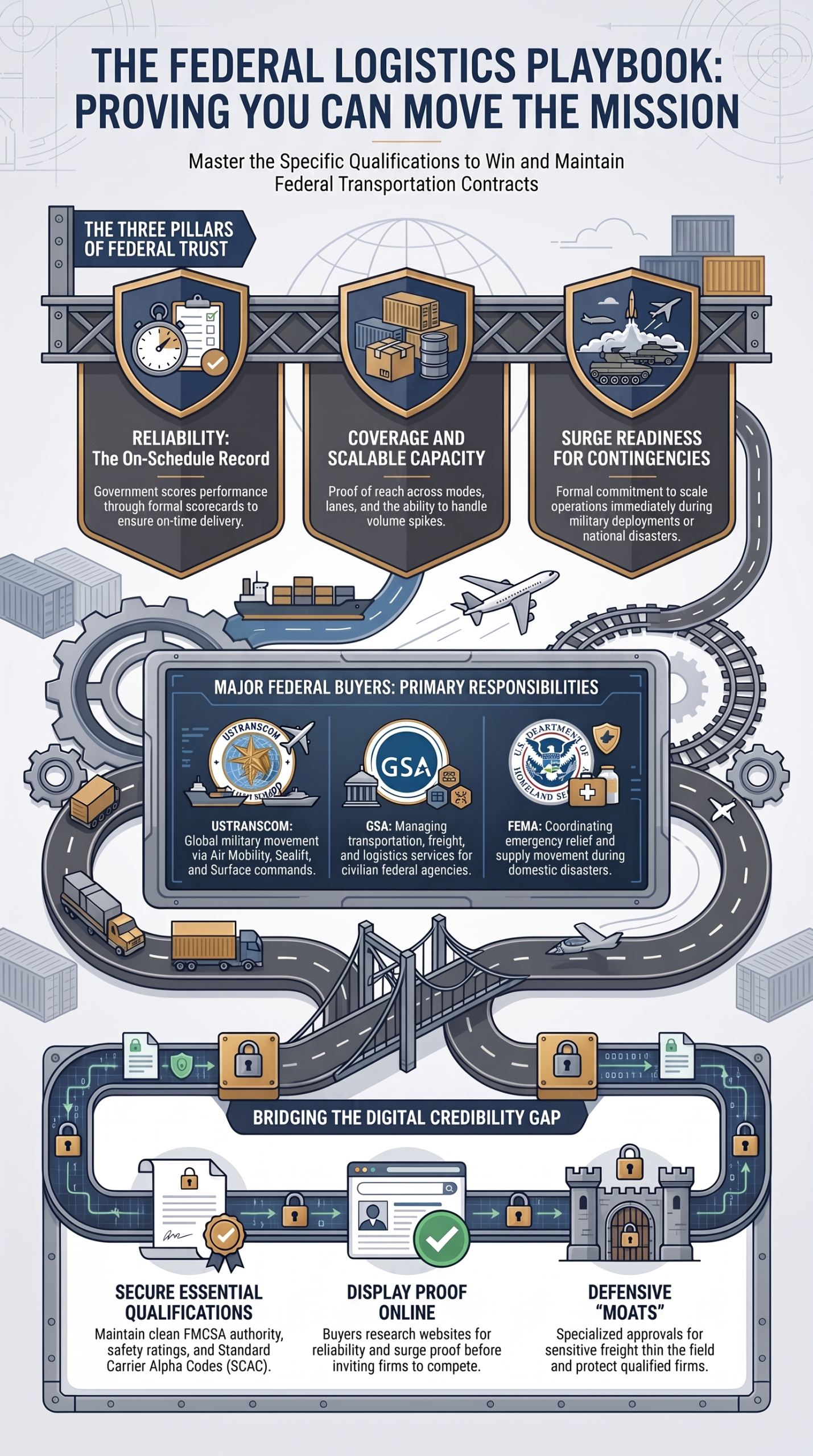
Table of Contents
- The Federal Logistics Mission: Everything, Everywhere, On Schedule
- Who Buys: The Agencies That Move the Government
- How the Work Is Bought: Task Orders, Tenders, and Set Asides
- The Modes: What the Government Ships and How
- Getting Qualified to Haul: Authority, Safety, and DoD Approval
- Reliability: The On Schedule Record That Wins Work
- Coverage and Capacity: Proving Reach Across Lanes and Modes
- Surge Readiness: The Civil Reserve Fleet and the Contingency Mission
- The Digital Credibility Gap: Why Your Website Decides the Task Order
- The Logistics Playbook: Putting Reliability, Coverage, and Surge on Display
I spent thirty years inside the federal government, across the Navy, the FBI, the Department of Homeland Security, and the National Security Agency, and I watched reliable carriers and logistics firms lose federal work they were fully able to perform. They did not lose because they could not move the freight. They lost because the government could not tell, before the competition, that they were reliable, that they had the reach, and that they could surge when it mattered. In federal logistics the proof is what wins, and the firms that show it capture far more than the firms that simply run good trucks and clean operations.
What follows is written for the carrier or logistics firm that wants to grow, to move from commercial freight into government work, or to climb from subcontractor to prime. It covers who moves the government, how the work is bought, what it takes to qualify, and the one thing that puts a firm’s reliability, coverage, and surge readiness in front of the people who choose. Let me walk through all of it.
Chapter 1. The Federal Logistics Mission: Everything, Everywhere, On Schedule
No shipper in the world moves on the scale the federal government does. In peacetime it sustains military bases and forces across the country and around the globe, keeps supply chains flowing, moves personnel and household goods, delivers fuel, and carries the materials of every agency. In a crisis it surges troops, equipment, and relief to wherever they are needed, on timelines a commercial customer never faces. Movement is not a support function for the government. It is a mission in its own right.
The Department of Defense alone runs a global transportation enterprise, and the civilian agencies move their own cargo, mail, and supplies on top of it. Around all of it sits a national freight system of ports, rail, highways, and inland waterways that the government both uses and invests in, and recent infrastructure funding has poured into the freight infrastructure that carries this movement. The demand is enormous, it is continuous, and it comes with a surge dimension no private market can match.
The work also concentrates in places. It clusters around the major ports and the strategic seaports that move military cargo, around the rail and highway corridors that carry freight inland, around the distribution centers and depots that store and stage supplies, and around the installations and agencies that generate the demand. The federal and defense markets where that movement concentrates are mapped across the regional market pages, and a firm that understands where the freight flows can position itself along the lanes that matter most.
For a carrier or a logistics firm, the meaning is direct. There is a vast and steady market for moving the government’s freight, and a firm that can serve it well can build a durable book of work. What decides whether a firm captures that work is not whether it can haul a load. It is whether it can prove, to a government that partners only with firms it trusts, that it is reliable, capable of reaching where the cargo goes, and ready to scale when the mission demands. That is what the rest of this guide is about.
Chapter 2. Who Buys: The Agencies That Move the Government
Federal transportation is concentrated in a handful of major buyers, and knowing who moves the government shapes how a firm should pursue the work.
The Defense Transportation Enterprise
The United States Transportation Command, established in 1987 and headquartered at Scott Air Force Base, is the single manager for defense transportation, responsible for moving the military by air, land, and sea in peace, crisis, and war. It works through three component commands. Air Mobility Command provides strategic airlift, aerial refueling, and aeromedical evacuation. Military Sealift Command provides sealift and ocean transportation with a fleet of civilian crewed ships and by chartering commercial vessels. The Surface Deployment and Distribution Command manages surface movement by road, rail, and inland waterway, along with port operations and the program that moves service members’ household goods. Alongside them, the Defense Logistics Agency runs the supply and distribution backbone that keeps the force stocked.
The Civilian and Emergency Buyers
Beyond defense, the General Services Administration manages transportation and freight for civilian agencies, the Federal Emergency Management Agency moves relief in disasters, and agencies across the government contract for their own transportation, warehousing, and distribution. Much of what the government moves is the supplies and materials that flow through this system, which is why the distinction between transportation and the broader supply chain often blurs. A firm that understands which buyer it is pursuing, and how that buyer moves its cargo, is a firm that can position itself where the work is.
The scale of these buyers is worth sitting with. The defense transportation enterprise alone moves cargo far beyond most commercial operations, and it does so continuously, year in and year out, with the volume rising sharply whenever forces deploy or a crisis unfolds. For a firm, that means the government is not an occasional customer to chase but a standing market to build a business around, provided the firm can meet its standards and prove it belongs.
Chapter 3. How the Work Is Bought: Task Orders, Tenders, and Set Asides
Federal transportation work is bought through several channels at once, and a firm that understands them knows where to compete.
Task Orders, Tenders, and Vehicles
A great deal of the work flows through indefinite delivery contracts under which an agency awards a master contract and then issues task orders for specific movement, warehousing, or distribution needs. Getting onto the right vehicle, and then competing well for its task orders, is often the real path to steady work. Alongside these vehicles, much government freight moves through tenders and rate filings, in which carriers offer their rates and capacity on defined lanes and the government selects among them, and through the General Services Administration’s transportation programs and the logistics and transportation management services that support them. A firm has to know which of these channels carries the work it wants.
Set Asides and Teaming
The government reserves a share of its transportation work for small businesses and for firms holding particular certifications through the Small Business Administration, including firms owned by socially and economically disadvantaged individuals, firms in historically underutilized business zones, women owned firms, and service disabled veteran owned firms. These certifications are not required to compete on open work, and a firm should pursue one only when it genuinely qualifies, but for a firm that does they open real lanes, and the current rule is that these program set asides require formal certification through the Small Business Administration rather than self certification. Teaming and subcontracting round out the paths in, letting a smaller carrier perform under a larger prime while building its own record.
The lesson across all of these channels is that federal transportation work is not a single door but many. A vehicle and its task orders, a rate tender on a lane, a set aside a firm qualifies for, a place on a larger team, each is a distinct path in, and firms across the sector directory of government work find their way through different combinations of them. The firms that grow pursue several paths at once rather than waiting for a single open competition to come to them.
Chapter 4. The Modes: What the Government Ships and How
The government moves its cargo across every mode, and a firm should understand where it fits and what each mode demands.
Land, Air, and Sea
Trucking carries the largest share of domestic government freight, in both full truckload and less than truckload movement, and it is the entry point for many firms. Rail carries heavy and bulk cargo over long distances, often as part of a multimodal move. Air freight moves urgent and high value cargo, handled by military airlift and by commercial carriers under contract. Ocean and sealift move the heavy equipment and sustainment cargo that cross oceans, carried by government ships and by chartered commercial vessels. Intermodal movement stitches these together, handing a shipment from one mode to the next across a single journey.
Warehousing and Distribution
Beyond movement itself, the government relies on warehousing, distribution, and third party logistics to store, manage, and position its materials, work that overlaps with the facilities and operations that keep government sites running. A firm may specialize in a single mode or offer several, and it may move freight with its own assets or arrange it through partners. What matters is that a firm knows its lane, can prove it performs there, and presents itself clearly to the buyers who need that capability.
The practical point is to be honest about which modes and services a firm truly delivers, and excellent at them, rather than claiming a breadth it cannot back. The government would rather find a carrier that is outstanding on its lanes than one that promises everything and proves nothing.
Chapter 5. Getting Qualified to Haul: Authority, Safety, and DoD Approval
Before a firm can move government freight, it has to be qualified, and the qualifications are specific to this industry. They are the gate that separates the firms that can compete from the firms that cannot.
Authority, Safety, and Identification
A motor carrier needs operating authority from the Federal Motor Carrier Safety Administration, tracked through its department of transportation and motor carrier numbers, and it needs a safety rating that is not unsatisfactory or conditional, since a poor rating closes the door to government freight. It also needs a Standard Carrier Alpha Code, the short letter code issued by the National Motor Freight Traffic Association that identifies a carrier across government and industry systems, with a separate code for each mode a firm registers. These are the basic credentials that let a carrier be recognized and trusted to haul.
Direct DoD Approval and Sensitive Freight
To work directly with the military rather than through a broker, a carrier registers through the Surface Deployment and Distribution Command’s carrier program, which generally requires several years of operating authority in good standing, cargo insurance, and a performance bond. Sensitive cargo raises the bar further. Moving arms, ammunition, and explosives, or other protected and sensitive shipments, requires an asset based carrier with special qualification, and brokers, freight forwarders, and non asset firms are restricted from handling it. Hazardous materials add their own permits and standards. A firm that earns these qualifications gains access to work that unqualified competitors simply cannot pursue.
It is worth seeing these qualifications the way a prepared firm does, not as obstacles but as a moat. Every credential that is demanding to obtain is a credential that thins the field of competitors. The carrier that does the work to hold clean authority, a strong safety standing, the right codes, and the approvals for sensitive freight competes against a far smaller pool for that work than it would for open commercial freight. The barrier that keeps others out is the same barrier that protects the firm that clears it.
Chapter 6. Reliability: The On Schedule Record That Wins Work
Here is the factor that matters most in federal logistics, and it is the first thing the hero of this whole effort turns on. The government moves everything on schedule, and it partners with firms it can count on, which means reliability is the currency of the entire market.
How Reliability Is Measured
The government does not take reliability on faith. It measures on time pickup and on time delivery, it records how a carrier performs against the terms of each movement, and it scores that performance formally through its evaluation systems and its carrier scorecards. A firm’s record follows it, and it shapes whether the firm keeps the work it has and wins more. A carrier that delivers on schedule, movement after movement, builds the strongest asset in this business, and one that misses loses standing quickly.
Reliability as a Reputation
Over time, reliability becomes a reputation, and reputation is what the government buys. Contracting officers and program managers talk, past performance records persist, and a firm known for delivering earns the benefit of the doubt in the next competition while a firm known for problems has to overcome its own history. Building and protecting a record of on schedule, on standard delivery is not one task among many. It is the core of a logistics firm’s standing with the government, and it deserves to be treated that way.
There is a compounding effect here that rewards patience. Each on schedule movement adds to a record, each strong evaluation strengthens the next proposal, and over years a firm that never stops delivering builds a body of proof a newer competitor cannot match at any price. Reliability is slow to build and fast to lose, which is exactly why the government trusts it as a signal. A firm that treats every load as a deposit into that record is building the one asset that compounds.
Chapter 7. Coverage and Capacity: Proving Reach Across Lanes and Modes
The second thing the government needs to see is reach. It moves cargo everywhere, so it partners with firms that can go where the freight needs to go and scale to the volume the mission requires.
Coverage
Coverage is the map of what a firm can serve: the lanes it runs, the regions it reaches, the modes it offers, and whether it can handle a movement from origin all the way to destination. A firm with broad, proven coverage can take on more of the government’s work, because it can solve more of the government’s problems. A firm with a narrow footprint competes only for the slice that fits it. Knowing and clearly presenting the true extent of its coverage is one of the most useful things a logistics firm can do.
Capacity
Capacity is the other half of reach: the scale a firm can bring to bear. That includes the assets it owns, the trucks, the equipment, and the space, and the partner and brokered capacity it can call on, along with its ability to add more as volume grows. The government needs to know that a firm will not be overwhelmed by the size of a requirement or the pace of a surge. A firm that can prove both broad coverage and real, scalable capacity presents itself as a partner the government can lean on for its larger and more demanding work.
The two together tell the government a simple story, that a firm can be handed a hard problem and solve it. A buyer with cargo that has to cross several regions and modes, or volume that spikes without warning, is looking for a partner that will not fold under either. A firm that has mapped its coverage honestly and knows the real limits of its capacity can speak to that with confidence, and confidence backed by proof is what moves a firm from a niche player to one the government reaches for first.
Chapter 8. Surge Readiness: The Civil Reserve Fleet and the Contingency Mission
The third thing that sets federal logistics apart, and the one with no commercial equivalent, is surge. When a contingency strikes, whether a conflict, a deployment, or a disaster, the government must move far more, far faster than any normal week demands, and it plans for that in advance with the transportation industry.
The Formal Surge Programs
The government maintains standing partnerships with commercial carriers built precisely for surge. Through the Civil Reserve Air Fleet, commercial airlines commit aircraft to augment military airlift when the need exceeds what military aircraft can carry, activated in stages as a contingency grows. Through the Voluntary Intermodal Sealift Agreement, commercial operators give the government assured access to ships flying the United States flag and to intermodal capacity in emergencies. Behind these sits the government’s own Ready Reserve Force of surge sealift ships. These programs let the nation reach far beyond its organic capacity by drawing on commercial industry when it counts.
The Domestic Surge Mission
Surge is not only a wartime matter. When disasters strike, the Federal Emergency Management Agency and its partners move relief, supplies, and equipment into affected regions on emergency timelines, and logistics firms that can respond quickly are part of that mission too. Whether a firm participates in a formal program or simply keeps the capacity and the plans to scale on short notice, being able to show surge readiness offers the government something it values deeply, because the moment it needs to surge is the moment it can least afford a partner who cannot.
What surge readiness really signals is trust under pressure. Any firm can look capable on a quiet day. The government wants to know what a firm will do on the worst day, when the volume triples and the timeline collapses, and a firm that can point to a plan, a track record, or a formal commitment to surge is answering the question that matters most. It is the clearest way a logistics firm can prove it understands what serving the government actually means.
Chapter 9. The Digital Credibility Gap: Why Your Website Decides the Task Order
Here is the piece most carriers and logistics firms are missing, and it explains why reliable operators keep losing work to firms that run no better. Every buyer, evaluator, and prime described in this guide now does the same thing before a firm is ever invited into a task order competition: they research it online.
What the Verification Looks For
That research maps directly onto the three things the government cares about. Can this firm show a record of reliable, on schedule delivery. Does it have the coverage across lanes and modes to reach where the cargo goes. Can it scale, and is it ready to surge when a contingency demands. Does it hold the authority, the safety standing, and the qualifications to haul. A firm that presents all of this clearly earns a place in the competition. A firm that is hard to find, or thin on proof, or that reads like a purely commercial carrier gets passed over, and it usually never learns it was even considered.
The Messaging Problem
The deeper issue is messaging. Most carriers and logistics firms present themselves the way they would to a commercial shipper, leading with the services and language that market expects. A government buyer is reading for something else: a record of reliability, proven coverage and capacity, surge readiness, and the qualifications federal freight requires. The firm often has all of it and simply never shows it to the audience that decides. Closing that gap is what a purpose built federal contractor website does: it puts a firm’s reliability, coverage, and surge readiness on display in the terms a government buyer reads for, before the first task order competition ever opens. The trucks and the ships were never the question. Whether the people choosing the carriers can see that you can be counted on is.
Chapter 10. The Logistics Playbook: Putting Reliability, Coverage, and Surge on Display
Pulling it together, here is what a carrier or logistics firm that wants to win government work should do, and where the digital piece fits.
Prove Reliability
Lead with your record. Present your on time performance, your history on comparable government or commercial movement, and the evaluations and references that show you deliver on schedule. Reliability is what the government buys, and it should be the first thing a buyer sees.
Show Coverage and Capacity
Map your reach plainly: the lanes and regions you serve, the modes you offer, and whether you handle movement from origin to destination. Then show your scale, the assets and the partner capacity you can bring, and your ability to grow with the work. Make it easy for a buyer to see that you can go where the cargo goes and handle the volume.
Document Surge and Qualifications
Show that you are ready to scale when it counts, through any formal programs you take part in or the capacity and plans you keep for short notice. And put your qualifications on display: your operating authority, your safety standing, your carrier code, and any sensitive freight approvals you hold. These are the credentials that let a buyer trust you with the load.
Reshape the Message and Start Now
Shift the firm’s story from a commercial carrier to a proven government logistics partner, in the language federal buyers read for, and present it so that a contracting officer, a prime, and a program manager each find what they need. A firm that pairs genuine logistics and transportation capability with a presence that proves reliability, coverage, and surge readiness is positioned to win. The government is moving freight around the clock, everywhere, right now, and it is choosing the firms it can count on. A credible federal contractor website is what makes sure your firm is one it can see and trust to deliver.
I help carriers and logistics firms put their reliability, coverage, and surge readiness on display, so that the government can see, before the first task order competition, that the firm can be counted on to move the mission. If you are ready to compete for federal transportation work, this is where it starts.
Authoritative Sources
The following sources inform the facts in this guide. Web addresses were current at the time of writing and should be verified for the latest information, since programs, requirements, and terms change over time.
Air Mobility Command. (n.d.). Air Mobility Command. U.S. Air Force. https://www.amc.af.mil/
Defense Logistics Agency. (n.d.). DLA. U.S. Department of Defense. https://www.dla.mil/
Federal Emergency Management Agency. (n.d.). Logistics. U.S. Department of Homeland Security. https://www.fema.gov/
Federal Motor Carrier Safety Administration. (n.d.). Registration and operating authority. U.S. Department of Transportation. https://www.fmcsa.dot.gov/
Maritime Administration. (n.d.). National defense reserve fleet and sealift programs. U.S. Department of Transportation. https://www.maritime.dot.gov/
Military Surface Deployment and Distribution Command. (n.d.). SDDC. U.S. Army. https://www.sddc.army.mil/
National Motor Freight Traffic Association. (n.d.). Standard Carrier Alpha Code (SCAC). https://nmfta.org/
U.S. Congress. (2024). Defense primer: United States Transportation Command. Congressional Research Service. https://www.congress.gov/
U.S. General Services Administration. (n.d.). Transportation and logistics. https://www.gsa.gov/
U.S. Small Business Administration. (n.d.). Contracting assistance programs. https://www.sba.gov/
U.S. Transportation Command. (n.d.). USTRANSCOM. U.S. Department of Defense. https://www.ustranscom.mil/
U.S. Department of the Treasury. (n.d.). USAspending.gov. https://www.usaspending.gov/
Explore your field in the sector directory, or browse the regional market pages to see where government buyers concentrate across the country.