

Bottom Line Up Front
Defense and aerospace is the most scrutinized market in government contracting, and it is moving in two directions at once. Spending has been running at record levels while the supplier base underneath it keeps thinning. The department’s own competition reporting found that the number of small businesses in the defense industrial base fell by more than forty percent over a decade, and warned it could lose roughly fifteen thousand more suppliers if the trend held. Meanwhile the prime tier has consolidated dramatically, and a large share of contract dollars now concentrates among a small number of vendors.
That combination is the opportunity. Buyers have money to place, fewer known suppliers to place it with, and rising pressure to justify every teaming and award decision. What they do not have is patience for firms they cannot verify. I spent three decades inside the national security community, and I can tell you how evaluation actually starts: quietly. A prime’s capture manager, a contracting officer’s market research, a teaming partner’s due diligence. They pull up your firm online and decide fairly quickly whether you look like a performer or a risk.
This guide covers how the defense and aerospace market works, who buys, the compliance gates that now decide eligibility, and how a firm proves it is contract ready, compliant, and worth a seat on the team. A credible federal contractor website is where mission credibility gets established before the first meeting. Read it as a playbook for surviving that quiet check.
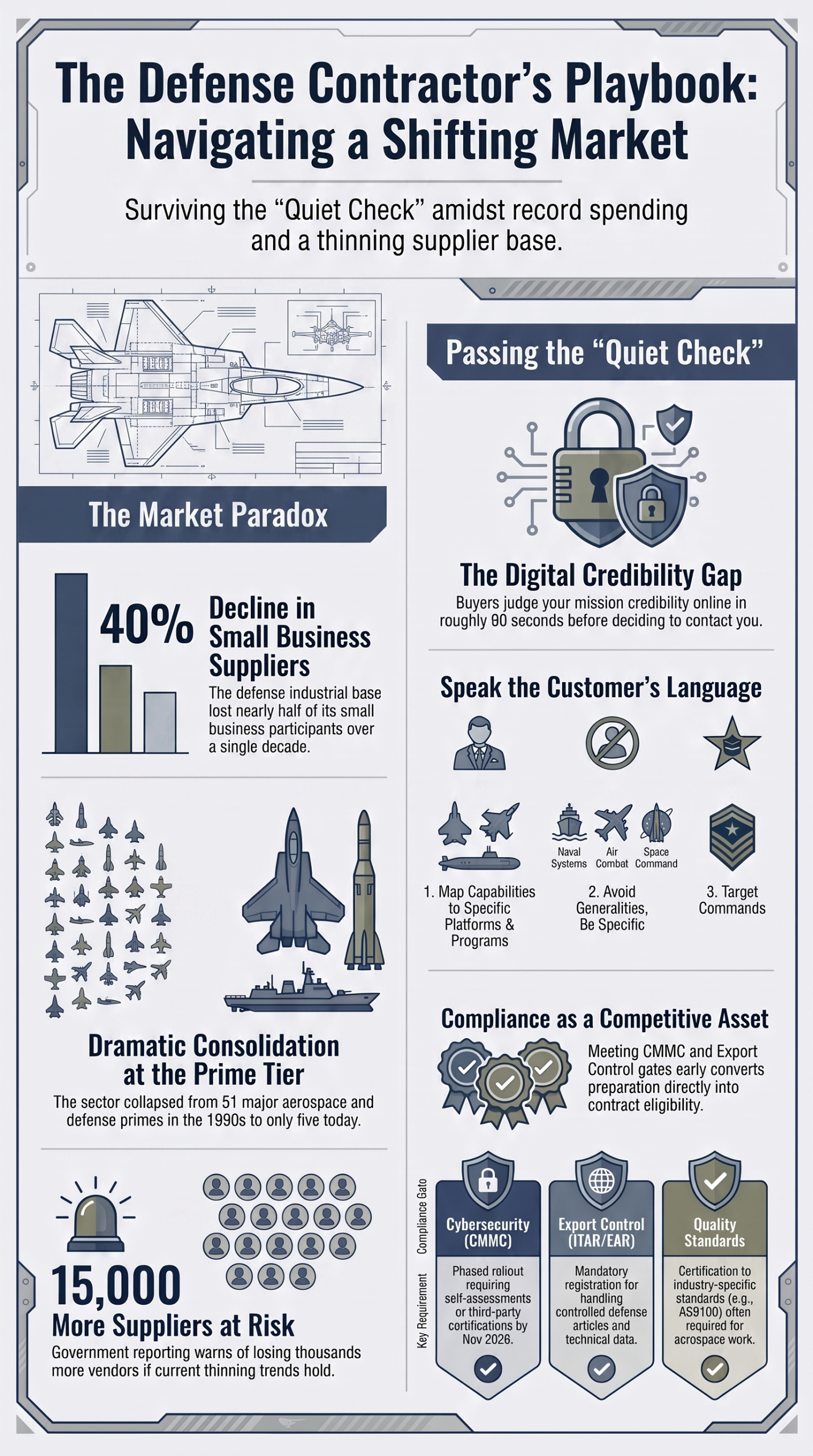
Table of Contents
- The Defense and Aerospace Market: Record Spending, Fewer Suppliers
- Who Buys: The Government and the Primes Above You
- What Defense and Aerospace Contractors Provide
- How the Work Is Bought: Programs, Vehicles, and Innovation Pathways
- Contract Ready: Capability a Capture Manager Can Map in Seconds
- Compliant: The Gates That Decide Eligibility
- Worth a Seat on the Team: Past Performance and Teaming Value
- Set Asides and the Opening Created by a Thinning Supplier Base
- The Digital Credibility Gap: They Check You Out Long Before They Call
- The Defense Contractor’s Playbook: Proving Readiness, Compliance, and Value
I spent thirty years inside the federal government, across the Navy, the FBI, the Department of Homeland Security, and the National Security Agency, and I have sat in the rooms where a contractor’s credibility gets judged. I know what government professionals look for when they size up a firm, and I know how much of that judgment happens before anyone picks up a phone. I also watched capable defense and aerospace firms lose work they could plainly have performed. They did not lose on engineering. They lost because a capture manager could not map them to a requirement, could not confirm their compliance posture, and could not find the delivery record that would have made the case for them.
What follows is written for the machine shop, the component manufacturer, the systems engineering firm, the sustainment provider, the software or mission systems developer, or the specialized supplier that wants to grow into defense work, or to move from commercial and aerospace clients into serving the mission. It covers how the market works, who actually buys, the gates that now decide who is eligible, and the one thing that shows primes, program offices, and source selection teams that your firm is contract ready, compliant, and worth a seat on the team. Let me walk through all of it.
Chapter 1. The Defense and Aerospace Market: Record Spending, Fewer Suppliers
Understanding this market starts with a contradiction that shapes every opportunity in it. The money is growing at the top while the industrial base underneath keeps shrinking.
Defense contract spending has been running at record levels, with the general scale of that spending visible at public reporting sites like USASpending.gov. But the supplier base has moved the other way. The department’s own reporting on competition within the defense industrial base found that the number of small businesses in that base declined by more than forty percent over the preceding decade, and it warned that continuing along the same path could cost roughly fifteen thousand additional suppliers over the following ten years, which it framed as a national security and economic risk. Independent analysis of prime contract vendor counts has shown a similar direction, with the total number of vendors falling by roughly a quarter over about a decade.
At the prime tier, the consolidation has been dramatic. The same departmental reporting noted that since the 1990s the sector went from roughly fifty one aerospace and defense prime contractors to five, leaving the government increasingly dependent on a small number of firms for critical capabilities, and a large share of contract dollars now concentrates among a small group of top vendors. For a contractor, this is the central strategic fact of the market. The government is worried about its supplier base, is actively trying to widen it, and has money to place. What it needs is to find firms it can verify quickly, which is precisely where most capable suppliers make themselves hard to find.
It is worth drawing the practical conclusion out. In a market with fewer suppliers and more money, the scarce resource is not opportunity, it is trust. A program office that has watched its supplier options narrow has every incentive to qualify a new firm, and every reason to be careful about which one. That means the barrier facing a capable newcomer is rarely the work itself. It is the absence of anything a buyer can point to when explaining why they took a chance on a firm nobody upstream had heard of.
Chapter 2. Who Buys: The Government and the Primes Above You
This market has two buying layers, and a firm that understands only one of them is competing with half a strategy.
The Government Layer
The Defense Department is the largest buyer, working through the military departments, the combatant commands, and the defense agencies, with program offices doing the actual buying for the systems they manage. On the aerospace side, the space and civil aviation authorities buy their own research, systems, and services. One naming point is worth knowing, because a firm will encounter both terms and should not be confused by them: an executive order signed in September 2025 authorized the Defense Department to use Department of War as a secondary title in public communications and correspondence, while the name set in statute remains the Department of Defense unless Congress changes it, which it has not. Contractors will see both in circulation, and the practical guidance is to follow whatever a given solicitation or customer uses.
The Prime Layer
The layer most firms actually enter through is the prime contractor. Major programs run through a tiered supply chain, and a prime’s capture manager, supply chain organization, and program leadership function as buyers in their own right, selecting the subcontractors and suppliers who will fill out a team. For a smaller firm, this often matters more than the government relationship, because the first real evaluation comes from a prime deciding whether to put you on a bid. Primes also carry flowdown obligations, meaning the compliance requirements imposed on them travel to you, which is why a prime’s diligence on a potential partner has grown noticeably stricter. Selling into this market means being legible to both layers at once.
Chapter 3. What Defense and Aerospace Contractors Provide
The category spans an enormous range, and a firm should be precise about where it sits.
Platforms, Components, and Sustainment
At one end sit the platforms and the hardware behind them: aircraft, ships, ground vehicles, munitions, space systems, and the components, assemblies, castings, forgings, electronics, and specialty materials that go into them, which is where defense work overlaps directly with manufacturing and supply. Alongside production runs sustainment, which is often the larger and steadier business: maintenance, repair, and overhaul, depot work, spares and supply support, field service, and the logistics that keep fielded systems running for decades after delivery.
Engineering, Technology, and Program Support
The other end is knowledge work. Systems engineering, test and evaluation, modeling and simulation, mission systems, and the software that increasingly defines what a platform can do, much of which grows out of research and development contracts and laboratory work. Around all of it sits program support, the acquisition, financial, and program management help that program offices buy as professional services to run their portfolios. A firm may occupy one niche or several, but every buyer is asking the same question: can this firm perform, and can I prove it to the people who will ask me why I chose them.
Chapter 4. How the Work Is Bought: Programs, Vehicles, and Innovation Pathways
Defense buying runs through several routes at once, and knowing which one applies changes how a firm should position itself.
Programs, Vehicles, and Subcontracts
Major systems are bought through structured acquisition programs, managed by program offices and governed by an acquisition framework that offers different pathways depending on what is being bought, from full major capability acquisition down to faster routes intended for software and for capability that needs to field quickly. Much of the rest flows through multiple award contracts and the task orders issued under them, where a firm competes once for a position and then again for each order. And a large share of the market never touches a government contract directly at all, because it arrives as a subcontract from a prime. For most firms entering defense, that subcontract path is the realistic first step, and it is won by being visible and verifiable to the primes assembling teams.
The Innovation Pathways
There is also a deliberate side door. The department holds authority to enter other transaction agreements, which sit outside standard procurement contracts and exist specifically to let the government work with firms that do not normally do business with it, along with innovation organizations and consortia built to reach commercial technology companies. These pathways were created in direct response to the industrial base problem described earlier, and they are the most accessible entry point for a technically strong firm without a long federal history. What they do not remove is the verification burden. A nontraditional firm still has to demonstrate that it can deliver and that it can meet the security and quality conditions the mission requires.
A word of realism about these pathways is in order, because they are often oversold. They shorten the contracting mechanics, not the qualification. A firm still has to show it can perform, protect information, and meet quality expectations, and the diligence it faces may be less formal but is no less real. What the pathways genuinely change is who gets a hearing. A firm with strong technology and no federal history is no longer automatically outside the conversation, provided it can be found and verified when someone goes looking.
Chapter 5. Contract Ready: Capability a Capture Manager Can Map in Seconds
This is the first thing the hero of this whole effort names, and it is the most common failure in the sector. Primes and program offices are not browsing when they look you up. They are verifying, and they are working against a deadline.
Speak in the Customer’s Language
A capture manager building a team has a requirement in front of them and a short list of candidates to fill it. They need to know which platforms, programs, commands, and mission areas your firm actually understands, stated in the language the customer uses rather than in your own internal vocabulary. A supplier that describes itself as a precision manufacturer serving demanding industries has told them nothing. A supplier that names the platforms it has produced for, the specifications it works to, and the programs it has supported can be mapped to a requirement immediately. Generalities force a busy evaluator to do translation work on your behalf, and they will not do it when the next candidate has already done it for them.
Make the Mechanics Visible
Being contract ready also means the administrative reality of buying you is obvious. Your contract vehicles and schedule positions, your classification codes, your registration identifiers, and your socioeconomic certifications should all be visible without a phone call, because each one answers a question a contracting officer or a prime would otherwise have to ask. These details feel like paperwork to an engineer and read as green lights to a buyer. A firm that publishes them removes friction from a decision that is already competing for attention, and in market research, friction is what quietly eliminates candidates who were otherwise qualified.
Chapter 6. Compliant: The Gates That Decide Eligibility
The second thing the hero names is compliance, and in defense it has stopped being a back office concern. Several requirements now function as gates that determine whether a firm can compete at all, and primes check them before they team.
The Cybersecurity Gate
The Cybersecurity Maturity Model Certification program is the most consequential recent change for the defense industrial base. The acquisition rule took effect on November 10, 2025, which made the requirement contractually enforceable, and applicable solicitations now carry it as a condition of award. The rollout runs in phases. The first phase brought self assessments at the lower levels, with scores posted to the government’s supplier performance system and contracting officers checking them before award. The second phase, beginning November 10, 2026, requires certification assessments performed by an authorized third party for applicable work involving controlled unclassified information, and primes are expected to flow those requirements down to subcontractors. Underneath it sits the standard for protecting controlled unclassified information on contractor systems and the safeguarding and incident reporting duties written into defense contract clauses, which is where this connects to broader information technology and cybersecurity practice. Because assessment capacity is limited and preparation commonly takes many months, the practical deadline sits well ahead of the published one, and any firm should confirm the specific requirement against the language of the solicitation it is pursuing.
Export Control, Quality, and Clearances
Three other gates matter. Export control is the one firms most often stumble into: defense articles and technical data are controlled, manufacturers, exporters, and brokers of those articles generally must register with the State Department office that administers the rules, and a firm handling controlled technical data carries real obligations about who may see it, including employees and foreign persons. Quality systems are the second, since aerospace work commonly requires certification to the industry quality management standard, with additional accreditation expected for special processes, and a supplier without the right certification is simply not qualified for the work. Facility and personnel clearances are the third, and they take time that cannot be compressed once a requirement is live. Publishing your posture on all of these, plainly and currently, is what lets a prime’s diligence proceed instead of stalling. State status, never internals.
The strategic reading is that compliance has become a competitive asset rather than an overhead cost. A firm that reaches the required posture ahead of the schedule can pursue work its unprepared competitors are ineligible to touch, and it can say so publicly while they cannot. It also becomes materially easier to team with, because a prime carrying flowdown obligations would rather add a partner who already meets them than one who promises to. Preparation bought early converts directly into eligibility, and eligibility converts into invitations.
Chapter 7. Worth a Seat on the Team: Past Performance and Teaming Value
The third thing the hero names is being worth a seat on the team, and it rests on two things: what you have delivered, and what you bring that the team does not already have.
Past Performance Written to Be Cited
Your delivery record is your strongest argument, and most defense firms bury it. Source selection teams and prime capture managers want the customer or prime, the mission area, the scope, the period of performance, and the outcome, in a form they can scan and cite, not a line of client names on an about page. All of it has to be written within releasability limits, which is a genuine constraint here, but the constraint is workable. A firm can state the mission area, the scale, and the result accurately without naming what it cannot name, and doing that well is itself a signal of judgment that a defense buyer notices. Alongside your own account sits the formal record the government keeps of contractor performance, which follows a firm from one competition to the next.
What You Bring to a Team
Teaming value is the other half, and it is the part firms most often leave unstated. A prime assembling a bid is solving for gaps: a capability it lacks, a certification it needs, cleared capacity it cannot spare, a socioeconomic status that helps it meet subcontracting commitments, or a vehicle position it does not hold. A firm that states plainly what it brings to a team makes itself easy to slot into someone else’s pursuit. Small firms win seats by removing every reason for a capture manager to hesitate, and hesitation almost always comes from something the capture manager could not confirm rather than something they learned and disliked.
The habit that makes this sustainable is capturing the record as programs close, while the scope, the dates, and the results are still at hand and the people who ran the work are still there. Firms that postpone it end up reconstructing history years later from memory and invoices, and what they recover is thinner and vaguer than what actually happened. The delivery was real either way. Only one version of it can be shown to someone deciding whether to put your firm on a bid.
Chapter 8. Set Asides and the Opening Created by a Thinning Supplier Base
The structural problem described at the start of this guide is, from a contractor’s point of view, an opening.
The Programs
The department buys heavily from small business and sets goals for doing so, and the certification programs, the ones for firms owned by socially and economically disadvantaged individuals, for service disabled veteran owned firms, for women owned firms, and for firms in historically underutilized business zones, all carry weight in defense buying. Prime contractors on large awards carry subcontracting commitments of their own, which means they have an active reason to find qualified small suppliers, not merely a regulatory one. There are also development programs pairing smaller firms with established ones to build capability over time. Firms across the sector directory of federal work find their way in through the certifications and partnerships that fit them.
Why the Moment Favors Prepared Firms
What makes this more than the usual set aside discussion is the context. The government has publicly identified the shrinking supplier base as a risk to national security, it is actively trying to widen participation, and its own reporting says so plainly. Primes need qualified partners to meet their commitments. Program offices need alternatives to single sources. That is a demand signal pointed directly at capable suppliers who are currently invisible. The firms that benefit will be the ones that are easy to find, easy to verify, and clearly eligible, which returns the question to whether a firm has done the work of making itself checkable.
Chapter 9. The Digital Credibility Gap: They Check You Out Long Before They Call
Here is the piece most defense and aerospace firms are missing, and it is exactly what the hero of this whole effort turns on. Verification now happens before conversation.
The Quiet Check
A prime’s capture manager, a contracting officer conducting market research, a teaming partner performing due diligence: each of them looks you up, and each of them reaches a judgment quickly about whether your firm reads as a performer or a risk. They are looking for mission credibility, capability they can map, compliance posture, and a delivery record. When that evidence is easy to find, you advance. When it is missing, they move to the firm where it is not, and you will never know the evaluation happened. There is a financial dimension to this that leadership feels directly, because every pursuit burns bid and proposal money that disappears into a submission folder, while a credibility focused presence turns that same capture work into an asset that keeps working between pursuits instead of resetting to zero.
The Messaging Problem
The deeper issue is messaging. Many firms in this sector present themselves the way a commercial supplier would, leading with quality language and facility photographs. A defense buyer is reading for something else: which platforms and mission areas you understand, what your compliance posture is, what you have delivered, and what you would bring to a team. The firm usually has all of it, sitting in proposals, quality manuals, and closed programs that were never turned into public evidence. Closing that gap is what a purpose built federal contractor website does: it presents readiness, compliance, and delivery the way primes and evaluators check them. The capability was never the question. Whether a stranger can confirm it, in the ninety seconds before they decide, is.
Chapter 10. The Defense Contractor’s Playbook: Proving Readiness, Compliance, and Value
Pulling it together, here is what a defense or aerospace firm that wants to grow should do, and where the digital piece fits.
Prove Readiness and Compliance
Name the platforms, programs, commands, and mission areas you support, in the customer’s language, with service lines a capture manager can map to a requirement in seconds. Publish your vehicles, classification codes, registration identifiers, and certifications so the path to buying you is obvious. Then state your compliance posture plainly and keep it current: your certification phase and assessment status, your alignment with the standard for protecting controlled information, your export control registration where it applies, your quality certifications, and your facility and personnel clearance depth where releasable. State status, not internals.
Prove Delivery and Teaming Value
Build a past performance library written for scanning and citation, with customer type, mission area, scope, period, and outcome, all inside your releasability limits. Then say plainly what you bring to a team, because primes are solving for gaps and the firm that names its contribution is the firm that gets called. Make the diligence effortless and you will be on lists you never knew existed.
Start Now
Spending is at record levels, the supplier base has thinned, the government has said publicly that it wants that reversed, and the compliance gates are tightening on a published schedule that rewards firms who prepare early. A firm that pairs genuine defense and aerospace capability with a presence proving it is contract ready, compliant, and worth a seat on the team is positioned to be found and chosen. Capture managers and contracting officers are checking firms right now, and a credible federal contractor website is what makes sure yours survives the check. The regions where this work concentrates are mapped across the regional market pages.
I translate complex defense and aerospace work into the credibility, capability, compliance, and past performance signals that buyers, primes, and evaluators actually check, built on a platform you own. If you are ready to compete for defense work, this is where it starts.
Authoritative Sources
The following sources inform the facts in this guide. Web addresses were current at the time of writing and should be verified for the latest information. Certification requirements and acquisition rules in this sector are changing on published schedules, so confirm any requirement against the actual language of the solicitation you are pursuing.
Acquisition.gov. (n.d.). Federal Acquisition Regulation and Defense Federal Acquisition Regulation Supplement. https://www.acquisition.gov/
Defense Counterintelligence and Security Agency. (n.d.). Industrial security, facility clearances, and personnel vetting. https://www.dcsa.mil/
Office of the Department of Defense Chief Information Officer. (n.d.). Cybersecurity Maturity Model Certification program. https://dodcio.defense.gov/
U.S. Department of Defense. (2022). State of Competition Within the Defense Industrial Base. https://www.defense.gov/
U.S. Department of Defense, Office of Small Business Programs. (n.d.). Small business programs and subcontracting. https://business.defense.gov/
U.S. Department of State, Directorate of Defense Trade Controls. (n.d.). International Traffic in Arms Regulations and registration. https://www.pmddtc.state.gov/
U.S. Department of Commerce, Bureau of Industry and Security. (n.d.). Export Administration Regulations. https://www.bis.gov/
National Institute of Standards and Technology. (n.d.). Special Publication 800 series. https://www.nist.gov/
National Aeronautics and Space Administration. (n.d.). NASA acquisition and procurement. https://www.nasa.gov/
U.S. Government Accountability Office. (n.d.). Defense acquisition and contracting reporting. https://www.gao.gov/
U.S. Small Business Administration. (n.d.). Contracting assistance programs. https://www.sba.gov/
System for Award Management. (n.d.). SAM.gov. https://sam.gov/
Contractor Performance Assessment Reporting System. (n.d.). CPARS. https://www.cpars.gov/
U.S. Department of the Treasury. (n.d.). USAspending.gov. https://www.usaspending.gov/
Explore your field in the sector directory, or browse the regional market pages to see where government buyers concentrate across the country.