

Bottom Line Up Front
The rebuild of American infrastructure is the largest run of public construction work in generations, funded across federal, state, and local buyers and running for years rather than months. For a government construction contractor ready to compete, the pipeline is deep and it is already flowing.
Winning that work is not a matter of the low bid. Federal construction is awarded on proof: past performance, safety record, capacity, financial and bonding strength, and disciplined delivery. Every one of those is now checked online before the site visit and before the shortlist, which means a firm’s website decides whether an evaluator or a prime ever takes it seriously.
This guide covers how federal construction is bought, who buys it, what evaluators check first, the bonding and safety gates that stop unprepared firms, the compliance rules that disqualify the careless, the set aside paths that open competition, and why a credible federal contractor website is what puts your delivery record where the people who award the work can see it. Read it as a playbook for proving you can build.
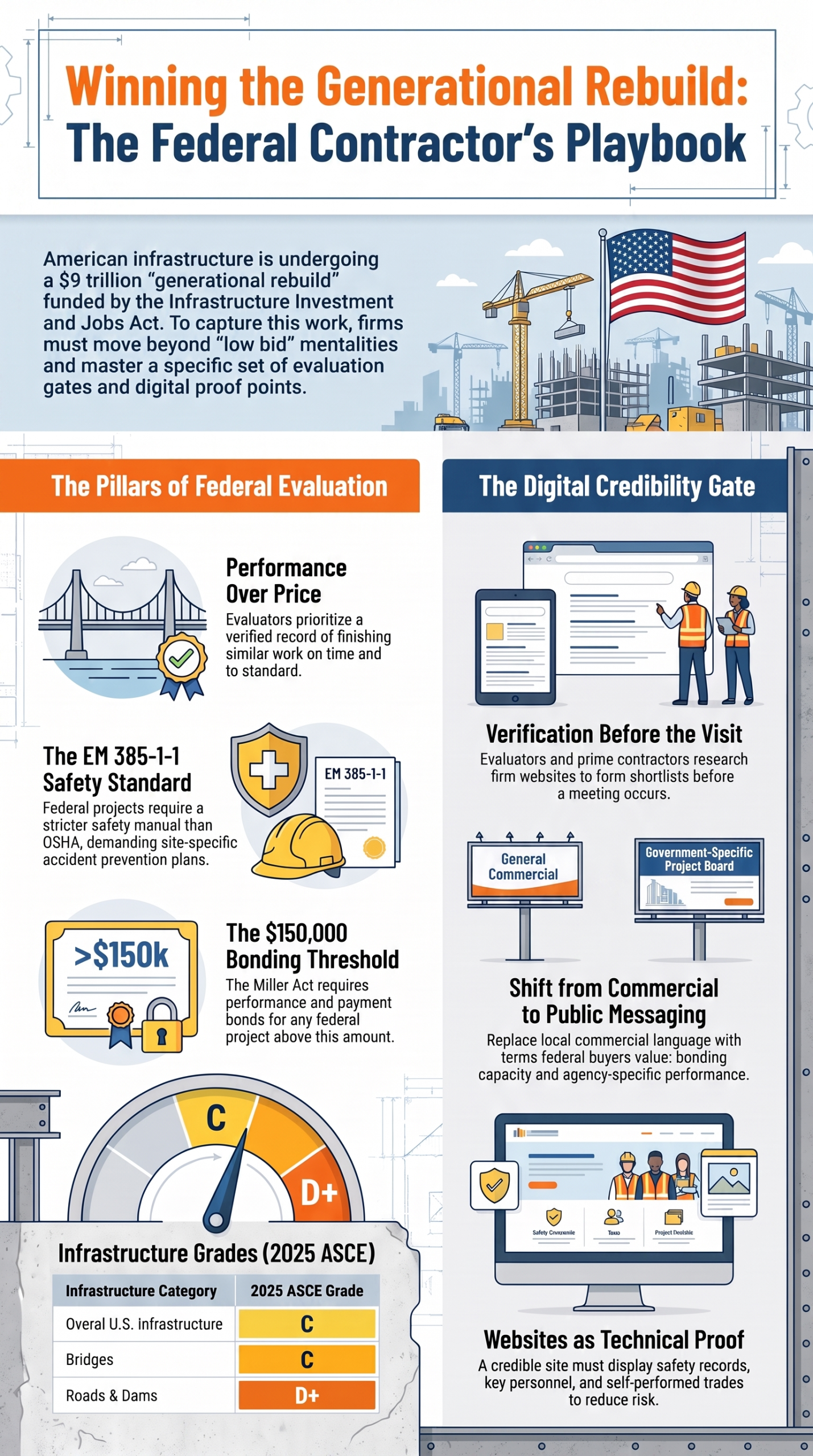
Table of Contents
- The Construction Opportunity: A Generational Rebuild
- How Government Construction Is Bought: Methods and Vehicles
- Who Buys: The Federal Construction Agencies
- What Evaluators Check First: Performance, Safety, Capacity, Strength
- Bonding and Surety: The Gate Most Firms Underestimate
- Safety as a Qualification: EM 385-1-1 and a Record That Wins
- Compliance: Wages, Domestic Sourcing, and the Rules That Trip Firms
- Set Asides, Certifications, and the Joint Venture Path
- The Digital Credibility Gap: Why Your Website Decides the Shortlist
- The Contractor’s Playbook: Putting Delivery on Display
I spent thirty years inside the federal government, across the Navy, the FBI, the Department of Homeland Security, and the National Security Agency, and I watched capable construction firms lose federal work they were fully able to perform. They did not lose on price. They lost because they could not prove, to an evaluator who had never met them, that they would deliver the job safely, on schedule, and to standard. In federal construction the proof is the product, and the firms that master it win far more than the firms that simply build well.
What follows is written for the government construction contractor that wants to grow, to move from local and commercial work into federal projects, or to climb from subcontractor to prime. It covers how the work is bought, who buys it, what decides an award, the gates that stop the unprepared, and the one thing that puts a firm’s record in front of the people who choose. Let me walk through all of it.
Chapter 1. The Construction Opportunity: A Generational Rebuild
The condition of American infrastructure is a matter of record. Every four years the American Society of Civil Engineers grades it, and in 2025 the country earned an overall C, its highest mark since the report began in 1998 and an improvement over the C minus of 2021. Read past the headline and the need is plain. Bridges hold a C. Roads sit at D plus. Dams sit at D plus. The engineers who assess this work estimate that bringing all of it to good repair would take on the order of nine trillion dollars of investment, a figure I cite as an approximation from the 2025 assessment and one worth confirming against the source directly.
Behind that need is money. The Infrastructure Investment and Jobs Act of 2021 committed the largest federal infrastructure investment in generations, and state and local spending has followed it. For the federal buyer this shows up as a sustained pipeline of construction: military construction on installations, the civil works and water projects of the U.S. Army Corps of Engineers, facility sustainment and restoration across agencies, veterans hospitals, federal courthouses and buildings, and the federal share of the nation’s highways. The work runs for years, and it is spread across the country.
The reach of it is easy to underestimate. Federal construction is not concentrated in one region or one kind of project. It runs from coastal installations to inland arsenals, from urban federal buildings to remote water works, and the federal and defense markets where it concentrates are mapped across the regional market pages. Wherever a firm is based, there is public construction demand within reach, and a firm that studies its own territory can pursue it deliberately.
For a government construction contractor, the meaning is direct. There has rarely been a deeper or more durable market for public building and heavy civil work, and it reaches the whole range of the trade, from vertical building to heavy civil and transportation projects. The demand is funded and it is real. What remains is proving your firm can capture it, which is what the rest of this guide is about.
Chapter 2. How Government Construction Is Bought: Methods and Vehicles
Federal construction is governed by its own rules, chiefly Part 36 of the Federal Acquisition Regulation, and it is bought through several delivery methods and contract vehicles. A firm that understands which one a buyer is using knows how to position itself, because each rewards a different strength.
The Delivery Methods
In the traditional design bid build method, the agency provides a completed design and contractors compete on a sealed bid, with the award generally going to the lowest responsive and responsible bidder. In the design build method, a single firm is responsible for both design and construction, and the award turns on technical merit, approach, and past performance rather than price alone. Construction manager at risk and other collaborative approaches add further options. The shift toward design build and best value selection matters, because it rewards firms that can prove capability, not just firms that can post the lowest number.
The Contract Vehicles
A great deal of federal construction now flows through indefinite delivery vehicles, under which an agency awards a master contract and then issues task orders for individual projects over several years. Job order contracting uses a catalog of priced tasks and adjustment factors for recurring maintenance and repair. Multiple award task order contracts and multiple award construction contracts pre qualify a pool of firms that then compete for individual task orders, and they tend to carry larger, more complex work and higher bonding demands. Single award task order vehicles are often friendlier to smaller firms. Getting onto the right vehicle, directly or through a partner, is frequently the real gate to a steady stream of work.
The practical takeaway is to read each opportunity for the method behind it. A sealed bid job rewards a sharp, accurate price and the proven ability to bond and perform. A best value design build rewards a firm that can show design capability, a strong technical approach, and a record of similar work. A task order under a vehicle rewards the firm that earned its place on that vehicle in the first place. Matching the pursuit to the firm’s real strengths is how a contractor spends its bidding effort where it can actually win.
Chapter 3. Who Buys: The Federal Construction Agencies
Federal construction is concentrated in a handful of major buyers, and knowing which one a firm is pursuing shapes everything from the standards it must meet to the way it should present itself.
The Major Federal Buyers
The U.S. Army Corps of Engineers is one of the largest construction agencies in the world, delivering military construction for the Army and the Air Force along with a vast portfolio of civil works, water resources, and flood control. The Naval Facilities Engineering Systems Command builds and maintains the shore facilities of the Navy and Marine Corps. The Air Force Civil Engineer Center manages Air Force construction and infrastructure. The General Services Administration, through its Public Buildings Service, builds and maintains federal buildings and courthouses. The Department of Veterans Affairs runs its own program for hospitals and medical facilities. Each of these buyers has its own standards, its own vehicles, and its own way of evaluating firms.
The State and Local Tiers
Below the federal tier sits an enormous volume of state and local construction: the state departments of transportation that build and maintain highways and bridges, the counties and municipalities that own local infrastructure and public buildings, and the school districts, transit authorities, and special districts that build for their communities. A firm that pursues work across the federal, state, and local tiers builds a broader and steadier book than one that depends on any single source, and the engineering and environmental partners it works with often span all three.
Chapter 4. What Evaluators Check First: Performance, Safety, Capacity, Strength
Here is the truth that reshapes how a firm should compete. Federal construction, outside the pure low bid, is awarded on far more than price. A best value evaluation scores a firm on whether it can actually deliver, and four factors carry most of the weight.
Past Performance
Past performance is often the single most important factor. Evaluators review a firm’s record on comparable projects through the government’s performance reporting system, through past performance questionnaires sent to prior clients, and through the narratives a firm submits. A record of finishing similar work on time, on budget, and to standard is the strongest asset a construction firm has, and it is the first thing an evaluator wants to see.
Safety, Capacity, and Financial Strength
Safety comes next, and on federal work it is close to pass or fail, judged by a firm’s incident history and its insurance experience rating. Capacity follows: the key personnel, the equipment, the trades a firm can self perform, and its proven ability to staff and manage a project of the size at hand. Financial and bonding strength rounds it out, since a firm has to show it can carry the work and secure the bonds the contract requires. An evaluator weighing these four is asking one question, whether this firm can be trusted to deliver, and the firm that answers it convincingly wins.
What makes these factors demanding is that they are weighed together, not in isolation. A firm with a spotless safety record but no comparable past performance still struggles, and so does a firm with a strong record but thin capacity for the size of the job. The strongest competitors are balanced across all four and can prove each one on demand. That is why assembling and maintaining the evidence, the performance history, the safety data, the personnel and equipment records, and the financial and bonding documentation, is not busywork. It is the raw material of every competitive proposal a firm will ever write.
Chapter 5. Bonding and Surety: The Gate Most Firms Underestimate
No requirement stops more construction firms from scaling into federal work than bonding, and none is more misunderstood. It deserves its own chapter because a firm’s bonding capacity sets the ceiling on the work it can pursue.
What the Law Requires
The Miller Act requires a prime contractor on a federal construction contract above a set threshold to provide both a performance bond and a payment bond before the contract is awarded. The Federal Acquisition Regulation implements that threshold at roughly one hundred fifty thousand dollars for construction, and for sealed bid work a bid bond is generally required as well. In plain terms, above the threshold there is no bond and no bid. The bonds themselves typically cost a small percentage of the contract value.
Bonding Capacity and How to Grow It
Behind the bond stands a surety, and the surety decides how much bonding a firm can carry based on its finances, its track record, and the strength of its management. That bonding capacity is a hard ceiling: a firm cannot bid work it cannot bond. Growing it is one of the central tasks of scaling, and it comes from a clean financial house, a record of completed projects, and a surety relationship built over time. For smaller firms, the Small Business Administration operates a surety bond guarantee program that helps them secure bonds they could not obtain on their own. A firm that treats bonding capacity as something to build deliberately, rather than a wall it keeps hitting, is a firm on its way up.
It helps to see bonding as a relationship rather than a transaction. A surety that knows a firm, understands its finances, and has watched it complete projects will extend more capacity than one meeting the firm for the first time. That is why contractors invest in the surety relationship the way they invest in their banking relationship, sharing clean financials, strong project records, and capable management, so that when a larger opportunity appears the bonding is there to pursue it.
Chapter 6. Safety as a Qualification: EM 385-1-1 and a Record That Wins
On federal and defense construction, safety is not a formality. It is a qualification a firm either meets or does not, and it is scrutinized before and during every project.
The Federal Safety Standard
Most construction in the country answers to the standards of the Occupational Safety and Health Administration, but federal and defense work administered by the Corps of Engineers and the Navy answers to a stricter one: the Corps of Engineers Safety and Health Requirements Manual, known as EM 385-1-1, whose most recent edition was issued in 2024. It is often more demanding than the baseline, requiring detailed accident prevention plans, activity hazard analyses for each phase of work, a designated site safety and health officer, and daily inspections and documentation. A firm pursuing this work has to be able to plan, staff, and document safety to that level.
Safety as a Competitive Edge
Beyond meeting the standard, a firm’s safety record is a factor evaluators weigh, read through its insurance experience rating and its incident history. A strong record signals a disciplined operation that will not create delays, injuries, or liabilities on a federal site, and a weak one raises exactly the opposite worry. Safety is both the ticket to the work and one of the clearest proofs a firm can offer that it runs its projects the way the government needs them run.
The documentation itself is a signal. A firm that can produce a thorough, site specific accident prevention plan, run and record activity hazard analyses, and staff a qualified safety officer is showing that it operates with the discipline federal work demands. Buyers know that a firm which takes safety planning seriously tends to take schedule, quality, and cost seriously too. In that sense a safety program is a window into how a firm runs everything else, which is why evaluators read it so closely.
Chapter 7. Compliance: Wages, Domestic Sourcing, and the Rules That Trip Firms
Federal construction carries a set of compliance requirements that have no commercial equivalent, and missing one can cost a firm the contract or worse. Discipline with these rules is part of what makes a firm trustworthy to a federal buyer.
Prevailing Wages
The Davis-Bacon Act requires contractors on federal construction above a low threshold to pay their workers the local prevailing wages determined by the Department of Labor, with a specific wage determination for each project by location and trade, and to document it through certified payroll. Getting this wrong is not a paperwork slip. Violations can lead to withheld payment, termination, and debarment from federal work.
Domestic Sourcing and Federal Clauses
Domestic sourcing rules add another layer. Buy American requirements, and the newer Build America Buy America provisions tied to the infrastructure law, set standards for the domestic content of the materials used on federally funded projects. Along with these come the many other clauses the Federal Acquisition Regulation flows into a construction contract. None of this is beyond a prepared firm, but all of it demands attention, and the firm that handles it cleanly signals to a buyer that it can be trusted with the rest of the work.
The pattern across all of these rules is the same. Federal construction assumes a contractor who takes compliance as seriously as it takes the build itself, and the firm that shows that discipline, in its paperwork and in its record, earns a trust that price alone can never buy.
Chapter 8. Set Asides, Certifications, and the Joint Venture Path
The government reserves a large share of its construction work for small businesses and for firms holding particular certifications, which opens competition to firms that master the paths into it.
Certifications and Set Asides
Through the Small Business Administration, firms owned by socially and economically disadvantaged individuals, firms in historically underutilized business zones, women owned firms, and service disabled veteran owned firms can qualify for work set aside for that status, competing against a smaller field. These certifications are not required to bid on open work, and a firm should pursue one only when it genuinely qualifies, but for a firm that does, they open real lanes. A current point worth knowing is that these program set asides require formal certification through the Small Business Administration rather than self certification.
Joint Ventures and Subcontracting Plans
The joint venture is one of the most powerful tools in federal construction. The Small Business Administration allows a mentor and a smaller partner to form a joint venture that can pursue work neither could win alone, letting a smaller firm perform on larger projects while building its own record. On the other side, larger contracts require a small business subcontracting plan, which drives prime contractors to bring qualified smaller firms onto their teams. Between set asides, joint ventures, and subcontracting, there are more paths into federal construction than most firms realize, and the facilities and specialty firms that understand them find steady footing.
The point is that federal construction is not a single door but many, and a firm should map the ones open to it. A certification it qualifies for, a joint venture with the right partner, a place on a subcontracting team, a spot on a vehicle, each is a distinct path, and firms across the sector directory of public construction, from general contractors to specialty trades, find their way in through different combinations of them. The firms that scale pursue several of these paths at once rather than betting everything on open competition.
Chapter 9. The Digital Credibility Gap: Why Your Website Decides the Shortlist
Here is the piece most construction firms are missing, and it explains why capable builders keep losing to firms that build no better. Every evaluator, contracting officer, and prime described in this guide now does the same thing before the site visit and before the shortlist is set: they research the firm online.
What the Verification Looks For
That research is specific, and it maps directly onto the factors that decide an award. Can this firm show relevant past performance on projects like ours. Is its safety record strong. Does it have the capacity, the key personnel, and the bonding to carry the work. Does it look like a disciplined, established operation or a risk. A firm that presents all of this clearly earns a closer look and a place on the shortlist. A firm that is hard to find, or thin on proof, or that reads like a purely local commercial builder gets set aside, and it usually never learns it was a candidate at all.
The timing is what firms miss. By the time a contracting officer or a prime picks up the phone or schedules a visit, the online research is already done and the shortlist is already forming. A firm cannot make its case in a meeting it is never invited to. The web presence is not a brochure that supports the real selling. For federal construction it is often the first round of selection, and a firm that treats it as an afterthought concedes that round before it begins.
The Messaging Problem
The deeper issue is messaging. Most construction firms present themselves the way they would to a private developer or a local owner, leading with the kind of projects and language that market expects. A federal evaluator is reading for something else entirely: past performance on public work, a documented safety program, capacity and bonding, and the discipline to handle federal requirements. The firm often has all of it and simply never shows it to the audience that matters. Closing that gap is what a purpose built federal contractor website does: it puts a firm’s past performance, safety record, capacity, and project discipline on display in the terms a federal evaluator and a prime read for, before the first site visit ever happens. The building was never the question. Whether the people awarding the work can see that you can build it is.
Chapter 10. The Contractor’s Playbook: Putting Delivery on Display
Pulling it together, here is what a government construction contractor that wants to win should do, and where the digital piece fits.
Lead With the Record
Put your past performance first. Present completed projects with the agency, the scope, the size, the schedule performance, and the outcome, so an evaluator can see that you have delivered work like theirs. Your record is your strongest argument, and it should be the easiest thing to find.
Show Safety, Capacity, and Bonding
Make the qualifications an evaluator scores visible and plain: a documented safety program and a strong safety record, the key personnel and equipment and self performed trades that show capacity, and the bonding strength that proves you can carry the work. These are the factors that decide awards, and a firm that displays them removes the doubt before it forms.
Reshape the Message and Build for Every Buyer
Shift the firm’s story from a local commercial builder to a proven public works contractor, in the language federal buyers read for, and present it so that an agency evaluator, a prime looking for a subcontractor, and a state or local owner each find what they need. A firm that pairs genuine construction and infrastructure capability with a presence that proves it serves every one of those audiences at once, whether it self performs or relies on trusted trades like precast producers, is positioned to win across all of them.
Start Now
The rebuild is underway, funded, and running across every level of government. The construction firms that scale during it will be the ones evaluators and primes can find, verify, and trust to deliver, and that trust is built on a credible federal contractor website that puts your record, your safety, your capacity, and your discipline on display. The projects are being awarded right now. The work is making sure the people choosing the builders can see that your firm delivers.
I help government construction contractors put their past performance, safety record, capacity, and project discipline on display, so that agencies, primes, and evaluators can see, before the first site visit, that the firm can deliver the work. If you are ready to compete for federal projects, this is where it starts.
Authoritative Sources
The following sources inform the facts in this guide. Web addresses were current at the time of writing and should be verified for the latest information, since thresholds, standards, and program terms change over time.
American Society of Civil Engineers. (2025). 2025 report card for America’s infrastructure. https://infrastructurereportcard.org/
Contractor Performance Assessment Reporting System. (n.d.). CPARS. U.S. General Services Administration. https://www.cpars.gov/
Naval Facilities Engineering Systems Command. (n.d.). NAVFAC. U.S. Department of the Navy. https://www.navfac.navy.mil/
U.S. Army Corps of Engineers. (2024). Safety and health requirements manual (EM 385-1-1). https://www.usace.army.mil/
U.S. Congress. (2021). Infrastructure Investment and Jobs Act (Public Law 117-58). https://www.congress.gov/
U.S. Department of Labor, Occupational Safety and Health Administration. (n.d.). Construction industry. https://www.osha.gov/
U.S. Department of Labor, Wage and Hour Division. (n.d.). Davis-Bacon and related acts. https://www.dol.gov/
U.S. Department of Veterans Affairs, Office of Construction and Facilities Management. (n.d.). Construction and facilities management. https://www.va.gov/
U.S. General Services Administration, Public Buildings Service. (n.d.). Public Buildings Service. https://www.gsa.gov/
U.S. General Services Administration. (n.d.). Federal Acquisition Regulation, Parts 28 and 36. https://www.acquisition.gov/
U.S. Small Business Administration. (n.d.). Surety bond guarantee program. https://www.sba.gov/
U.S. Department of the Treasury. (n.d.). USAspending.gov. https://www.usaspending.gov/
Explore your field in the sector directory, or browse the regional market pages to see where government buyers concentrate across the country.