

Bottom Line Up Front
The federal government runs the largest healthcare enterprise in the country. The Veterans Health Administration alone operates well over a thousand facilities as the nation’s largest integrated health system, the Defense Health Agency runs care for service members and their families, and the agencies of Health and Human Services carry the public health, research, and regulatory mission. The demand for medical staffing, services, supplies, and technology is vast and it never pauses.
But health missions do not gamble on unknown vendors. When patient care is on the line, federal health buyers choose firms they can trust, and they judge them on three things: compliance, whether you meet the privacy, credentialing, and quality standards healthcare demands; staffing capability, whether you can recruit, credential, and field qualified clinical people; and patient impact, whether your work improves outcomes and serves the mission. Every one of those is now checked online before the first conversation.
This guide covers who buys federal health, how the work is bought, and how a firm proves the compliance, staffing capability, and patient impact that win the trust of health buyers. A credible federal contractor website is what puts that proof in a form a health buyer can verify before ever picking up the phone. Read it as a playbook for earning trust before the first call.
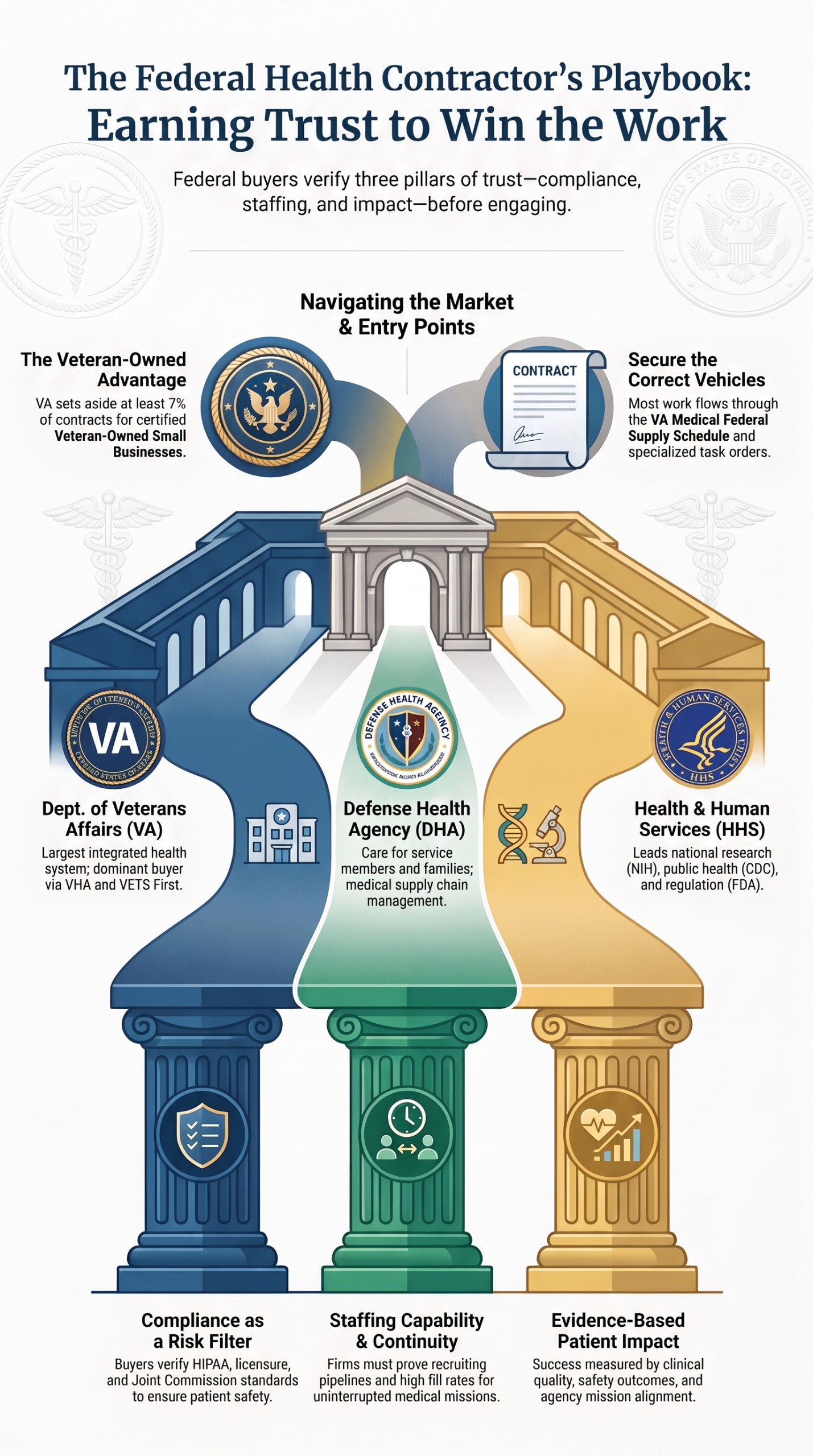
Table of Contents
- The Federal Health Mission and Market
- Who Buys: The Federal Health Agencies
- What Federal Health Contractors Provide
- How the Work Is Bought: Schedules, Vehicles, and Task Orders
- Compliance: HIPAA, Credentialing, and the Standards Health Buyers Require
- Staffing Capability: Recruiting, Credentialing, and Filling the Need
- Patient Impact: Quality, Outcomes, and Mission Alignment
- Set Asides, the Veteran Owned Advantage, and Teaming
- The Digital Credibility Gap: Why Your Website Decides the First Conversation
- The Health Contractor’s Playbook: Putting Compliance, Staffing, and Impact on Display
I spent thirty years inside the federal government, across the Navy, the FBI, the Department of Homeland Security, and the National Security Agency, and I watched capable healthcare and medical firms lose federal work they were fully able to perform. They did not lose because they could not deliver care. They lost because a health buyer could not verify, before committing, that the firm was compliant, that it could field qualified clinical staff, and that its work would hold up where patient safety was on the line. In federal health the proof is what earns trust, and trust is what wins the work.
What follows is written for the healthcare or medical firm that wants to grow, to move from commercial or clinical work into federal health, or to climb from subcontractor to prime. It covers who buys federal health, how the work is bought, what compliance and capability the buyers require, and the one thing that puts a firm’s compliance, staffing, and patient impact in front of the people who choose. Let me walk through all of it.
Chapter 1. The Federal Health Mission and Market
The scale of federal healthcare is hard to overstate. The Veterans Health Administration is the largest integrated health system in the United States, operating well over a thousand medical centers, hospitals, and community clinics that serve millions of veterans. The Defense Health Agency runs the care for service members and their families across a network of military treatment facilities. The agencies of Health and Human Services carry the nation’s research, public health, and regulatory work. Taken together, this is one of the largest and most complex healthcare buying enterprises in the world.
That enterprise generates continuous demand across every part of the field. It buys medical staffing to fill clinical positions, contracts for services from telehealth to specialty care, purchases medical and surgical supplies, pharmaceuticals, and equipment, and acquires the technology that runs modern healthcare. Its facilities are aging and its modernization needs are large, which adds to the work. For a healthcare or medical firm, the federal market is deep, durable, and spread across the country.
That reach is worth understanding. Federal healthcare is delivered wherever veterans, service members, and communities live, from major medical centers in large metropolitan areas to clinics on remote installations and in rural regions, and the federal and defense markets where it concentrates are mapped across the regional market pages. A firm that knows where the facilities and the buyers are can focus its effort where the demand for its capability is greatest.
What sets it apart from commercial healthcare is what the buyer cares about first. A federal health buyer is a mission organization, and its first concern is not price but patient care: whether a vendor is safe, compliant, capable, and aligned with the mission of caring for the people it serves. That is why health missions do not gamble on unknown vendors, and it is why proving compliance, capability, and impact matters more here than almost anywhere else. The rest of this guide is about how a firm does that.
Chapter 2. Who Buys: The Federal Health Agencies
Federal health spending is concentrated in a handful of major buyers, and knowing who they are and how they buy shapes how a firm should pursue the work.
The Department of Veterans Affairs
The Department of Veterans Affairs, through its Veterans Health Administration, is the dominant federal health buyer. Its contracting runs through the Office of Procurement, Acquisition and Logistics and its National Acquisition Center, and much of its buying authority is distributed across regional networks known as Veterans Integrated Service Networks, each with its own contracting offices. The VA also manages a medical Federal Supply Schedule and national contract programs that other federal health agencies buy through, which makes the VA both a buyer and a gateway to the wider federal health market.
Defense Health, Health and Human Services, and Indian Health
The Defense Health Agency, which completed taking over the military treatment facilities from the individual services in 2022, buys care and support for service members and their families, while the Defense Logistics Agency handles much of the medical supply chain for those facilities. Across Health and Human Services, the National Institutes of Health drives medical research and development, the Centers for Disease Control and Prevention lead public health, the Food and Drug Administration handle regulation, and the Centers for Medicare and Medicaid Services run the largest health programs in the country. The Indian Health Service provides care to Native communities and adds its own Buy Indian preferences. Each of these buyers has its own priorities, vehicles, and standards.
The practical lesson is that these are not interchangeable customers. Selling to a VA network is not the same as selling to a defense health office or a research agency, and a firm that treats them as one market misreads all of them. Each has its own way of buying, its own priorities, and its own standards for the vendors it trusts. A firm that learns the specific buyer it is pursuing, and shapes its approach to that buyer, competes far more effectively than one that broadcasts a generic message at the whole of federal health.
Chapter 3. What Federal Health Contractors Provide
Federal health buyers contract for a wide range of work, and a firm should understand where it fits in that range.
People, Services, and Supplies
Medical staffing is one of the largest categories, as buyers contract for physicians, nurses, and allied health professionals to fill clinical needs across their facilities. Beyond staffing, firms deliver clinical services from primary and specialty care to telehealth and behavioral health, and they supply the medical and surgical products, pharmaceuticals, and devices that healthcare runs on, the manufacturing and supply side of the field.
Technology, Research, and Support
Health technology is a growing category of its own, including electronic health records and the health information systems that sit alongside broader IT and cybersecurity work, where the security of patient data is paramount. Firms also provide research and laboratory services, and a wide range of support work: case management, medical records and coding, biomedical equipment maintenance, and the operation of health facilities. A firm may specialize in a single category or offer several, but in every case the buyer wants to see that the firm can deliver it safely and to standard.
The breadth of this work is one reason federal health rewards focus. A firm rarely wins by claiming to do everything. It wins by being demonstrably strong in a defined lane, whether that is a clinical specialty, a category of supply, a technology, or a support function, and firms across the sector directory of federal work find their place through that kind of focus. Knowing exactly what a firm does well, and proving it, matters more than the length of a capabilities list.
Chapter 4. How the Work Is Bought: Schedules, Vehicles, and Task Orders
Federal health work is bought through several channels at once, and a firm that understands them knows where to compete.
Schedules and Prime Vendor Programs
The VA’s medical Federal Supply Schedule is a central channel, offering pre negotiated pricing on a large catalog of medical products and services and serving as a preferred, and for many categories effectively mandatory, source. For many suppliers, getting onto that schedule, directly or through a partner, is the prerequisite for broad adoption across the VA and other federal health agencies. Alongside it, prime vendor and national contract programs move medical and surgical supplies through just in time distribution, and the General Services Administration’s schedules and government wide vehicles carry professional services and technology.
Task Orders, Agreements, and Registration
Much federal health work flows through indefinite delivery contracts and blanket purchase agreements, under which an agency awards a master vehicle and then issues task or delivery orders for specific needs. Getting onto the right vehicle, and competing well for its orders, is often the real path to steady work. Programs for care in the community extend the reach of federal health beyond government facilities. Underneath all of it, a firm has to be registered in the government’s award management system and has to watch the individual network contracting offices where much of the work is posted. Knowing which channel carries the work a firm wants is half the battle.
There is a sequence to this that prepared firms follow. They register and get their credentials in order, they identify the specific vehicles and schedules that carry their kind of work, they position themselves onto those vehicles directly or through a partner, and then they compete for the orders that flow through them. Skipping steps rarely works, because a buyer cannot easily award work to a firm that is not reachable through the channel the buyer uses. Understanding the path, and walking it in order, is what turns interest in the federal health market into actual contracts.
Chapter 5. Compliance: HIPAA, Credentialing, and the Standards Health Buyers Require
Here is the first thing a federal health buyer checks, and it is the first proof the hero of this whole effort names. Healthcare is one of the most heavily regulated fields there is, and a health buyer will not engage a firm it cannot trust to meet the standards that protect patients.
Privacy, Licensure, and Credentialing
The Health Insurance Portability and Accountability Act governs the privacy and security of protected health information, and a firm that handles that information usually does so as a business associate under a formal agreement, bound to safeguard it. Clinical work adds licensure, credentialing, and privileging: verifying that every clinician holds the required licenses, training, and competence, and granting the specific privileges to practice at a facility. These are not formalities. They are the mechanisms that keep unqualified or unsafe people away from patients, and a buyer expects a firm to manage them rigorously.
Accreditation, Data Security, and Facility Access
Beyond the individual, healthcare organizations are held to accreditation standards, most visibly through the Joint Commission, and clinical laboratories are certified under the Clinical Laboratory Improvement Amendments. Medical devices and drugs answer to the Food and Drug Administration. Health technology carries its own layer: the security rule that protects electronic health information, federal information security requirements, and an authority to operate for systems that touch government data, along with the defense data standards that apply where military health information is involved. Staff placed at federal facilities need background checks and, in some cases, security clearances. Compliance in federal health is not paperwork. It is patient safety, and it is the first thing a buyer verifies.
It is worth seeing compliance the way a health buyer does, as a filter rather than a formality. A buyer facing a vendor it cannot verify as compliant does not weigh the decision. It moves on, because the risk to patients and to the institution is not worth taking. That makes compliance a threshold a firm either clears or does not, and it makes the ability to demonstrate compliance clearly one of the most valuable things a health firm can offer. The firms that treat it as central, and can prove it at a glance, are the ones buyers feel safe engaging.
Chapter 6. Staffing Capability: Recruiting, Credentialing, and Filling the Need
The second proof a health buyer looks for is capability, and in much of federal health that means people. The government needs firms that can put qualified clinical staff where the care is delivered, and keep them there.
The Recruiting and Credentialing Pipeline
Staffing capability begins with recruiting: a firm has to be able to find qualified physicians, nurses, and allied health professionals in a market where clinical talent is scarce and competition for it is fierce. It continues with credentialing, the rigorous process of verifying each person’s qualifications before they ever reach a patient, and it depends on retention, because a firm that places staff only to lose them creates gaps the buyer feels. Much of this work is contracted as professional services, and a buyer judges a staffing firm on how well it manages the entire pipeline.
Fill Rates and Surge
Two measures matter most to the buyer. The first is the fill rate: whether a firm can actually staff the positions it is awarded, completely and on time, rather than leaving them open. The second is the ability to surge, because pandemics, disasters, and contingencies can demand a rapid mobilization of medical staff far beyond normal levels. A firm that can prove a strong recruiting pipeline, a disciplined credentialing process, a record of filling and holding positions, and the capacity to scale when needed is offering the buyer exactly the capability it depends on.
What a buyer is really buying, when it contracts for staffing, is continuity of care. An open position is not an abstraction. It is a clinic that cannot see as many patients, a service that runs short, a mission that slips. That is why buyers watch fill rates and retention so closely, and why a firm that reliably keeps positions covered earns standing that a firm with gaps never does. Dependable staffing is not a commodity in federal health. It is a capability the buyer counts on, and it deserves to be shown as one.
Chapter 7. Patient Impact: Quality, Outcomes, and Mission Alignment
The third proof, and the one that speaks most directly to a federal health buyer, is impact. These are mission organizations, and their purpose is caring for the people they serve.
Quality and Outcomes
A federal health buyer cares about results measured in patient terms: clinical quality, safety, outcomes, and the experience of the people receiving care. A firm that can point to its record on those measures, rather than simply listing the services it offers, is speaking the buyer’s language. Quality metrics, patient safety records, and demonstrated outcomes carry real weight in a field where the whole point of the work is the wellbeing of patients.
Serving the Mission
Beyond the numbers, federal health buyers want vendors who understand and share the mission, whether that is caring for veterans who served, for the service members and families who defend the country, for Native communities, or for the public. A firm that shows it grasps that mission, and that its work advances it, stands apart from a vendor that treats federal health as just another market. Impact is what a health mission exists to produce, and a firm that can demonstrate it earns a trust that a list of capabilities alone never will.
This is also where a firm can most clearly separate itself from its competitors. Many vendors can describe what they do. Far fewer can show what their work produced for patients, and fewer still can tie that to the mission the buyer serves. A firm that has gathered its outcomes, its quality data, and the stories of the difference its work made is holding something most competitors lack, and it is exactly what a mission driven buyer wants to see. Impact, documented and shown, is one of the strongest arguments a health firm can make.
None of this requires exaggeration, which matters in a field where claims are checked. It requires gathering what a firm has genuinely done and presenting it honestly and clearly, so a buyer can see the real record without having to dig for it.
Chapter 8. Set Asides, the Veteran Owned Advantage, and Teaming
Small business set asides run throughout federal health, and one advantage is unusually strong here because the Department of Veterans Affairs is the dominant health buyer.
The Veteran Owned Advantage
The VA runs a program, known as Vets First, that gives priority to veteran owned firms, setting aside at least seven percent of its contracts each year for certified veteran owned and service disabled veteran owned small businesses. Across the whole federal government, a goal reserves at least three percent of contracting dollars for certified service disabled veteran owned firms. Since January of 2023, that certification runs through the Small Business Administration’s Veteran Small Business Certification program rather than through the VA, and self certification is no longer accepted for these set asides. For a health firm owned by a qualifying veteran, this is one of the clearest paths into the federal health market there is.
Other Programs and Teaming
Other Small Business Administration programs apply as well, including those for firms owned by socially and economically disadvantaged individuals, firms in underutilized zones, and women owned firms, while the Indian Health Service adds Buy Indian preferences. A firm should pursue any certification only when it genuinely qualifies, but for one that does, the doors these open are real. Teaming and subcontracting round out the paths in, letting a smaller health firm perform under a larger prime while building the record that lets it stand on its own.
A word of realism belongs here. A certification opens a door, but it does not carry a firm through it. Buyers still expect the compliance, the capability, and the impact that the rest of this guide describes, and a set aside simply narrows the field a firm competes in. The strongest position is a firm that both qualifies for a valuable set aside and can prove it is excellent on the merits, so that when it competes in that narrower field, it wins on substance and not on status alone.
Chapter 9. The Digital Credibility Gap: Why Your Website Decides the First Conversation
Here is the piece most healthcare and medical firms are missing, and it is exactly what the hero of this whole effort turns on. Health missions do not gamble on unknown vendors, which means that before a health buyer ever has a first conversation with a firm, they research it online.
What the Verification Looks For
That research maps directly onto the three things a health buyer needs to trust. Does this firm demonstrate compliance, the privacy posture, the credentialing rigor, the accreditations and certifications that healthcare requires. Can it prove staffing capability, a recruiting pipeline, a credentialing process, a record of filling and holding positions. Does it show patient impact, real quality, outcomes, and alignment with the mission. A firm that presents all of this, verifiably, earns the conversation. A firm that is hard to find, or thin on proof, or that reads like a generic commercial vendor is passed over quietly, and it usually never learns it was even a candidate.
The Messaging Problem
The deeper issue is messaging. Most healthcare and medical firms present themselves the way they would to a commercial client or a clinical peer, leading with the services and language those audiences expect. A federal health buyer is reading for something else: verifiable compliance, proven staffing capability, demonstrated patient impact, and an understanding of the federal health mission. The firm often has all of it and simply never shows it to the audience that decides. Closing that gap is what a purpose built federal contractor website does: it puts a firm’s compliance, staffing capability, and patient impact in a form a health buyer can verify and trust before the first conversation. The care a firm can deliver was never the question. Whether the buyer can verify it before committing is.
Chapter 10. The Health Contractor’s Playbook: Putting Compliance, Staffing, and Impact on Display
Pulling it together, here is what a healthcare or medical firm that wants to win federal work should do, and where the digital piece fits.
Show Compliance
Make your compliance visible and verifiable. Present your privacy and data security posture, your credentialing and privileging rigor, and the accreditations and certifications your firm holds. A health buyer checks this first, so a firm that displays it plainly clears the highest bar before any conversation begins.
Show Staffing Capability and Patient Impact
Present your staffing capability in the terms a buyer measures: your recruiting reach, your credentialing process, your record of filling and holding positions, and your ability to surge. Then show your patient impact, the quality, outcomes, and safety that prove your work serves patients well, along with your understanding of the mission. These are the proofs that turn a capable firm into a trusted one.
Reshape the Message and Start Now
Shift the firm’s story from a commercial or clinical vendor to a proven federal health partner, in the language federal buyers read for, and present it so that a VA network, a defense health office, a research agency, and a prime contractor each find what they need. A firm that pairs genuine healthcare and medical capability with a presence that proves compliance, staffing, and impact is positioned to win. Federal health buyers are choosing vendors they can trust with patient care, right now, and a credible federal contractor website is what makes sure your firm is one they can verify and trust before the first call.
I help healthcare and medical firms put their compliance, staffing capability, and patient impact on display, in a form federal health buyers can verify and trust before the first conversation. If you are ready to compete for federal health work, this is where it starts.
Authoritative Sources
The following sources inform the facts in this guide. Web addresses were current at the time of writing and should be verified for the latest information, since programs, requirements, and standards change over time.
Centers for Medicare and Medicaid Services. (n.d.). Clinical Laboratory Improvement Amendments (CLIA). U.S. Department of Health and Human Services. https://www.cms.gov/
Defense Health Agency. (n.d.). Military Health System. U.S. Department of Defense. https://www.health.mil/
Indian Health Service. (n.d.). IHS. U.S. Department of Health and Human Services. https://www.ihs.gov/
National Institutes of Health. (n.d.). NIH. U.S. Department of Health and Human Services. https://www.nih.gov/
The Joint Commission. (n.d.). Accreditation and certification. https://www.jointcommission.org/
U.S. Department of Health and Human Services, Office for Civil Rights. (n.d.). HIPAA. https://www.hhs.gov/hipaa/
U.S. Department of Veterans Affairs. (n.d.). Office of Procurement, Acquisition and Logistics. https://www.va.gov/
U.S. Food and Drug Administration. (n.d.). FDA. U.S. Department of Health and Human Services. https://www.fda.gov/
U.S. Small Business Administration. (n.d.). Veteran Small Business Certification (VetCert). https://veterans.certify.sba.gov/
U.S. Small Business Administration. (n.d.). Contracting assistance programs. https://www.sba.gov/
U.S. General Services Administration. (n.d.). System for Award Management (SAM.gov). https://sam.gov/
U.S. Department of the Treasury. (n.d.). USAspending.gov. https://www.usaspending.gov/
Explore your field in the sector directory, or browse the regional market pages to see where government buyers concentrate across the country.