

The Hidden Reasons Federal Contractors Lose
Written by the founder of Federal Contracting Web Design. I spent thirty years inside the FBI, DHS, the U.S. Navy, and the NSA before I started building websites and capture tools for the contractors who serve those missions. Everything in this article comes from sitting on the government side of the table, watching vendors win and lose, and then spending years on your side of the table fixing the reasons they lost.
BLUF: Bottom Line Up Front
Most federal, defense, and aerospace contractors do not lose pursuits because their capability is weak. They lose because their business development and capture teams are fighting with an incomplete toolset. The pipeline lives in a spreadsheet, the website says nothing to the specific buyer, there is no landing page for the pursuit, the capability statement is a PDF from three years ago, and nobody can find the firm when a contracting officer or prime teaming lead goes looking. The fix is not more effort. The fix is a working digital capture stack: a federal contractor website built for the government reader, mission specific landing pages for each pursuit, current sales collateral, search and answer engine visibility, and a lead capture system that turns attention into conversations. This article explains each layer, how the government buyer actually evaluates you, and how to aim that stack at the specific installations and agency ecosystems where your buyers live, from the National Capital Region to Huntsville, San Diego, Colorado Springs, and every major federal market in between.
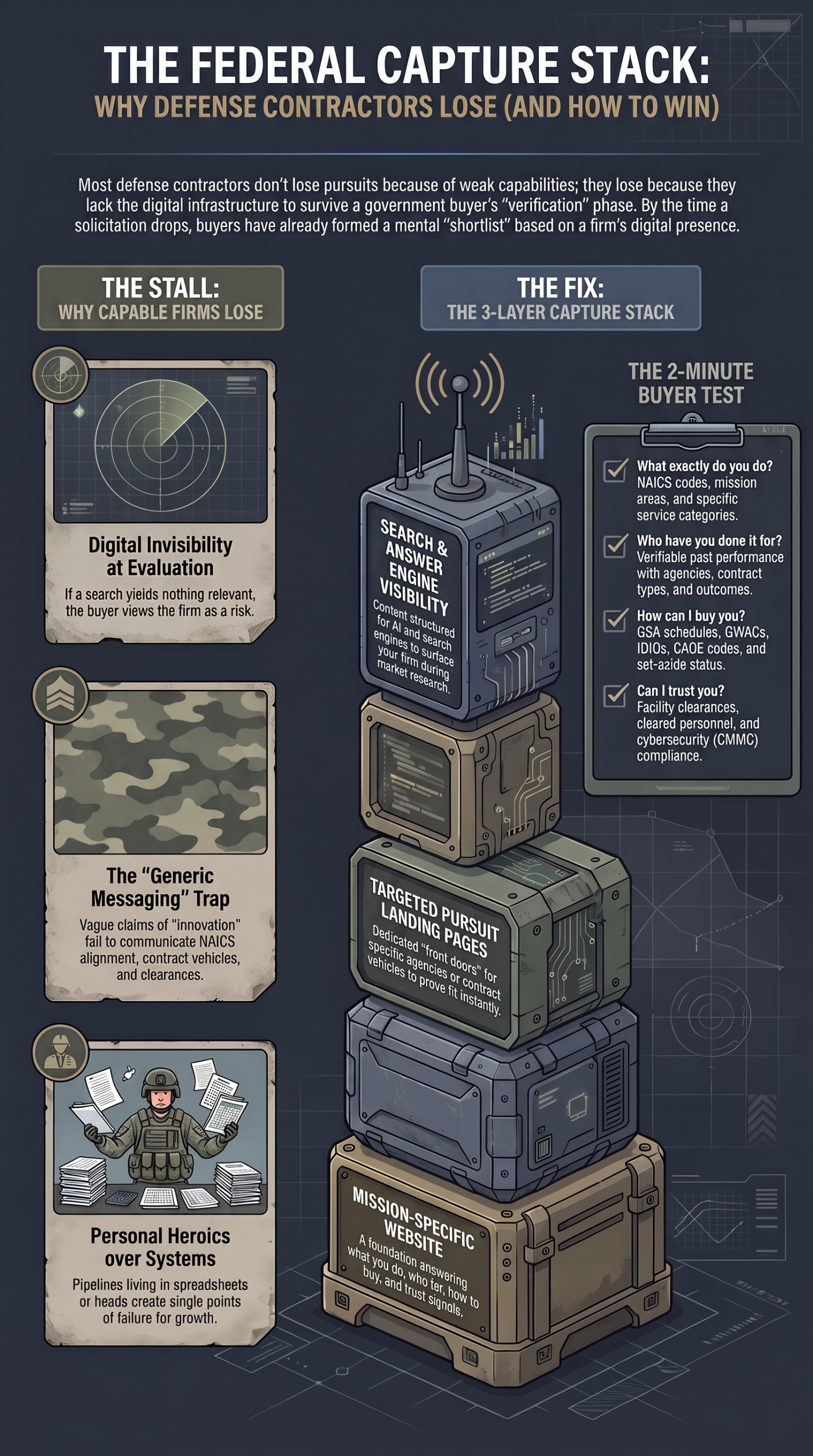
Table of Contents
- Chapter 1: Why Business Development Stalls in Federal Contracting
- Chapter 2: How the Government Buyer Actually Reads You
- Chapter 3: The Digital Tool Gap Inside Most Capture Teams
- Chapter 4: The Federal Capture Stack, Layer by Layer
- Chapter 5: Market Intelligence and Pipeline Discipline
- Chapter 6: Regional Targeting: Fight Where the Buyer Lives
- Chapter 7: Measuring What Matters in Federal BD
- Chapter 8: A Ninety Day Plan to Rebuild Your Capture Toolset
- Chapter 9: Frequently Asked Questions
- Authoritative Sources
Chapter 1: Why Business Development Stalls in Federal Contracting
Let me start with the question I hear most often from owners and BD leads, because the answer sets up everything else in this article.
Why do capable federal contractors keep losing winnable work?
Capable federal contractors lose winnable work because the buyer never gets a clear, credible, buyer specific picture of the firm before the decision hardens. By the time a solicitation drops, most contracting officers, program managers, and prime teaming leads have already formed a short mental list of who belongs on the work. If your firm is not on that list, your proposal is climbing a hill that was built months earlier. That is the whole game in one sentence, and it is a game played long before proposal day.
I watched this from the inside for three decades. When a program office starts shaping a requirement, people in that office talk. They remember the vendor who briefed them at a conference. They remember the firm a prime mentioned during a teaming conversation. They look companies up. They read websites, capability statements, LinkedIn pages, and past performance narratives. What they find, or fail to find, quietly sorts vendors into two piles: firms that feel like a safe, obvious fit, and firms that feel like a gamble. Nobody writes this sorting down. It happens in hallway conversations and in thirty second website visits, and it decides more competitions than most proposal teams want to admit.
The federal market is enormous. The U.S. government obligates hundreds of billions of dollars in contracts every fiscal year, a figure you can verify yourself on USASpending.gov, and the Department of Defense accounts for the largest share of that spending. The statutory government wide goal for small business participation is 23 percent of prime contract dollars, set by the Small Business Act and tracked in the SBA procurement scorecard. The money is real and the doors are open. Yet the same pattern repeats in firm after firm: a strong technical team, real past performance, honest pricing, and a business development motion that cannot convert any of it into new pipeline.
When I sit down with these firms, the stall almost always traces back to some combination of five conditions.
First, the firm is invisible at the exact moment of evaluation. A contracting officer hears the company name, searches it, and finds a thin website that could belong to any company in any industry. Or worse, finds nothing relevant at all. In an environment where every buyer verifies before they trust, invisibility reads as risk.
Second, the messaging speaks to everyone and therefore to no one. The homepage says the firm delivers innovative solutions to complex challenges. Every federal buyer has read that sentence ten thousand times. It communicates nothing about NAICS alignment, contract vehicles, clearances, agency experience, or mission fluency. Generic language forces the buyer to do the translation work, and buyers with fifty other things on their desk simply will not do it.
Third, business development and capture run on personal heroics instead of systems. One rainmaker carries the pipeline in their head and their inbox. When that person is out, or leaves, the pipeline goes with them. There is no shared opportunity tracking, no standard qualification gates, no repeatable way to warm up a target agency before a pursuit goes hot.
Fourth, the digital assets that should support every pursuit do not exist. No landing page for the agency being courted. No page for the contract vehicle the firm just won a seat on. No current capability statement matched to the pursuit. The BD lead walks into teaming conversations armed with a general homepage and a dated PDF, which is like showing up to a rifle qualification with a borrowed weapon you have never zeroed.
Fifth, nobody measures anything. The firm cannot say how many qualified conversations last quarter came from digital channels, which pages buyers visited before booking a call, or whether the money spent on the last website refresh produced a single opportunity. Without measurement there is no way to improve, so the firm keeps repeating motions that feel productive and produce nothing.
None of these five conditions is about talent. They are about tooling and structure. That distinction matters because it means the problem is fixable on a schedule, with a plan, by deliberate work. The rest of this article is that plan.
The relationship objection, answered
Whenever I lay this out, someone raises the objection that federal contracting is a relationship business, and that a firm with strong relationships does not need digital tooling. Half of that sentence is true. This is absolutely a relationship business. The conclusion drawn from it is wrong, and it is wrong in a way that gets more expensive every year.
Relationships open doors. Verification decides what happens once you are through them. The program manager who likes your BD lead still has to bring your firm to colleagues who have never met you, and those colleagues will check you the way strangers check you: quickly, digitally, and skeptically. The champion inside an agency who wants to include you in market research still needs material they can put in front of others. Your relationship gets you the look. Your digital presence determines what the look finds. When it finds specificity and credibility, the relationship compounds. When it finds a thin brochure, you have handed your own champion a reason to hesitate on your behalf.
There is also a durability problem with relationship only BD. People rotate. The contracting officer who knew you retires, the program manager moves commands, the prime’s capture lead changes companies, and the relationship capital walks out the door with each of them. Digital infrastructure is the part of your reputation that does not rotate. It keeps making your case to every new arrival in every office you care about, around the clock, in exactly the language you chose. The firms that grow fastest in this market are not choosing between relationships and digital presence. They are using each to multiply the other.
Field note from the government side
In my years inside federal agencies, I never once saw a program office award work to a firm because its website was pretty. I saw many firms quietly dropped from consideration because a five minute look at their digital presence raised questions nobody had time to chase down. The website rarely wins the work. It very often loses it.
Chapter 2: How the Government Buyer Actually Reads You
Before we talk about tools, you need to understand the reader those tools are built for, because the federal buyer does not read like a commercial customer. I spent thirty years being that reader inside the FBI, DHS, the Navy, and the NSA, and I can tell you the evaluation habit is different in ways that should change how you build everything.
What does a contracting officer or program manager look for on a contractor website?
A government buyer scans a contractor website for fast, verifiable answers to four questions: what exactly do you do, who have you done it for, what vehicles and codes can I buy you through, and can I trust you with my mission. If those answers are not visible within the first minute, the buyer leaves and mentally files the firm as unproven. The visit is not browsing. It is verification under time pressure.
Walk through those four questions the way the buyer does.
What exactly do you do? The buyer needs your capability stated in the language of their world: the NAICS codes, the service categories, the platforms, the mission areas. A cybersecurity firm that says it does managed detection and response for defense industrial base companies under NIST SP 800-171 and CMMC requirements gives the buyer something to hold. A firm that says it provides end to end technology solutions gives the buyer nothing.
Who have you done it for? Past performance is the currency of federal trust. The buyer wants to see agencies, contract types, scope, and outcomes, framed carefully within what your agreements let you disclose. Even when specific work is sensitive, you can describe the class of work, the environment, and the standards you performed under. Silence about past performance reads as absence of past performance.
What vehicles and codes can I buy you through? Contracting officers think in procurement mechanics. GSA schedules, GWACs, IDIQs, set aside status, SAM registration, CAGE codes. When your site answers the how do I buy you question directly, you remove friction from the one person whose job is to move paper. When it does not, you become homework.
Can I trust you with my mission? This is the quiet question underneath the other three. Trust signals in this market are specific: cleared personnel, facility clearances where relevant, compliance posture, veteran or former government leadership, disciplined handling of sensitive information, and messaging that shows you understand the mission rather than merely wanting the money. Buyers in this space have finely tuned detectors for vendors who learned the vocabulary last week.
Now notice something about all four questions. Every one of them can be answered before you ever meet the buyer, through the digital assets your firm controls. That is the entire argument for treating your website, landing pages, and collateral as capture infrastructure rather than marketing decoration. The buyer is going to conduct this evaluation whether you prepare for it or not. Preparation just decides the verdict.
How primes evaluate potential teaming partners
There is a second reader you must build for: the prime contractor teaming lead. If you are a small or mid sized firm, a large share of your revenue path runs through primes assembling teams for major pursuits. The prime’s evaluation is even faster and colder than the government’s, because the prime is managing risk on a proposal with a deadline.
A capture manager at a large integrator who is filling a gap on a task order team will look at your firm for perhaps two minutes. In that window they need to confirm your socioeconomic status, your relevant capability, your clearance posture, and whether putting your name in their proposal makes their team stronger or introduces a question mark. A sharp, current, specific web presence answers all of that in the window available. A vague one gets you passed over for the next name on the list, and you never even learn the pursuit existed.
This is why I tell every client the same thing: your digital presence is not talking to the public. It is talking to a small number of professional skeptics who evaluate for a living, and it must be engineered for exactly that audience. My team builds around the same framework search engines now use to weigh content quality: experience, expertise, authoritativeness, and trustworthiness. Those four signals are not just search concepts. They are a fair summary of how a federal buyer decides whether you are real.
The evaluator’s paper trail, and why it favors specific firms
There is one more thing about the government reader that outsiders rarely appreciate, and it explains why specificity beats polish every single time. Federal buyers work inside an accountability system. Source selections get documented, debriefed, and sometimes protested. Market research gets written into memoranda. Sole source justifications get reviewed. Every meaningful choice a contracting professional makes may one day need to be defended in writing to someone whose job is to find fault with it.
Now put yourself in that chair. When you must be able to defend your market research, which firm are you more comfortable including: the one whose website states its NAICS codes, vehicles, certifications, and past performance in checkable terms, or the one whose site offers inspiring language and no verifiable facts? The specific firm gives the evaluator material they can cite. The vague firm gives them exposure. This is why I keep repeating that your digital presence must be built from verifiable claims. You are not writing to persuade an emotional consumer. You are arming a professional who needs defensible reasons to keep you in the pool, and who will quietly drop any firm that makes their documentation harder.
The same dynamic governs how buyers treat inconsistency. If your SAM registration, your website, your capability statement, and your LinkedIn page disagree about your size status, your codes, or your service lines, the buyer does not investigate which version is true. Investigating costs time they do not have. They simply mark the firm as unreliable and move on. Consistency across every surface a buyer can check is not a branding nicety in this market. It is a qualification requirement enforced silently, with no notice of failure ever sent.
The two minute test
Open your own website and set a timer for two minutes. In that time, can a stranger determine your core NAICS codes, your top three past performance areas, your contract vehicles, your set aside status, and one reason to trust you with sensitive work? If not, you are failing the exact test your buyers run every week. Our federal digital advisory engagements usually begin with this audit, and most firms fail it on the first pass.
Chapter 3: The Digital Tool Gap Inside Most Capture Teams
Here is the uncomfortable pattern I see when I look inside the business development operations of federal, defense, and aerospace contractors, from eight person subcontractors to firms with several hundred employees. The capture methodology is often fine. People have read the books, attended the training, and can recite the gate review process. What is missing is the equipment. The team is running a modern capture playbook with a toolset from 2009.
What digital tools do federal BD and capture teams actually need?
A federal BD and capture team needs six working digital tools: a buyer specific federal contractor website, mission specific landing pages for active pursuits, current sales collateral, search and answer engine visibility, a lead capture and follow up system, and a shared pipeline with market intelligence feeds. Each tool covers a distinct stage of the buyer’s journey from first awareness to first conversation. When one layer is missing, opportunities leak out at that exact stage, silently, and the team usually blames the loss on price or politics.
Let me describe the gap as I actually encounter it in the field.
The website gap. The firm has a website, but it was built by a generalist agency that also builds sites for dentists and restaurants. It looks respectable and says nothing a contracting officer can use. There is no vehicles page, no NAICS listing, no past performance framing, no mention of compliance posture, no schema markup telling search engines what the firm is. It is a brochure aimed at nobody.
The landing page gap. The firm is actively pursuing three agencies and one large IDIQ, and every one of those pursuits points buyers to the same homepage. There is no page that speaks to the specific agency mission, no page that frames the firm’s fit for the specific vehicle, nothing a BD lead can send a prime that proves fit in sixty seconds. Each pursuit deserves its own front door, and none of them has one.
The collateral gap. The capability statement was last updated when the firm won its 8(a) certification, the pitch deck has three different template generations fighting inside it, and every version lives in someone’s email. When a prime asks for a two pager on a specific capability, the team builds it from scratch under deadline pressure, again.
The visibility gap. When a buyer searches for the firm by name, results are thin. When a buyer searches for the capability in the region, the firm is absent entirely. And in the newest version of this problem, when a buyer asks an AI assistant to list firms that do a certain kind of work near a certain installation, the firm never appears, because nothing on its site is structured for answer engines to read and cite. Buyers have changed how they find and verify vendors. Most contractor websites have not changed with them.
The capture gap. Interest arrives and evaporates. Someone visits the site from a .mil network, reads four pages, and leaves. A conference contact downloads nothing, signs up for nothing, hears nothing. There is no mechanism that converts attention into an identified, followed up conversation. The firm spends real money generating awareness and then lets the awareness escape.
The intelligence gap. The pipeline is a spreadsheet updated before board meetings. Opportunity discovery means one person scanning SAM.gov when they remember to. There is no systematic monitoring of forecasts, recompetes, or incumbent contract end dates, so the firm consistently discovers opportunities after the shaping window has closed, which is to say, after the work was already lost.
Read those six gaps again and notice what they have in common. Every single one sits between your real capability and the buyer’s perception of it. The firm is strong. The signal is weak. And in a market where the buyer must justify every decision in writing, perception built on verifiable signals is not a soft factor. It is the mechanism of selection.
How the tool gap compounds over a contract cycle
These gaps do not merely cost individual opportunities. They compound, and the compounding is what turns a tooling problem into a growth ceiling. Watch how it plays out across a typical cycle.
Year one: the firm misses the shaping window on two recompetes because nobody was tracking incumbent end dates, and gets passed over for a teaming slot because the prime’s capture lead could not verify capability fast enough. Year two: revenue concentrates further in the firm’s one anchor contract, which makes the firm look riskier to new buyers, which makes the thin digital presence even more damaging, because now the buyer’s quick check confirms the concern instead of answering it. Year three: the anchor contract itself comes up for recompete, and the firm discovers that the challenger positioning for its own work started eighteen months earlier, run by a competitor whose landing page has been speaking to that program office all along.
I have watched versions of this sequence end companies that did excellent technical work to the last day. The lesson is not that digital tools are magic. The lesson is that in a market where the buyer verifies everything and the shaping windows open years before award, the firm without working capture infrastructure is perpetually late, and perpetual lateness in federal contracting compounds exactly like debt.
A note on honesty in this diagnosis
I build these tools for a living, so you should weigh my incentives as you read. Here is my answer to that fair concern: everything in this article is verifiable against your own data. Run the two minute test on your site. Count your pursuits and count your landing pages. Ask your team where the pipeline lives and what happened to the last fifty inbound contacts. You do not need to take my word for any of it. The evidence is sitting in your own operation.
Chapter 4: The Federal Capture Stack, Layer by Layer
Now the constructive part. This chapter lays out the digital capture stack I build for federal, defense, and aerospace contractors, layer by layer, in the order the buyer encounters it. Think of it the way you would think about layered security: each layer catches what the previous one missed, and the system only works when the layers connect.
Layer one: a federal contractor website built for the government reader
The foundation is a federal contractor website engineered around the four buyer questions from Chapter 2. In practice that means a capabilities architecture organized by NAICS and mission area rather than by internal org chart, a contract vehicles page a contracting officer can use, past performance framed within disclosure limits, a compliance and trust section covering items like SAM registration, CAGE code, clearances, and cybersecurity posture, and leadership bios that establish who is behind the work. It also means the technical substrate the buyer never sees: clean structure, fast load, secure hosting, and schema markup so machines can parse what humans read.
I want to stress the framing here. This is not a marketing site that happens to mention government work. It is capture infrastructure. Every page exists to move a skeptical professional evaluator one step closer to a conversation. When my team writes these pages, we write them the way we learned to write inside government: bottom line up front, claims backed by specifics, no adjectives doing the work that evidence should do. That discipline is also the heart of our government copywriting and messaging service, because most contractor sites do not fail on design. They fail on words.
Layer two: mission specific landing pages for every serious pursuit
A homepage speaks to everyone. A pursuit is won by speaking to exactly one buyer. That is why the second layer is a set of mission specific landing pages: targeted pages engineered for one agency, one vehicle, or one opportunity, so your message lands exactly where the opportunity lives.
When you are courting a specific agency, sending that buyer to a general homepage asks them to do the translation work themselves, and most will not. A mission specific page removes that gap. It names the buyer’s world, mirrors their mission language, arranges your past performance in the exact context of their problem, and points to one obvious next step. The same logic applies to contract vehicles. If you hold a seat on a GWAC or an IDIQ, a dedicated page framing your fit for that vehicle gives primes and evaluators a place to confirm you belong there. And when a live opportunity is moving fast, a targeted page can be deployed while the window is still open, giving your BD lead a sharp, credible link to send a teaming partner that proves your value in seconds.
In capture terms, these pages do the positioning before the meeting starts. They are the difference between walking into a teaming call as one more vendor hoping to be noticed and walking in as the firm that already speaks the mission.
Layer three: sales collateral that matches the moment
The third layer travels where websites cannot: into inboxes, conference bags, and proposal annexes. Current, disciplined sales collateral and pitch decks mean a capability statement that actually reflects this year’s certifications and past performance, pursuit specific one pagers that can be produced from a maintained template instead of a midnight scramble, and a pitch deck that tells one coherent story in the buyer’s language. Collateral and web presence must agree with each other, because buyers cross check. When the PDF says one thing and the website says another, the buyer does not average the two. The buyer trusts neither.
Layer four: visibility in search engines and answer engines
The fourth layer determines whether buyers who do not already know you can find you, and whether buyers who do know you find confirmation instead of silence. This is the domain of SEO, AEO, and digital visibility.
Search engine optimization in this market is not about chasing traffic volume. It is about owning a small number of high intent queries: your firm name, your capability plus your region, your capability plus the installations and agencies you serve. Answer engine optimization is the newer discipline layered on top: structuring your content with direct answers, question format headings, and schema markup so that AI assistants and answer engines can read, understand, and cite your firm when a buyer asks them who does this work. Government buyers and prime capture teams already use these tools for market research. Firms whose content answers questions directly get surfaced. Firms with vague brochure copy do not exist in that channel at all.
Layer five: lead capture and business development tooling
The fifth layer converts attention into conversations. Lead generation and BD tools give every page a working next step: strategy call scheduling, gated content that identifies serious readers, contact routing that reaches a human the same day, and analytics that show which agencies, regions, and pages are producing real interest. The standard I hold is simple. Every piece of buyer attention your firm earns should have exactly one obvious path to a conversation, and every conversation should land in a system your whole team can see.
Layer six: continuity, maintenance, and advisory
The final layer keeps the stack alive. Federal markets shift, vehicles turn over, past performance grows, and a capture stack that is not maintained decays back into the brochure it replaced. Ongoing website maintenance and support keeps the infrastructure current and secure, and periodic federal digital advisory reviews keep the whole system pointed at the pursuits that matter this year, not the ones that mattered when the site launched. For firms that want the layers delivered as a coherent whole, our packages bundle the stack in stages built for how contractors actually grow.
A layer that runs through all six: trust and compliance signals
Before leaving the stack, I want to name the thread that runs through every layer, because it is the one commercial marketers most often miss when they wander into this market: the deliberate presentation of trust and compliance signals.
Defense and aerospace buyers operate under security and compliance regimes that shape who they can work with and who they want to work with. The defense industrial base carries cybersecurity obligations built on NIST SP 800-171 and the Department of Defense CMMC program. Classified work requires cleared personnel and, for some contracts, facility clearances. Export controlled work brings ITAR considerations. Buyers and primes screen for all of this, sometimes formally in solicitation requirements and always informally in how they judge whether a small partner will survive the compliance scrutiny that comes with a defense team.
Your digital presence should present these signals plainly and honestly: what you hold, what you comply with, and how you handle sensitive information, stated in the buyer’s terms without exaggeration. Two cautions from someone who spent a career around classification. First, never overstate. Claiming compliance you cannot evidence is worse than silence, because this market runs on verification and the community is small enough that reputations travel. Second, never leak. Your website should demonstrate that you understand handling discipline, which means naming the classes of work you do without exposing details that identify protected programs, customers who have not consented, or your own pursuit intentions. Firms that get this balance right project exactly the quality defense buyers are screening for: an organization that can be trusted around things that matter.
Presenting these signals well is a copywriting problem as much as a compliance one, and it is one of the places where writing the way government writes, precise, restrained, and evidence bound, pays for itself. The buyer notices the discipline before they consciously notice anything else.
Why the layers must connect
A common failure mode is buying these layers from different vendors at different times with no shared strategy. The website says one thing, the landing pages another, the deck a third. Buyers experience the seams as inconsistency, and inconsistency reads as risk. The stack works when one strategy, one voice, and one set of facts run through every layer. That is also the security argument for keeping the work in house with cleared hands rather than scattering your pursuit details across offshore subcontractors.
Chapter 5: Market Intelligence and Pipeline Discipline
The digital stack from Chapter 4 handles how buyers see you. This chapter handles the other direction: how your team sees the market. Because the second half of the tool gap is intelligence, and here the good news is that the primary sources are free and official.
Where should a federal BD team look for opportunities and market data?
A federal BD team should build its intelligence practice on the official sources first: SAM.gov for contract opportunities, USASpending.gov for who is buying what from whom, agency long range acquisition forecasts for what is coming, and GAO.gov for protest decisions and acquisition trend reports. Commercial platforms such as Deltek GovWin and Bloomberg Government add aggregation, forecasting, and workflow on top, and they earn their cost for many firms, but no subscription substitutes for a team that actually works the free official sources on a schedule.
Here is the discipline I recommend, drawn from watching how well run capture shops operate.
Monitor SAM.gov systematically, not casually. Saved searches aligned to your NAICS codes and keywords, reviewed on a fixed schedule, with sources sought and RFI notices treated as first class citizens. By the time a solicitation posts, the shaping window has mostly closed. Sources sought notices are your invitation to shape, and responding to them well is one of the highest return activities in federal BD.
Mine USASpending.gov for ground truth. Who holds the contracts you want? When do they end? Which offices buy your capability, through which vehicles, at what dollar levels? An afternoon on USASpending answers questions that firms otherwise guess about for years. Incumbent contract end dates in particular should feed directly into your pipeline as recompete targets with lead times measured in years, not weeks.
Read agency forecasts and small business office materials. Most major agencies publish acquisition forecasts and run offices of small business programs whose entire mission is connecting capable firms to buying activity. These offices are underused by the exact firms that need them most.
Watch GAO for the rules of the road. Bid protest decisions on GAO.gov teach you how evaluations actually get scored and where agencies make mistakes. You do not need to be a lawyer to learn from them. Patterns in protest decisions tell you what evaluators are held accountable for, which tells you what your positioning must survive.
Put the pipeline in shared tooling with real gates. Whether you run a purpose built federal capture platform or a well configured general CRM matters less than this: the pipeline must live where the whole team can see it, opportunities must pass defined qualification gates before they consume proposal resources, and every entry must carry the basics: agency, vehicle, incumbent, value, dates, capture lead, and current probability assessment. A pipeline in one person’s head is not a pipeline. It is a resignation letter away from being nothing.
Trade shows, conferences, and the digital follow through
One more intelligence and relationship channel deserves its own section, because defense contractors spend heavily on it and most waste half the spend: the trade show and conference circuit. Events like the major service association conferences, regional industry days, and installation level small business outreach sessions remain among the best places in this market to meet buyers and primes face to face. The relationships are real. The problem is what happens after the handshake.
Here is the sequence I have watched hundreds of times. Your BD lead has a genuinely good conversation at a booth or a mixer. The other party pockets the card, and that evening or the following week, they do what every professional in this market does: they look the firm up. At that moment, your website is your second impression, and it either confirms the conversation or contradicts it. A program office contact who met an impressive, mission fluent BD lead and then finds a generic template site experiences the contradiction as doubt. All the money spent getting your people to that event now hangs on a web presence that costs a fraction of one booth to fix.
The fix is to treat every event as a campaign with a digital spine. Before the event: a landing page for the event audience, so your people have a specific link to share, and search visibility for the terms that audience uses. During: collateral that matches the web presence word for word, and a capture mechanism so interest gets identified rather than scattered across pockets and memories. After: same day follow through routed through a system the whole team can see, pointing contacts to the pursuit or capability page that continues the exact conversation your BD lead started. Run this way, one conference produces months of pipeline motion. Run the usual way, it produces a stack of cards and a warm feeling that fades by Friday.
Industry days and installation outreach events deserve special mention because they connect directly to the regional strategy in the next chapter. When an installation’s contracting office holds a small business event, the firms that show up with presence already built for that installation’s market, a page in its mission language, visible search results for their capability in that region, walk in as locals. Everyone else walks in as strangers asking to be remembered. The buyers do remember, and what they remember is who did the homework.
Now connect this chapter to the previous one, because the connection is where firms win. Intelligence tells you which agency, which installation, which vehicle, and which recompete to pursue. The digital stack is how you show up prepared in front of exactly that buyer. Intelligence without presence means you see the opportunity and lose it anyway. Presence without intelligence means you are visible to a market you are not actually working. The firms that grow have both, pointed at the same targets.
Chapter 6: Regional Targeting: Fight Where the Buyer Lives
Everything in this article so far applies nationwide. This chapter is about a truth that took me years inside government to fully appreciate: federal contracting is a national market that behaves like a collection of local ones. Money is appropriated in Washington, but it is obligated and executed at installations, laboratories, program offices, and federal centers scattered across the country, each with its own mission culture, prime contractor ecosystem, and informal network of people who know each other.
Why does regional targeting matter in federal business development?
Regional targeting matters because federal buying decisions are shaped by installation level ecosystems, and a firm that speaks to a specific base, laboratory, or federal center will outposition a firm that speaks generically to the whole government. A program office at a sustainment depot in Oklahoma evaluates vendors through the lens of that depot’s mission and community. A capture page, a search presence, and a message aimed at that specific ecosystem meets the buyer where they actually work. That is why we built a dedicated regional hub for every major federal and defense market we serve, each one written to the mission of that place. The complete directory lives at our Federal & Defense Hubs page, and the sections below walk the map the way a capture strategist should read it.
One practical note on how to read the tour that follows. These are not tourism summaries. Each paragraph names the buying character of a market, because that character is what your positioning must match. Sustainment markets buy differently than research markets. Laboratory ecosystems evaluate differently than fleet concentrations. Headquarters corridors reward different signals than depot towns. The regional hub pages behind each link carry the full treatment of each market: the installations, the mission areas, the buyer types, and how a contractor website should speak to each. Use this chapter as the map and the hubs as the terrain.
The National Capital Region and the Chesapeake corridor
The densest concentration of federal buying power on earth runs from Washington through Northern Virginia and Maryland down the Chesapeake. Headquarters buyers cluster in the District itself, where policy shops and agency headquarters set requirements that ripple outward; our hub for Washington, DC federal agency contractors is built for firms selling into that headquarters environment. Across the river, the system integrator capital of the world operates out of Northern Virginia, where teaming relationships with primes are the dominant path to revenue and where your firm’s credibility must survive the most sophisticated vendor evaluations in the market.
The signals intelligence and cyber mission anchors at Fort Meade, home to NSA and U.S. Cyber Command, a market I know personally from the inside and one where trust signals and clearance posture decide who even gets a conversation. South of the District, Quantico pairs Marine Corps combat development with the FBI Academy and laboratory ecosystem, another environment where my own career history runs deep. Army test, evaluation, and C5ISR work concentrates at Aberdeen Proving Ground in Maryland, while naval aviation test and evaluation runs through Patuxent River and surface warfare weapons development through Dahlgren in Virginia. Each of these markets rewards vendors who speak its specific technical mission, and punishes generic positioning, which is exactly why each has its own hub.
Hampton Roads and the Atlantic seaboard
Follow the coast south and you enter the largest naval ecosystem in the world. The fleet concentration around Norfolk and Hampton Roads drives an enormous market in ship repair, fleet readiness, and installation support, while next door the nation’s aircraft carriers and submarines take shape in the Newport News shipbuilding ecosystem, with its deep supplier tiers and constant demand for specialized trades and engineering support.
Further down the seaboard, North Carolina hosts three distinct defense markets that outsiders often blur together and insiders never do: the airborne and special operations community at Fort Bragg and Fayetteville, the Marine expeditionary and logistics ecosystem at Camp Lejeune and Jacksonville, and Marine aviation and depot maintenance at MCAS Cherry Point, home of Fleet Readiness Center East. Inland, the Research Triangle concentrates federal research money across health, environment, and advanced technology. South Carolina adds the naval and information warfare market at Charleston, where cyber and C4ISR engineering work runs through a distinct government engineering community. A firm pursuing all of these with one generic Southeast message is invisible in every one of them. A firm with a page speaking each market’s language is a local everywhere it competes.
Florida and the Gulf Coast
Florida alone contains several of the most distinct defense markets in the country. Special operations and Central Command headquarters buyers concentrate at MacDill AFB in Tampa, my own home market and the center of gravity for SOCOM aligned services. Space launch and range operations run up the coast at Cape Canaveral and the Space Coast, where commercial launch growth keeps expanding the contractor base. Fleet and maritime patrol aviation work anchors at Jacksonville and Mayport, naval aviation training at Pensacola, and air armament, test, and special operations aviation at Eglin AFB and Fort Walton Beach on the panhandle. West along the Gulf, the New Orleans market combines naval and shipbuilding work with the disaster response contracting that follows FEMA and the Gulf hurricane cycle.
The Southeast interior: sustainment, health, and missile defense
Inland Georgia and the Tennessee Valley hold some of the largest concentrated contract markets in the nation. Air Force sustainment, avionics, and software work runs through Robins AFB and Warner Robins. Atlanta anchors federal public health buying through the CDC and a broad federal civilian base, covered in our Atlanta and CDC federal health hub. Infantry, armor, and training support contracting concentrates at Fort Moore and Columbus.
Then there is Huntsville, arguably the most intense defense engineering market outside the National Capital Region, where Army aviation and missile programs, the Missile Defense Agency, and NASA Marshall stack on top of each other and where the local ecosystem of primes and mid tiers is famously tight knit. Tennessee and Kentucky add the national laboratory market at Oak Ridge, the air assault and special operations aviation community at Fort Campbell, and the Army human resources and accessions enterprise at Fort Knox and Louisville.
The Northeast and Mid-Atlantic industrial corridor
New England’s defense market centers on electronic systems, command and control, and federally funded research around Boston and Hanscom AFB, a market where technical credibility is the entire ballgame. The Mid-Atlantic adds naval engineering and a large federal civilian base in Philadelphia, armament research and energetics at New Jersey’s Picatinny Arsenal, and the strategic airlift and aerial port mission at Dover AFB in Delaware.
The Midwest and the central sustainment belt
The middle of the country runs much of the military’s logistics, sustainment, and industrial base. Transportation and mobility commands and defense logistics buyers concentrate at Scott AFB and the Metro East outside St. Louis. The Army’s organic industrial base and sustainment commands anchor at Rock Island Arsenal in the Quad Cities. Indiana hosts the remarkable microelectronics and surface warfare engineering market at Crane. Ohio holds one of the largest acquisition and research complexes in the Air Force at Wright-Patterson AFB and Dayton, home to Air Force Materiel Command and the Air Force Research Laboratory.
Kansas City carries a major IRS and Treasury federal civilian workload, covered in our Kansas City federal civilian hub, while Wichita remains one of the country’s great aircraft manufacturing and sustainment ecosystems. Nebraska anchors strategic deterrence buying at Omaha and Offutt AFB, home of U.S. Strategic Command.
Texas and the southern plains
Texas contains several defense markets big enough to be states of their own. San Antonio combines Air Force cyber, military medicine, and installation support into a dense buying environment covered by our San Antonio cyber and military health hub. Human spaceflight and mission operations contracting runs through Houston and Johnson Space Center. The Army’s largest armored installation drives training and readiness contracting at Fort Cavazos and Killeen. North across the Red River, Oklahoma pairs one of the Air Force’s great sustainment centers at Tinker AFB and Oklahoma City with the fires, artillery, and air defense center of excellence at Fort Sill and Lawton.
The Mountain West: space, nuclear, and national laboratories
Colorado‘s Front Range is the center of the military space economy. Space operations, NORAD, and homeland defense buyers concentrate at Colorado Springs, while Denver and Aurora combine aerospace primes, federal civilian centers, and intelligence community facilities into a distinct second market an hour north. Utah pairs the massive sustainment and weapons work at Hill AFB and Ogden with the federal civilian and IRS workload in Salt Lake City.
New Mexico is national security science country. Nuclear enterprise, space research, and national laboratory buying meet at Albuquerque and Kirtland AFB, and the weapons science mission runs north to Los Alamos National Laboratory. Arizona adds the Army intelligence and electronic proving ground ecosystem at Fort Huachuca and Sierra Vista, a market where my own intelligence community background maps directly onto the buyer’s world.
California and the Pacific
California‘s federal markets are so distinct from each other that treating the state as one market is a capture error. Navy and Marine Corps maritime and unmanned systems buying concentrates at San Diego, the largest naval market on the west coast. The Marine Corps trains for expeditionary war at Camp Pendleton and runs large scale combined arms training in the desert at Twentynine Palms. Naval weapons research and test lives at China Lake and Ridgecrest, and the flight test capital of the world operates at Edwards AFB in the Antelope Valley, surrounded by the aerospace engineering base that grew up around it.
Space and planetary science contracting runs through Pasadena and JPL, while the nuclear weapons and energy science mission anchors the Livermore and Sandia national laboratory market in the Bay Area. In the Pacific Northwest, electronic attack and maritime patrol aviation concentrate at NAS Whidbey Island, and the joint power projection platform at Joint Base Lewis-McChord drives Army and Air Force readiness contracting across the Puget Sound. And across the ocean, Indo-Pacific fleet and joint operations buying runs through Pearl Harbor and Honolulu, the contracting front door to the theater the entire defense strategy now centers on.
How to use this map in your capture strategy
Pick the three to five regional ecosystems where your past performance, clearances, and teaming relationships give you a genuine right to win. Build presence for those markets specifically: a landing page in the mission language of each, search visibility for your capability plus that region, collateral versions that name the installations and program offices. Depth in a few markets beats a thin film spread across fifty. The buyers can tell the difference in about ninety seconds.
Chapter 7: Measuring What Matters in Federal BD
I said in Chapter 1 that most firms measure nothing, so let me be specific about what to measure instead. Federal business development has a long sales cycle, which tempts teams to treat it as unmeasurable. It is not. The cycle is long, but it is made of short, observable stages, and each stage produces numbers you can watch.
What metrics should a federal contractor track for business development?
A federal contractor should track metrics at four stages: visibility, engagement, conversation, and pipeline. Visibility means search rankings and impressions for your firm name and your capability plus region terms, and whether answer engines surface your firm for buyer style questions. Engagement means visits to your capability, vehicles, and regional pages, including traffic from government and prime contractor networks, time on page, and which pursuits’ landing pages actually get read. Conversation means strategy calls booked, capability statement downloads, sources sought responses submitted, and teaming inquiries received, each traced to its source. Pipeline means qualified opportunities entering the funnel, gate progression rates, proposal submissions, and win rate, reviewed at fixed intervals rather than when the mood strikes.
Two practical notes from experience. First, connect the stages. A firm that tracks website analytics in one silo and pipeline in another will never see the pattern that matters: which digital activity precedes which conversations, and which conversations become which awards. The whole point of measurement is to find the paths that produce revenue and pour resources into them. Second, respect small numbers. Federal BD is a low volume, high value discipline. Twenty visits to a pursuit landing page might include the three evaluators who decide your fate. Read your numbers with that lens, and treat every government network visit to a specific capability page as the meaningful signal it is.
The honest baseline exercise
Before you change anything, capture your baseline. Record where you rank today for your firm name and your five most important capability and region queries. Count last quarter’s inbound federal inquiries and where each came from. Pull the visit data for your top ten pages. Write down your pipeline’s current qualified value and last year’s win rate. This takes one afternoon, and it converts every future improvement from a feeling into a fact. When someone asks a year from now whether the investment worked, you will answer with numbers instead of impressions. That habit, learned in government where every decision must survive review, is worth more than any single tool in this article.
Chapter 8: A Ninety Day Plan to Rebuild Your Capture Toolset
Plans fail from scope more often than from difficulty, so here is a ninety day sequence that rebuilds the capture toolset in the order that produces results fastest. I have organized it in three phases of thirty days, and each phase produces something a buyer can see.
Days 1 through 30: audit, intelligence, and foundation
Run the two minute test on your own site and record the failures honestly. Complete the baseline measurement exercise from Chapter 7. Stand up your intelligence discipline: saved SAM.gov searches aligned to your NAICS codes, a USASpending review of your target agencies and their incumbents, a calendar of recompete dates that matter to you, and a shared pipeline with defined qualification gates. Then pick your targets: the three to five pursuits and the three to five regional markets where you have a genuine right to win. Everything in the next sixty days aims at those targets and nothing else.
Days 31 through 60: rebuild the core presence
Rebuild or overhaul the website around the four buyer questions: capabilities in buyer language, a working vehicles page, past performance framed within disclosure limits, and trust signals presented plainly. Rewrite the copy with government discipline, bottom line up front, evidence over adjectives. Refresh the capability statement and align it word for word with the site. Add the technical layer buyers never see but machines require: schema markup, clean structure, fast and secure hosting. If your team cannot carry this internally, this is the phase where a specialist partner earns their fee, and it is the reason my firm exists.
Days 61 through 90: deploy pursuit weapons and turn on capture
Build a mission specific landing page for each of your named pursuits and each priority regional market, in the buyer’s mission language, each with one obvious next step. Wire up lead capture so every page can convert attention into an identified conversation, and route every inquiry to a human the same day. Submit at least two sources sought responses using your new positioning. Then hold the first monthly review against your baseline: rankings, visits, conversations, pipeline. Ninety days will not finish the job, because this work is never finished. But ninety days executed this way puts a firm in a different weight class than it started in, with the evidence to prove it.
Beyond day ninety: the operating rhythm
What separates firms that sustain growth from firms that spike and fade is the rhythm they settle into after the rebuild. The rhythm I recommend is monthly, quarterly, and annual. Monthly: review the four metric stages against baseline, work the SAM.gov and forecast feeds, and hold a pipeline gate review that actually kills weak opportunities instead of letting them linger. Quarterly: refresh the pursuit landing pages against how each capture campaign has evolved, update collateral for new wins and certifications, and add or retire regional targets based on where conversations are actually happening. Annually: rerun the full audit from day one, because the market, the vehicles, and your own capability have all moved, and a capture stack pointed at last year’s targets is quietly decaying no matter how good it looked at launch.
None of this is glamorous. Neither was most of the work that mattered in my government career. The firms that win in this market are rarely the ones with the flashiest presence or the biggest event budget. They are the ones whose systems make them consistently early, consistently specific, and consistently easy to verify, pursuit after pursuit, year after year. Build the stack, point it with intelligence, aim it at the regions where you have a right to win, and measure honestly. That combination is not a secret. It is just discipline, and discipline is the one advantage in this market that no incumbent can protest.
Give your next pursuit its own front door
If you would rather compress this timeline with a partner who has sat on the government side of the table, that is exactly what we do. Federal Contracting Web Design builds websites, mission specific landing pages, collateral, and visibility systems for federal, defense, and aerospace contractors, in house, with cleared hands, by a founder who spent thirty years inside the FBI, DHS, the U.S. Navy, and the NSA. Book a strategy call and we will map your pursuits, your regions, and the fastest path to a capture stack that wins. You can also review our full capability list, our packages, and the founder’s background before you commit.
Chapter 9: Frequently Asked Questions
What is the difference between business development and capture in federal contracting?
Business development is the broad, ongoing work of identifying markets, building relationships, and filling the pipeline with qualified opportunities. Capture is the focused campaign to win one specific opportunity after it enters the pipeline, covering customer engagement, teaming, solution shaping, and positioning before the proposal phase begins. Healthy firms run both as distinct, connected disciplines, and the digital stack in this article supports both: the website and visibility layers feed business development, while mission specific landing pages and pursuit collateral serve capture.
Does a website really influence federal contract decisions?
Yes, though rarely in the way vendors imagine. A website almost never wins an award by itself. It influences the informal verification that happens throughout the buying cycle, when contracting officers, program staff, and prime teaming leads look a firm up to confirm it is real, capable, and safe to shortlist. A specific, credible site keeps you in consideration. A vague or dated one quietly removes you, and no debrief will ever tell you that is what happened.
What is answer engine optimization and why should federal contractors care?
Answer engine optimization, or AEO, is the practice of structuring content so AI assistants and answer engines can read, understand, and cite it when users ask questions. Federal buyers and prime capture teams increasingly ask these tools to identify firms with specific capabilities near specific installations. Contractors whose pages contain direct, well structured answers get named in those results. Contractors with generic brochure copy do not appear at all, which makes AEO a visibility channel no serious federal marketer can ignore.
How many regional markets should a contractor target at once?
Three to five, chosen where your past performance, clearances, and relationships give you a genuine right to win. Federal markets are installation level ecosystems, and credible presence in each one takes real work: a dedicated page in that market’s mission language, search visibility for your capability in that region, and collateral that names the local buying activity. Depth in a few markets consistently outperforms shallow coverage of many, and you can expand once the first markets produce conversations.
How long does it take for this digital capture stack to produce results?
Expect early signals within the first quarter and meaningful pipeline effect over two to four quarters, tracking the length of federal buying cycles. Visibility improvements and inbound inquiries typically move first. Opportunities influenced by your improved positioning follow as pursuits already in motion reach decision points. This is a reasonable planning expectation drawn from experience rather than a guarantee, and any vendor who promises you awards on a fixed schedule is telling you something no honest practitioner can promise.
Can this work be outsourced safely given the sensitivity of capture details?
Only with discipline. Your pursuit targets, teaming intentions, and positioning strategy are competitive intelligence, and in some cases touch sensitive mission context. Keep the work with partners who operate in house, sign nondisclosure agreements as a standing practice, and understand the handling norms of the defense world. This is a core reason our work never leaves our own environment and is performed by a former U.S. government professional with an active clearance. Ask any vendor you consider exactly who will touch your pursuit details and where that work will be performed.
Should a small contractor invest in this before winning its first prime contract?
Yes, scaled sensibly, because the toolset matters most precisely when nobody knows you. A firm pursuing its first prime work or its first meaningful subcontracts lives entirely on verification: primes checking whether the small partner is real, contracting officers confirming a set aside candidate is capable, and small business offices deciding who to introduce. A modest but specific presence, a credible site answering the four buyer questions, one or two landing pages aimed at your best markets, and a current capability statement, costs a fraction of one lost teaming slot. Scale the investment to the pipeline, but do not wait for the win that the missing toolset is preventing.
Authoritative Sources
The claims in this article rest on official sources you can verify directly, alongside my own three decades of firsthand government experience. I encourage you to check everything.
- SAM.gov: the official U.S. government system for contract opportunities and entity registration.
- USASpending.gov: the official open data source for federal spending, including contract obligations by agency, vendor, and year.
- Acquisition.gov: the official home of the Federal Acquisition Regulation.
- SBA.gov: the U.S. Small Business Administration, including the annual small business procurement scorecard and the statutory 23 percent government wide small business contracting goal established under the Small Business Act.
- GAO.gov: the U.S. Government Accountability Office, publisher of bid protest decisions and federal acquisition reports.
- NIST.gov: the National Institute of Standards and Technology, publisher of NIST SP 800-171, the cybersecurity standard underlying defense industrial base requirements and the CMMC program.
- APMP.org: the Association of Proposal Management Professionals, the professional body for capture and proposal practice.
A note on figures: where this article references federal spending levels, I have deliberately described them in general terms and pointed you to USASpending.gov rather than quoting precise totals, because those figures change every fiscal year and you deserve current numbers from the primary source rather than a static claim from me.
{
“@context”: “https://schema.org”,
“@type”: “FAQPage”,
“mainEntity”: [
{
“@type”: “Question”,
“name”: “What is the difference between business development and capture in federal contracting?”,
“acceptedAnswer”: {
“@type”: “Answer”,
“text”: “Business development is the broad, ongoing work of identifying markets, building relationships, and filling the pipeline with qualified opportunities. Capture is the focused campaign to win one specific opportunity after it enters the pipeline, covering customer engagement, teaming, solution shaping, and positioning before the proposal phase begins.”
}
},
{
“@type”: “Question”,
“name”: “Does a website really influence federal contract decisions?”,
“acceptedAnswer”: {
“@type”: “Answer”,
“text”: “Yes. A website rarely wins an award by itself, but it shapes the informal verification contracting officers, program staff, and prime teaming leads perform throughout the buying cycle. A specific, credible federal contractor website keeps a firm in consideration, while a vague or dated one quietly removes it.”
}
},
{
“@type”: “Question”,
“name”: “What is answer engine optimization and why should federal contractors care?”,
“acceptedAnswer”: {
“@type”: “Answer”,
“text”: “Answer engine optimization is the practice of structuring content so AI assistants can read, understand, and cite it. Federal buyers and prime capture teams increasingly use these tools to identify firms with specific capabilities near specific installations, so contractors whose pages contain direct, structured answers get named while generic sites do not appear.”
}
},
{
“@type”: “Question”,
“name”: “How many regional markets should a federal contractor target at once?”,
“acceptedAnswer”: {
“@type”: “Answer”,
“text”: “Three to five, chosen where past performance, clearances, and relationships give the firm a genuine right to win. Credible presence in each installation level market requires a dedicated page in that mission’s language, regional search visibility, and collateral naming the local buying activity.”
}
},
{
“@type”: “Question”,
“name”: “How long does a digital capture stack take to produce results?”,
“acceptedAnswer”: {
“@type”: “Answer”,
“text”: “Expect early visibility and inquiry signals within the first quarter and meaningful pipeline effect over two to four quarters, tracking the length of federal buying cycles. This is a planning expectation from experience, not a guarantee.”
}
},
{
“@type”: “Question”,
“name”: “Can capture focused web work be outsourced safely?”,
“acceptedAnswer”: {
“@type”: “Answer”,
“text”: “Only with discipline. Pursuit targets and positioning strategy are competitive intelligence, so the work should stay with partners who operate in house, sign nondisclosure agreements as standing practice, and understand defense handling norms.”
}
}
]
}