

Bottom Line Up Front
Manufacturing and supply is the broadest sector in government contracting, and most firms inside it do not realize how broad. It runs from aircraft structures and ammunition to pharmaceuticals, uniforms, semiconductors, castings, batteries, laboratory instruments, furniture, and the fasteners holding all of it together. If the government uses a physical thing, somebody manufactures or distributes it under contract, and the buyer screening that supplier is asking the same question every time: can this firm deliver on specification, on schedule, every time.
What has changed is that the question now extends past your own factory. Domestic content thresholds are rising on a published schedule, entire categories of foreign produced components are prohibited outright, and the government increasingly expects a supplier to know where its own inputs came from. Supply chain visibility has moved from a back office concern to a condition of eligibility, and a firm that can document component origin, approved sources, and traceability holds an advantage that a competitor cannot assemble in a bid cycle.
This guide covers the industries inside this sector, how the government buys products, the supply chain rules that decide who qualifies, and how a firm proves its production capacity, quality systems, and reliability. A credible federal contractor website is where a contracting officer or a prime supply chain team qualifies you as a safe source. Read it as a playbook for becoming one.
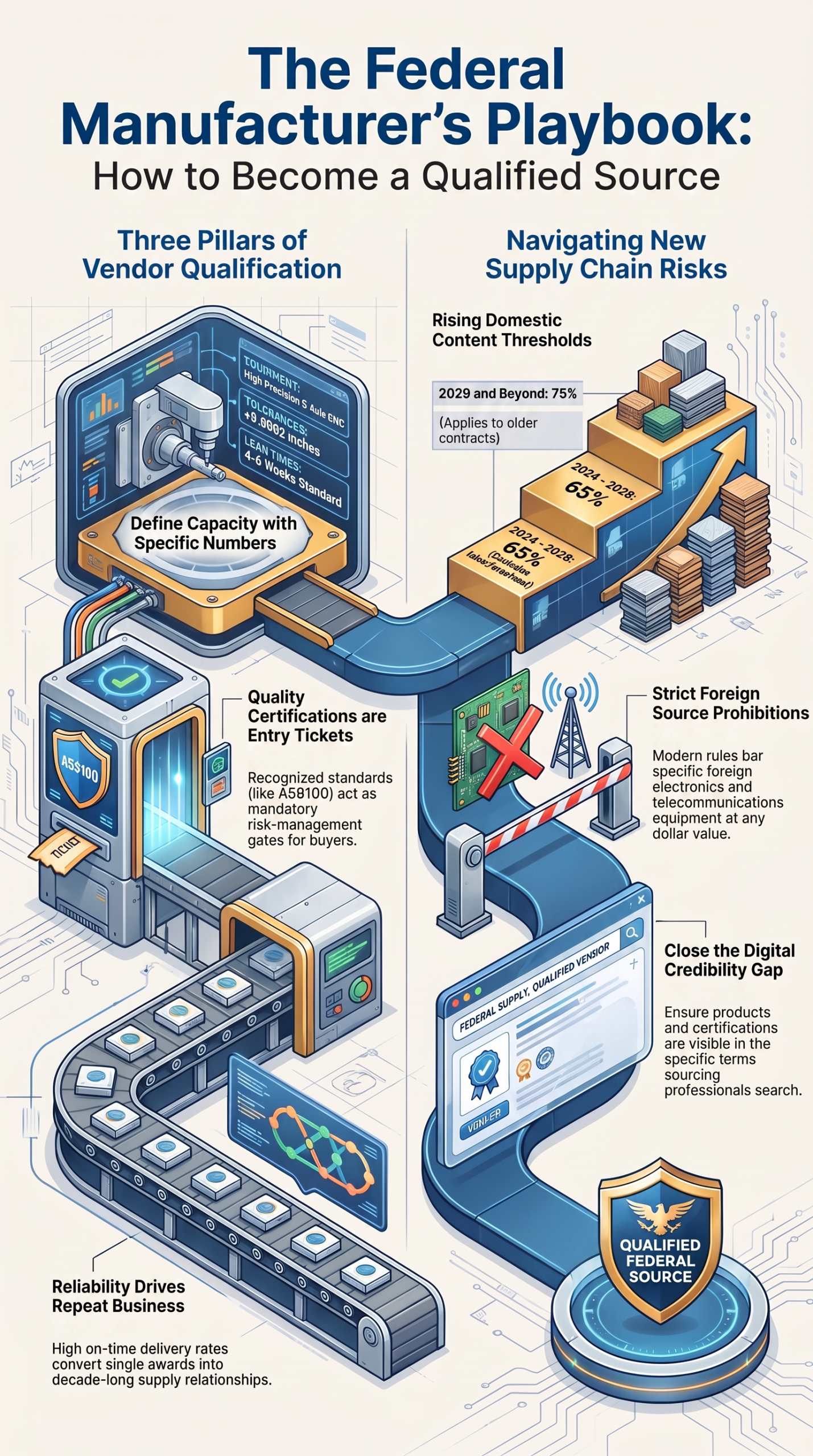
Table of Contents
- The Federal Manufacturing and Supply Market
- The Industries Inside This Sector
- Where a Firm Sits: Prime, Subcontractor, Distributor, or Specialty Source
- How the Work Is Bought: Solicitations, Vehicles, and the Prime Supply Chain
- Production Capacity: What You Can Actually Make
- Quality Systems: Proving Conformance Before the First Article
- Reliability: The Delivery Record That Keeps the Orders Coming
- Supply Chain Risk: Domestic Content, Prohibited Sources, and Traceability
- The Digital Credibility Gap: Sourcing Searches You Never See
- The Manufacturer’s Playbook: Becoming the Easiest Source to Qualify
I spent thirty years inside the federal government, across the Navy, the FBI, the Department of Homeland Security, and the National Security Agency, and for most of that time I was on the receiving end of the federal supply chain. A late part or an out of specification component was not a procurement inconvenience. It was a capability that did not work when somebody needed it. The government buys products with that memory, which is why it screens manufacturers and suppliers harder than almost any other category of vendor.
I also watched capable manufacturers get passed over for firms that were no better at making things but were considerably better at being found and verified. What follows is written for the machine shop, the component manufacturer, the electronics or textile producer, the chemical or materials supplier, the distributor, and the specialty source that wants to grow into federal work or move deeper into a prime supply chain. It covers the industries this sector actually spans, how products are bought, the supply chain rules that now decide eligibility, and the one thing that puts your capacity, quality, and delivery record where a buyer can check them. Let me walk through all of it.
Chapter 1. The Federal Manufacturing and Supply Market
The government buys an enormous quantity of physical goods, and the money is concentrated in ways a supplier should understand before choosing where to compete.
Federal product buying runs to hundreds of billions of dollars a year, with the defense side accounting for the large majority of it and civilian agencies buying substantially as well, and the general scale of that spending is visible at public reporting sites like USASpending.gov. On the defense side the single largest product category is aircraft, and on the civilian side it is pharmaceuticals and biological products, which by itself tells you how wide this sector runs. Total federal contracting reached a record level in recent reporting, and at the same time the dollars have been concentrating among a smaller pool of the largest awardees.
That concentration is the strategic fact for a smaller manufacturer. When spending consolidates upward, the path for a small firm runs less through direct federal awards and more through the supply chains of the primes who hold them, alongside the set aside programs that carve out direct opportunities. Both routes have the same gatekeeping mechanism, which is a sourcing decision made by somebody who needs to qualify a supplier quickly and defend that choice later. Making that person’s job easy is the entire competitive problem.
Chapter 2. The Industries Inside This Sector
This is the widest category in government contracting, and firms routinely fail to recognize that they belong in it. Here is the actual span.
Hardware, Metals, and Electronics
The defense hardware base covers aircraft structures and components, propulsion, avionics, ordnance and ammunition, missiles and munitions, ground vehicles, and shipbuilding components, all of it feeding the defense and aerospace market. Underneath sits the metals and materials layer that most people never see: castings and forgings, precision machined parts, fasteners, bearings, springs, seals, specialty alloys and titanium, composites, coatings and surface treatments, and heat treating. Alongside runs electronics: semiconductors and microelectronics, circuit card assemblies, connectors and cable assemblies, sensors, optics and night vision, displays, antennas, and power electronics. These are the categories where domestic sourcing rules bite hardest, and where a supplier’s traceability discipline matters most.
Medical, Textiles, Chemicals, and Consumables
The civilian product side is dominated by pharmaceuticals, biological products, medical devices, surgical instruments, diagnostics, and protective equipment, all tied to the healthcare and medical market and to the veterans health system that buys much of it. Textiles and apparel form their own distinct world, covering uniforms, boots, body armor and load carrying equipment, tentage, and parachutes, governed by domestic sourcing rules stricter than almost anything else the government buys. Chemicals cover industrial chemicals, lubricants, paints and coatings, propellants, and gases. Consumables run to packaging, containers, cleaning supplies, and the general maintenance and repair items that installations order continuously.
Equipment, Construction Products, and Everything Else
Beyond those sit vehicles and heavy equipment, trailers, material handling and construction machinery, generators and power equipment, batteries and energy storage, and fuel handling systems. Construction products form another large family: structural steel, heating and cooling equipment, electrical gear, plumbing and piping, doors and hardware, and the precast concrete and other structural components that federal building and installation work consumes. Then come the categories nobody lists in a capability statement but the government buys constantly: furniture and furnishings, laboratory and scientific instruments, information technology hardware, tools and industrial supplies, safety equipment, and training aids. If your firm makes or distributes any of it, you are in this sector whether or not you have described yourself that way.
One practical consequence of that breadth deserves attention. The government classifies what it buys through code systems, and a firm that has not identified every code covering its products is invisible in the searches run against the ones it missed. Many manufacturers register under a single code describing their primary process and never add the codes describing what they actually sell. Working through the full set, and publishing them, is unglamorous administrative work that quietly determines how many searches your firm appears in.
Chapter 3. Where a Firm Sits: Prime, Subcontractor, Distributor, or Specialty Source
Within that span, a firm occupies one of a few positions, and the position determines who needs to be convinced.
The Four Positions
A firm may sell directly to the government as a prime supplier, filling orders against a solicitation or a supply contract. It may sit in a prime contractor’s supply chain as a subcontractor or vendor, making components that go into a larger system. It may distribute rather than manufacture, aggregating products from many makers and holding inventory, which is a legitimate and substantial part of this market with its own qualification requirements. Or it may be a specialty source, the firm that holds a qualification, a certification, a tooling set, or a process capability that few others have, which is the strongest position of all because it converts a technical capability into a form of scarcity.
Why the Position Changes the Argument
Each position answers to a different evaluator. A direct federal sale is judged by a contracting officer working through a solicitation and a set of specifications. A subcontract is judged by a prime’s supply chain organization, which is often faster and less formal but no less demanding, and which is screening for flowdown compliance as much as for capability. A distributor is judged on sourcing legitimacy and inventory position. A specialty source is judged on whether the qualification is real. Firms that write one description of themselves for all four audiences dilute the case in every direction, while a firm that states clearly which positions it occupies makes itself easy to place.
Chapter 4. How the Work Is Bought: Solicitations, Vehicles, and the Prime Supply Chain
Products are bought through several channels at once, and each has a different rhythm.
Direct Federal Channels
Much routine product buying happens through the defense supply agency and the civilian schedules, using long term supply contracts, indefinite delivery vehicles, and repetitive ordering against established item numbers. Larger or more specialized items are competed through individual solicitations built around technical data packages and specifications. A great deal of lower value ordering happens quickly through simplified procedures and government purchase cards, which rewards firms that are easy to find and set up as a vendor. Set aside programs run throughout, and manufacturing is one of the categories where small business participation is most substantial, provided a firm holds the matching certification.
The Prime Supply Chain
The channel most small manufacturers should focus on is the prime supply chain, because that is where the concentrated dollars actually get spent. Primes holding major awards carry subcontracting commitments and a continuous need for qualified sources, and their supply chain organizations run their own vendor qualification processes covering quality systems, capacity, financial stability, and compliance flowdowns. Getting onto an approved vendor list is a durable asset, because once a firm is qualified the ordering can continue for years without recompeting. Firms across the sector directory of federal work find their way in through the certifications, qualifications, and supply chain relationships that fit them.
Chapter 5. Production Capacity: What You Can Actually Make
This is the first thing the hero of this whole effort names, and it is where suppliers most consistently undersell themselves through vagueness.
State It in Numbers
A buyer routing an order needs to know what your plant can do: the processes you operate and the equipment behind them, the size and tolerance envelope you can hold, the materials you work in, your throughput, your typical lead times, and your ability to surge when a requirement grows. A supplier describing itself as a precision manufacturer serving demanding industries has told a sourcing engineer nothing actionable. A supplier that names its machine list, its capacity range, its tolerances, and its lead times can be matched to a requirement immediately. Vague capability language does not protect a firm from scrutiny. It just moves the order to a competitor whose numbers were visible.
Capacity Includes Willingness
There is a second dimension buyers care about that firms rarely address. Federal orders are frequently low volume, high mix, and specification heavy, and many commercial manufacturers quietly do not want them. A firm that states plainly that it accepts small quantity orders, works from government technical data packages, handles build to print work, and supports long production tails for parts that went out of commercial production is answering a question every federal sourcing professional carries: will this supplier actually take the job. Being visibly willing to do the awkward work is itself a competitive position, and it is one large commercial suppliers frequently concede.
Chapter 6. Quality Systems: Proving Conformance Before the First Article
The second thing the hero names is quality, and in federal product work it functions as a gate rather than a differentiator.
Certifications Are the Entry Ticket
Federal and prime buyers expect a recognized quality management system, and for aerospace work the sector specific standard is frequently mandatory rather than preferred, with additional accreditation expected for special processes such as welding, heat treating, nondestructive testing, and coatings. A supplier without the right certification is often not evaluated at all, regardless of the quality it actually delivers, because the certification is how a buyer manages its own risk. Publishing which certifications you hold, their scope, and their currency answers the first screening question and removes a reason to skip you.
The Discipline Behind the Certificate
Beyond the certificate sits the machinery buyers actually care about: your inspection capability and the equipment behind it, your calibration program, your first article inspection process, your statistical process control, your nonconformance and corrective action handling, and your material traceability from receiving through shipment. Traceability deserves particular emphasis, because it is the same capability that answers the supply chain questions in the next chapter. A firm that can trace a finished part back to a heat lot and an approved supplier has built something valuable twice over, and describing that system plainly tells a buyer the conformance will be real rather than certified on paper.
It is also worth preparing for the audit that follows qualification. Prime supply chain organizations and government quality representatives conduct source inspections and system audits, and the firms that pass smoothly are the ones whose documentation matches their practice. A quality system that exists mainly to satisfy a registrar tends to reveal itself quickly under a customer audit, while one that genuinely runs the shop makes the audit routine. Describing your system honestly, including how you handle nonconformances, signals which kind you operate.
Chapter 7. Reliability: The Delivery Record That Keeps the Orders Coming
The third thing the hero names is reliability, and in a repeat ordering market it is what converts one award into a decade of business.
On Time Is the Metric
Product buyers track delivery performance closely, because a late component stops an assembly line, a depot repair, or a fielded system. Your on time delivery rate, your quality acceptance rate, your responsiveness on expedites, and your record on long lead items are the numbers that matter, and they are numbers most suppliers already produce for their commercial customers without ever publishing them. Delivery reliability is also inseparable from the logistics and transportation that moves the product, including packaging and marking requirements that are more prescriptive in government work than most commercial suppliers expect and that cause more rejections than the parts themselves.
The Record the Government Keeps
The government formally documents contractor performance, and supplier ratings follow a firm from one competition to the next. Primes maintain their own scorecards that function identically. In a market built on repeat ordering against established item numbers, that record compounds faster than in almost any other sector, because a good supplier simply keeps receiving orders while a marginal one gets quietly designed out. A firm with a strong delivery history holds exactly the asset federal product buyers value most, and publishing it converts an internal metric into a competitive argument.
Chapter 8. Supply Chain Risk: Domestic Content, Prohibited Sources, and Traceability
This is where federal manufacturing has changed most in recent years, and it now decides eligibility before capability is ever considered.
Domestic Content Is Rising on a Schedule
The domestic preference rules governing federal product buying set a minimum percentage of an end product’s component cost that must be domestic. That threshold has been climbing deliberately. It stands at sixty five percent for items delivered in calendar years 2024 through 2028, and rises to seventy five percent for items delivered starting in calendar year 2029. Three details catch suppliers out. The calculation is based on the cost of components only, excluding your labor and overhead. There is no grandfathering across a contract that spans a threshold increase, so a supplier delivering in a later year must meet the higher requirement even under an award made earlier. And separate, stricter regimes apply on top of the general rule, including the defense preference covering textiles, clothing, food, and specialty metals, and the domestic sourcing requirements attached to federally funded infrastructure work. Commercially available off the shelf items are treated differently, and products consisting wholly or predominantly of iron or steel follow their own rule.
Prohibited Sources and What They Reach
Separate from content percentages, entire categories of foreign produced equipment are barred outright. The telecommunications and video surveillance prohibition enacted in 2019 is the one most suppliers encounter, and it is unusually far reaching: one part bars the government from buying covered equipment, and a second part bars the government from contracting with any company that uses covered equipment anywhere in its own operations, including in facilities that have nothing to do with government work. It carries no exemption for commercial items and applies at any dollar value, including small purchases. A parallel prohibition covering semiconductors from named foreign producers was enacted in 2023 with a delayed effective date arriving in late 2027, and its scope is narrower, reaching what a contractor delivers rather than what it uses internally. Implementation details are still being written into the acquisition regulations, and the lists of covered entities can expand, so confirm the current requirements against the solicitation in front of you.
Why Traceability Became a Capability
Underneath all of it sits the same practical demand: know where your inputs come from. Counterfeit parts prevention requires purchasing electronic components through authorized sources and documenting the chain. Forced labor restrictions reach into raw materials. Cybersecurity requirements flow down to manufacturers handling controlled information. And a prime remains responsible for verifying compliance in what it buys, which means your certifications become their risk. The consequence is that a supplier who can produce a bill of materials with component origin, name approved sources, and document traceability is not merely compliant, it is easier to buy from than a competitor who cannot. Inaccurate origin certifications carry real legal exposure, which makes the ability to substantiate a claim genuinely valuable. Supply chain transparency has quietly become one of the few defensible advantages left in a market where machining capability is widely available.
The practical starting point is a bill of materials exercise most firms have never completed. Take a representative end item, list every component, and record its country of origin and acquisition cost. That single document answers domestic content questions, exposes where prohibited or higher risk sources may be hiding in lower tiers, and identifies which inputs would be difficult to replace if a rule tightened. Firms that maintain it can answer a sourcing question in an afternoon. Firms that do not will spend weeks reconstructing it under deadline.
Chapter 9. The Digital Credibility Gap: Sourcing Searches You Never See
Here is the piece most manufacturers are missing, and it costs them opportunities they never learn existed.
How Sourcing Actually Starts
Buyers and prime supply chain teams search by part, material, process, specification, and standard. They are not browsing for a manufacturing partner. They are trying to find someone who can make a specific thing to a specific requirement, and the search that precedes an award happens entirely without your knowledge. If your products, processes, materials, standards, certifications, capacity, and classification codes are not visible and specific, your firm simply does not appear, and no amount of manufacturing excellence compensates for absence from the search. When the firm is found, the same page has to answer the qualification questions quickly: what you make, to what standards, at what capacity, with what certifications, from what sources, and with what delivery record.
The Messaging Problem
The deeper issue is that manufacturers write for the wrong reader. Most present themselves to commercial industrial buyers, leading with facility photographs and general assurances about quality and service. A federal or prime sourcing professional is reading for specifics: processes, tolerances, materials, certifications with scope and dates, domestic content posture, classification and registration codes, and delivery performance. The firm almost always has all of it, sitting in quality manuals, capability matrices, and customer scorecards that were never turned into public evidence. Closing that gap is what a purpose built federal contractor website does: it makes a plant findable in a sourcing search and qualifiable in one visit. The capability was never the question. Whether anyone could find and verify it is.
Chapter 10. The Manufacturer’s Playbook: Becoming the Easiest Source to Qualify
Pulling it together, here is what a manufacturer or supplier that wants federal and prime work should do, and where the digital piece fits.
Publish the Plant and the Certifications
Name your products, processes, materials, and the standards and specifications you build to, in the terms a sourcing search actually uses. State your production capacity, size and tolerance envelope, and typical lead times as numbers. Publish your quality certifications with scope and currency, your inspection and calibration capability, and your traceability system. Then say plainly whether you accept low volume orders, work from government technical data packages, and support long production tails, because that willingness is a differentiator most competitors leave unstated.
Publish the Sourcing Posture and the Record
Document your domestic content posture and your ability to substantiate it, your approved supplier and authorized distribution practices, and your traceability from receiving to shipment, because those are now qualification questions rather than paperwork. Add your delivery performance and quality acceptance record, your registration and classification codes, your certifications and any vehicle positions, and a direct path for a sourcing professional to reach a human being who can quote.
Start Now
Domestic content requirements step up again in 2029, a major prohibition takes effect in 2027, spending keeps concentrating toward primes who need qualified sources, and the suppliers who benefit will be the ones already visible and already documented when a sourcing engineer starts searching. A firm that pairs genuine manufacturing and supply capability with a presence proving its production capacity, quality systems, and reliability is positioned to be found, qualified, and kept. Sourcing decisions are being made right now that you will never see, and a credible federal contractor website is what makes sure your plant is in the running for them. The industrial and depot regions where this work concentrates are mapped across the regional market pages.
I organize your production capability, quality discipline, sourcing posture, and supply record into verifiable proof that contracting officers and prime supply chains respond to, on a platform as precise as the products you deliver. If you are ready to compete for federal manufacturing and supply work, this is where it starts.
Authoritative Sources
The following sources inform the facts in this guide. Web addresses were current at the time of writing and should be verified for the latest information. Domestic content thresholds step up on a published schedule, prohibited source lists can expand, and implementing regulations are still being written, so confirm every requirement against the solicitation you are pursuing.
Acquisition.gov. (n.d.). Federal Acquisition Regulation Part 25, Foreign Acquisition, and the Defense Federal Acquisition Regulation Supplement. https://www.acquisition.gov/
Defense Logistics Agency. (n.d.). Supply chains and selling to DLA. https://www.dla.mil/
U.S. Congress. (n.d.). National Defense Authorization Act supply chain provisions and the Berry Amendment. https://www.congress.gov/
U.S. Department of Commerce, Bureau of Industry and Security. (n.d.). Export Administration Regulations. https://www.bis.gov/
U.S. Department of Defense, Office of Small Business Programs. (n.d.). Small business and subcontracting. https://business.defense.gov/
U.S. General Services Administration. (n.d.). Multiple Award Schedule and product categories. https://www.gsa.gov/
U.S. Government Accountability Office. (n.d.). Federal contracting snapshots and product spending reporting. https://www.gao.gov/
U.S. Small Business Administration. (n.d.). Contracting assistance programs and size standards. https://www.sba.gov/
National Institute of Standards and Technology. (n.d.). Manufacturing extension and standards resources. https://www.nist.gov/
U.S. Customs and Border Protection. (n.d.). Forced labor and supply chain enforcement. https://www.cbp.gov/
System for Award Management. (n.d.). SAM.gov. https://sam.gov/
Contractor Performance Assessment Reporting System. (n.d.). CPARS. https://www.cpars.gov/
U.S. Department of the Treasury. (n.d.). USAspending.gov. https://www.usaspending.gov/
Explore your field in the sector directory, or browse the regional market pages to see where government buyers concentrate across the country.