

Bottom Line Up Front
Facilities management is the rare federal service where success is invisible and failure is immediate. Nobody praises the contractor whose chillers ran all summer. Everybody remembers the one whose did not. That asymmetry shapes how the government buys this work, because a contracting officer handing over a building is not buying enthusiasm. They are buying the absence of problems, and they want evidence that the absence will hold.
The market itself is enormous and under strain. Federal oversight reporting has found that building repair backlogs across defense and civilian agencies more than doubled in recent years, reaching a figure in the hundreds of billions, which pushed building condition onto the government’s own high risk list. The Defense Department alone manages hundreds of thousands of facilities. The civilian real estate portfolio runs to hundreds of millions of square feet. All of it is aging, and much of it is maintained by contractors.
This guide covers how the federal facilities market works, who buys, how the work is competed and recompeted, and how a firm proves its operational reliability, workforce depth, and safety and compliance record. A credible federal contractor website is where the operational record you already produce becomes evidence a buyer can act on. Read it as a playbook for making consistency visible.
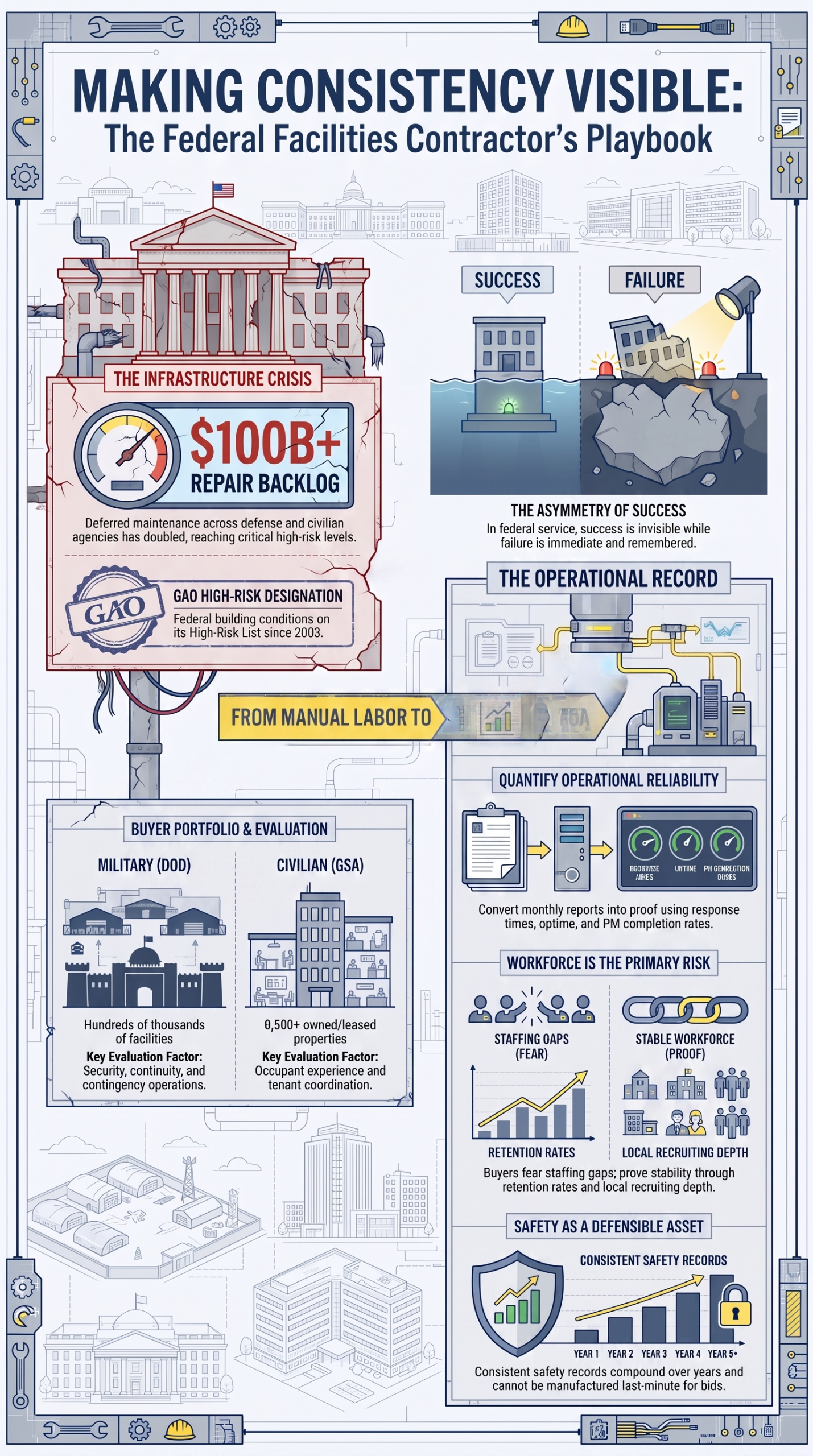
Table of Contents
- The Federal Facilities Management Market
- Who Buys: Installations, Agencies, and the Federal Landlord
- What Federal Facilities Contractors Provide
- How the Work Is Bought: Bundled Scopes, Vehicles, and Recompetes
- Operational Reliability: Proving the Buildings Keep Running
- Workforce Depth: The Staffing Question Behind Every Award
- Safety and Compliance: The Record That Keeps You Eligible
- Set Asides, Transition, and Teaming
- The Digital Credibility Gap: Invisible Work Needs Visible Proof
- The Facilities Contractor’s Playbook: Making Consistency Visible
I spent thirty years inside the federal government, across the Navy, the FBI, the Department of Homeland Security, and the National Security Agency, and most of those years were spent inside federal buildings and on military installations. I have been the occupant when the heat failed in January, and the tenant when a contract changed hands and nothing worked properly for a month afterward. I formed opinions about facilities contractors the same way every government professional does, which is by living with the results. I also watched capable firms lose recompetes they should have held, and lose new work they were plainly qualified to perform.
They did not lose on capability. They lost because the operational record that would have made their case existed only in monthly reports to a single customer, invisible to everyone else. What follows is written for the operations and maintenance provider, the custodial or grounds firm, the multi trade contractor, or the base operations support company that wants to grow into federal work, or to expand beyond the one contract it has held for years. It covers how the market works, who buys, how the work is competed, and the one thing that turns an invisible service into visible proof. Let me walk through all of it.
Chapter 1. The Federal Facilities Management Market
The federal government owns and operates one of the largest real estate portfolios on earth, and it is struggling to keep it in working order. That struggle is the market.
The scale is difficult to overstate. The Defense Department alone manages hundreds of thousands of facilities worldwide, with a replacement value measured in trillions, and military installations hold well over a million individual real property assets when structures beyond buildings are counted. On the civilian side, the government’s landlord agency manages a portfolio of roughly eight and a half thousand owned and leased properties covering hundreds of millions of square feet and housing more than a hundred tenant agencies. The government spends heavily on operating and maintaining all of it every year, with the general scale of that spending visible at public reporting sites like USASpending.gov.
What defines this moment is the condition of that portfolio. Federal oversight reporting has documented that deferred maintenance and repair backlogs across defense and civilian buildings more than doubled over recent years, rising into the hundreds of billions of dollars, and that finding was significant enough to put building condition itself onto the government’s high risk list, alongside the broader management of federal real property that has sat on that list since 2003. Agencies are disposing of buildings they no longer need precisely because they cannot afford to maintain everything they hold. For a contractor, the meaning is direct. The work is not going away, the pressure on performance is rising, and buyers are increasingly unwilling to gamble on a firm whose reliability they cannot verify.
There is a second consequence of that condition problem worth naming. When budgets cannot cover everything, agencies shift from replacing systems to extending their life, which raises the value of maintenance done well. A firm that keeps aging equipment running past its expected service life is delivering something the government urgently needs and can measure. That is a better position to compete from than it sounds, because it turns a firm’s daily work into the exact outcome the customer is under pressure to produce.
Chapter 2. Who Buys: Installations, Agencies, and the Federal Landlord
Federal facilities work runs through several distinct buyers, and each one competes and evaluates somewhat differently.
The Installation Side
Military installations are the largest source of facilities work. Each service runs its own installation and engineering organizations, and individual garrisons, bases, and stations buy operations, maintenance, and support for everything inside the fence. This work sits alongside the broader defense and aerospace market and carries some of its conditions, including base access, security requirements, and the expectation that operations continue through contingencies. Installation contracts are often large, bundled, and long running, which makes them worth pursuing and difficult to unseat.
The Civilian Side
On the civilian side, the government’s landlord agency manages the federal office and courthouse portfolio and buys building operations across it, while agencies with their own real estate, notably the Veterans Health System, the land management agencies, and the research laboratories, run their own facilities programs. Two features distinguish civilian work. The buildings are frequently older, urban, and occupied by the public as well as employees, and the portfolio is actively being consolidated, which means some sites are being invested in while others are being disposed of. A firm that understands which way a given portfolio is moving is positioned to pursue the right work.
The buyer also determines what the evaluation emphasizes. Installation work tends to weight security, continuity through contingencies, and the ability to operate inside a controlled environment. Civilian building work tends to weight occupant experience, tenant coordination, and the constraints of working in an occupied public building. The technical skills overlap almost entirely. What differs is which risks the customer worries about, and a firm that speaks to the right set of worries reads as familiar rather than generic.
Chapter 3. What Federal Facilities Contractors Provide
The category is broad, and agencies rarely buy a single piece of it, so a firm should understand both what it does and how that fits into the way the work is packaged.
Operations, Maintenance, and Trades
The core is operations and maintenance: running and repairing heating, ventilation, and cooling systems, electrical and plumbing systems, elevators, fire protection, building controls, and the preventive maintenance program that keeps all of it from failing. Around it sit the recurring services, custodial and janitorial work, grounds care and snow removal, pest control, waste and recycling, and the trades that handle repairs and small projects. Larger repair and renovation work shades into construction and infrastructure, and building systems work overlaps directly with the energy and utility side, since the same equipment that keeps a building comfortable is where most of its energy consumption lives.
Base Operations and Technical Support
At installations, the package often widens into base operations support, which can fold in facilities work along with vehicle and equipment maintenance, warehousing, airfield services, and other installation functions under a single contract. Alongside all of it runs technical support: facility condition assessments, maintenance management systems, space and occupancy planning, and the compliance work that older buildings demand. A firm may self perform a narrow scope or manage a broad one through subcontractors, but a buyer is always asking the same question. Will this contractor keep the place running.
Where a firm sits on the self performance question matters more than most realize. A buyer reading a proposal wants to know which disciplines your own employees handle and which you subcontract, because each subcontracted scope adds a management layer and a potential failure point. Neither answer is wrong. A firm that self performs a focused scope and one that manages a broad scope through vetted partners can both perform well. What a buyer cannot evaluate is a firm that leaves the question unanswered, so answer it plainly.
Chapter 4. How the Work Is Bought: Bundled Scopes, Vehicles, and Recompetes
Facilities work is competed in ways that reward preparation, and a firm that misreads the structure loses before it starts.
Bundles, Vehicles, and Performance Standards
Agencies typically buy bundled scopes rather than individual services, combining operations and maintenance with custodial, grounds, and trades under one requirement, which means a firm whose capabilities are presented as separate offerings may not visibly cover what is being solicited. Much of the work runs through multiple award contracts and the task orders issued under them, along with agency specific vehicles for installation and building support. The contracts themselves are usually written around performance rather than procedure: the government states the outcomes it requires, the contractor proposes how to achieve them, and a surveillance plan defines how performance will be measured. That structure puts your own quality control approach directly into the evaluation, because the government is buying your management system as much as your labor.
The Recompete Reality
The defining rhythm of this market is the recompete. Facilities contracts end, and when they do, incumbency by itself will not hold them. Agencies use the recompete to test whether they are getting current value, and a challenger with a documented record can unseat an incumbent whose performance was fine but was never made legible to anyone outside the program office. This cuts both ways, and it is the single most important strategic fact for a facilities firm. Every contract you hold is a future competition, and the evidence you accumulate while performing is what defends it. A firm that treats documentation as an afterthought is quietly disarming itself before a fight it knows is coming.
The timing of a recompete rewards preparation in a specific way. Market research usually begins many months before a solicitation appears, which means the record a firm has published before that window opens is the record that shapes how the requirement gets written and who the contracting officer expects to see bid. A firm that starts assembling its evidence when the solicitation drops is already late. The work of being visible has to happen during performance, not during pursuit.
Chapter 5. Operational Reliability: Proving the Buildings Keep Running
This is the first thing the hero of this whole effort names, and it is the proof most facilities firms already possess without realizing it is proof.
The Numbers You Already Track
Your team measures this work every month. Response times on service calls and how they vary by priority. Resolution times and first visit completion. Preventive maintenance completion rates against the scheduled program. Service call volume and backlog. Uptime on the systems that matter most, the chillers, the boilers, the generators, the elevators. Every one of those figures is exactly what an evaluator wants and rarely receives, because most firms describe themselves with adjectives while the numbers sit inside a monthly report that goes to one customer and nowhere else. A firm that publishes its performance record in the same terms the government uses to measure it has answered the reliability question before it is asked.
Context Makes the Numbers Mean Something
Raw metrics need context to be useful, so pair them with the profile of the work. The facility types you have managed, hospitals and laboratories and courthouses and industrial buildings each carry different demands. The square footage under your care. The number of buildings, the age of the systems, the hours of coverage. An evaluator reading that your firm sustained high preventive maintenance completion across two million square feet of aging federal office space for eight years learns something no capability statement can convey. Reliability in this business is not a claim about intent. It is a pattern across time, and patterns can be shown.
One caution about publishing numbers. Report them accurately and define them, because a metric without a definition invites doubt, and an inflated one will not survive a reference check. Say what counts as a response, what period the figure covers, and how it was measured. Precision reads as competence to anyone who has managed against a surveillance plan, and it protects you if a buyer decides to verify. Contractors who round generously in their own favor tend to get caught by the customers most worth having.
Chapter 6. Workforce Depth: The Staffing Question Behind Every Award
The second thing the hero names is workforce, and in facilities management it is the risk buyers fear most, because this is a labor business before it is anything else.
Why Staffing Is the Real Risk
The government has watched contractors win on price and then fail to field the trades a site actually needs, leaving positions unfilled, supervision thin, and service degrading month by month. That experience shapes how evaluators read every proposal. They want to know that you can recruit in the local labor market, that you will pay in accordance with the wage determination that applies, that you can retain people once you have them, and that supervision is real rather than nominal. A firm that documents its recruiting approach, its retention record, its supervision structure, and the certifications and licenses its people actually hold is directly reducing the risk an evaluator assigns to it.
Wage Determinations and the Local Market
One feature separates federal facilities work from commercial work, and a firm has to understand it. Service contracts carry wage determinations that set minimum wages and fringe benefits for service employees by locality and labor category, which means labor cost is substantially set by rule rather than by negotiation. That levels the field in a useful way. If competitors are working from similar wage floors, the differentiator becomes who can actually attract, keep, and supervise good people at that rate, which is a management capability rather than a pricing trick. Showing that you understand this, and that your workforce approach is built around it, signals competence to anyone who has administered one of these contracts.
Retention deserves its own emphasis, because it is the measure that predicts everything else. A crew that stays learns the building, and a technician who knows which valve sticks and which panel mislabels its breakers is worth more than a resume suggests. Turnover destroys that knowledge and shows up later as slower response and repeated failures. A firm that can point to low turnover on federal sites is describing an operational advantage rather than a personnel statistic, and buyers who have lived through a bad transition understand it immediately.
Chapter 7. Safety and Compliance: The Record That Keeps You Eligible
The third thing the hero names is safety and compliance, and in facilities work these are not paperwork. They are the conditions of being allowed on site at all.
Safety as a Qualification
Facilities work puts people on roofs, in mechanical rooms, around energized equipment, and in confined spaces, often in occupied buildings and sometimes on active installations. Agencies treat a contractor’s safety performance as a direct indicator of management quality, because a firm that cannot control its own hazards is unlikely to control anything else. Your injury and incident rates, your safety program, your training records, and your record on federal sites are evidence a buyer weighs seriously. On installations, the safety requirements are more demanding still, and a firm that has worked to those standards should say so plainly.
The Compliance Stack
Around safety sits everything else the government requires: wage and labor compliance, environmental requirements covering hazardous materials, waste handling, refrigerants, and water, which is where facilities work meets engineering and environmental practice, along with base access and personnel vetting, and the quality control plan you will be measured against. Each of these is a place where a contract can go wrong quietly and expensively. A firm that presents its compliance posture clearly and keeps it current is telling a buyer that the administrative side of the contract will not become their problem, which is worth more to a contracting officer than most contractors realize.
Worth adding that these records compound. Safety statistics accumulate over years and cannot be manufactured before a bid, and the same is true of a clean compliance history. A firm that has invested steadily in its safety program holds something a competitor cannot assemble quickly, which makes it one of the few genuinely defensible advantages in a market where most technical capabilities are comparable. Publishing it is simply refusing to waste an asset you have already paid for.
Chapter 8. Set Asides, Transition, and Teaming
Three structural features shape which facilities opportunities a firm can realistically pursue.
Set Asides and the Programs That Shape This Market
Small business participation runs deep in federal facilities work, and the certification programs, the ones for firms owned by socially and economically disadvantaged individuals, for service disabled veteran owned firms, for women owned firms, and for firms in historically underutilized business zones, all open real doors here. This sector also carries a program most others do not: a share of federal custodial, grounds, and related services is reserved for nonprofit agencies employing people who are blind or who have significant disabilities, which means a firm pursuing those scopes has to understand where that channel applies before it invests in a bid. Firms across the sector directory of federal work find their way in through the certifications and channels that fit them.
Transition Is the Argument
Here is the element unique to this sector, and the one most firms underuse. A contracting officer changing facilities contractors is accepting a real risk of service disruption, and that fear is often larger than any concern about price. A documented transition approach, covering how you assess the site, how you handle continuity of the existing workforce, how you capture the knowledge that lives in the heads of the outgoing crew, and how you stand up systems without a gap, addresses that fear directly. Firms that make phase in look routine win work that firms with lower prices lose, and the same discipline makes a firm attractive to primes assembling teams for larger installation contracts.
Chapter 9. The Digital Credibility Gap: Invisible Work Needs Visible Proof
Here is the piece most facilities firms are missing, and it follows directly from the nature of the service. This work is invisible when it goes well, which means it does not advertise itself. Somebody has to make it visible on purpose.
What a Buyer Checks
Agencies and primes research a facilities firm before they engage it, and they read for the same things they weigh in an evaluation: the scope disciplines you self perform, the facility types and site sizes you have managed, your performance metrics, your workforce depth and certifications, your safety record, and your transition approach. A firm whose site presents all of that has answered the evaluation in advance. A firm offering a services list and a contact form has answered nothing, and the buyer moves to the firm that did the work of being checkable. Smaller firms have more room here than they think, because a specialist with published numbers is often more convincing than a national brand that cannot show its performance at any particular site.
The Messaging Problem
The deeper issue is messaging. Most facilities firms present themselves to commercial property managers, leading with service lists and building photographs. A federal evaluator is reading for something else entirely: metrics, workforce, safety, compliance, and continuity, tied to facility types resembling their own. The firm almost always has the material, sitting in monthly reports, safety logs, staffing plans, and closed contracts that were never turned into public evidence. Closing that gap is what a purpose built federal contractor website does: it converts an operations record into award evidence, arranged the way facilities buyers evaluate. The performance was never the question. Whether anyone outside the program office can see it, is.
Chapter 10. The Facilities Contractor’s Playbook: Making Consistency Visible
Pulling it together, here is what a facilities firm that wants to grow and hold what it has should do, and where the digital piece fits.
Publish the Operational Record
Start with the numbers you already produce. Response and resolution times, preventive maintenance completion, service call closure, and uptime on critical systems, paired with the context that makes them meaningful: facility types, square footage, building counts, and duration. Present each contract history with site profile, scope, and results, so an evaluator can judge whether your experience resembles their requirement rather than guessing.
Show the People and the Safety Record
Then present your workforce, because staffing is the risk they are actually pricing. Your trades and supervision structure, the certifications and licenses your people hold, your recruiting and retention approach, and your understanding of wage compliance. Add your safety record and program, your quality control approach, and your compliance posture, stated plainly and kept current. Finally, publish your transition methodology, because in a market defined by recompetes, the firm that makes phase in look routine removes the objection that decides close calls.
Start Now
The portfolio is aging, the repair backlog has grown into one of the government’s acknowledged high risk problems, and agencies are under real pressure to get more reliability from every dollar they spend on buildings. A firm that pairs genuine facilities management capability with a presence that proves its operational reliability, workforce depth, and safety and compliance record is positioned to win new work and defend what it holds. Contracting officers are evaluating facilities firms right now, many of them ahead of recompetes already on the calendar, and a credible federal contractor website is what makes sure your record is part of that evaluation. The regions where this work concentrates are mapped across the regional market pages.
I take the operational record your team already produces, the response times, the completion rates, the safety numbers, the workforce depth, and structure it into proof a contracting officer trusts, built on a platform whose reliability reflects the service you sell. If you are ready to compete for federal facilities work, this is where it starts.
Authoritative Sources
The following sources inform the facts in this guide. Web addresses were current at the time of writing and should be verified for the latest information, since portfolio figures, backlog estimates, and program requirements change as agencies report.
Acquisition.gov. (n.d.). Federal Acquisition Regulation, including Part 37 on service contracting. https://www.acquisition.gov/
Naval Facilities Engineering Systems Command. (n.d.). NAVFAC. https://www.navfac.navy.mil/
U.S. AbilityOne Commission. (n.d.). AbilityOne Program. https://www.abilityone.gov/
U.S. Air Force Civil Engineer Center. (n.d.). AFCEC. https://www.afcec.af.mil/
U.S. Army Corps of Engineers. (n.d.). Safety and health requirements. https://www.usace.army.mil/
U.S. Department of Labor. (n.d.). Service contract labor standards and wage determinations. https://www.dol.gov/
U.S. Environmental Protection Agency. (n.d.). Facility environmental compliance. https://www.epa.gov/
U.S. General Services Administration. (n.d.). Public Buildings Service and federal real estate. https://www.gsa.gov/
U.S. Government Accountability Office. (2025). Federal Real Property: Disposing of Unneeded Facilities Could Help Reduce Maintenance Backlog. https://www.gao.gov/
U.S. Government Accountability Office. (2025). DOD Real Property: Actions Needed to Improve Oversight of Underutilized and Excess Facilities. https://www.gao.gov/
U.S. Occupational Safety and Health Administration. (n.d.). OSHA. https://www.osha.gov/
U.S. Small Business Administration. (n.d.). Contracting assistance programs. https://www.sba.gov/
System for Award Management. (n.d.). SAM.gov. https://sam.gov/
Contractor Performance Assessment Reporting System. (n.d.). CPARS. https://www.cpars.gov/
U.S. Department of the Treasury. (n.d.). USAspending.gov. https://www.usaspending.gov/
Explore your field in the sector directory, or browse the regional market pages to see where government buyers concentrate across the country.