

Bottom Line Up Front
Every sector in government contracting is judged partly on its digital presence. This one is judged entirely on it. When a firm sells communications, its own website is not marketing for the work, it is a sample of the work, and an agency evaluating a communications vendor forms a judgment about the quality of what it will receive before it reads a single line of the proposal. A firm that cannot present itself clearly has already argued against its own capability.
The market is substantial and unusually accessible. The federal government is one of the largest advertisers and communicators in the country, spending on the order of a billion and a half dollars a year on public relations activities alone, with advertising contract obligations running to roughly fifteen billion dollars across a recent ten year period. More than half of that is driven by the Defense Department, largely for military recruiting, and a meaningful share of advertising dollars has gone to disadvantaged, minority owned, and women owned firms, which makes this one of the better sectors for a smaller agency with genuine capability.
This guide covers how the federal communications market works, who buys, the rules governing what the government may say and how, and how a firm proves its strategic capability, creative quality, and results. A credible federal contractor website is the single most persuasive, or most damaging, item in a communications firm’s portfolio. Read it as a playbook for making sure it is the former.
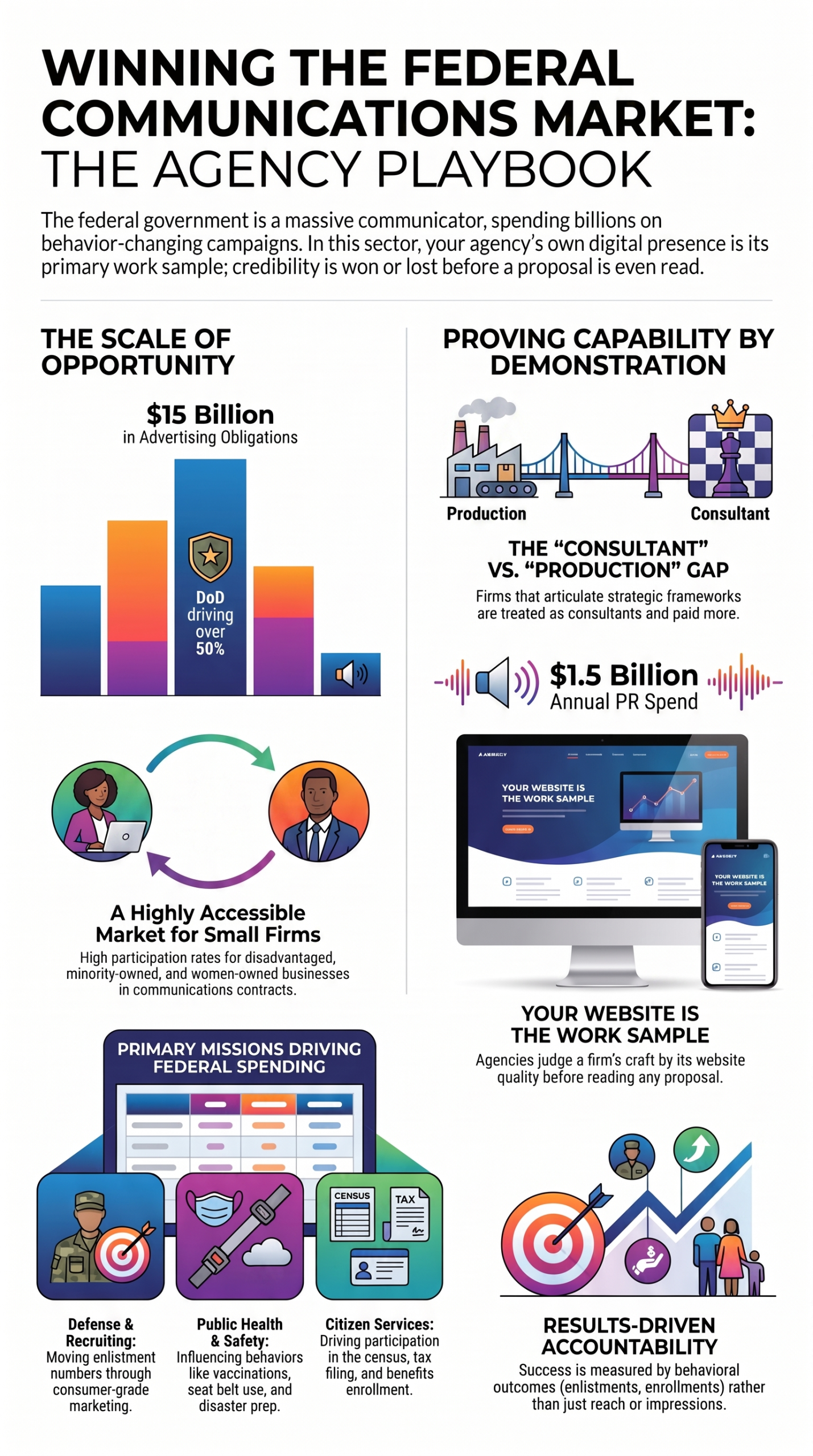
Table of Contents
- The Federal Communications and Marketing Market
- Who Buys: Recruiting, Public Health, Safety, and Citizen Services
- What Federal Communications and Marketing Contractors Provide
- How the Work Is Bought: Schedules, Domains, and Agency Vehicles
- Strategic Capability: Being Read as a Strategist, Not a Shop
- Creative Quality: Work Samples Under Federal Constraints
- Results: The Accountability Agencies Now Demand
- The Rules That Govern Government Speech
- The Digital Credibility Gap: Your Website Is the Work Sample
- The Communications Firm’s Playbook: Proving Capability by Demonstrating It
I spent thirty years inside the federal government, across the Navy, the FBI, the Department of Homeland Security, and the National Security Agency, working inside agencies that buy communications and under the rules that govern how the government speaks to the public. I watched agencies choose communications partners, and I watched how quickly a vendor’s own presentation shaped the judgment. A firm that arrived with a sharp, clear, evidently well made presence started from a position of credibility. A firm whose own materials were muddled had to argue its way out of a hole it dug before the meeting began.
I also watched capable agencies lose federal work because they presented themselves to the wrong reader. What follows is written for the advertising or marketing agency, the public relations and public affairs firm, the digital and content shop, the creative production company, and the strategic communications consultancy that wants to grow into federal work. It covers how the market works, who buys, the boundaries specific to government speech, and the one thing that proves your strategic capability, creative quality, and results by demonstrating them. Let me walk through all of it.
Chapter 1. The Federal Communications and Marketing Market
The federal government communicates constantly, at scale, and it buys much of that capability from outside firms.
Federal oversight reporting has put annual spending on public relations activities at roughly a billion and a half dollars, carried out through advertising and public relations contracts and by public affairs employees, with advertising contract obligations running to something near fifteen billion dollars across a recent decade. The Defense Department drives well over half of that, and the general scale of federal spending is visible at public reporting sites like USASpending.gov. What the money buys is not brand building in the commercial sense. It is behavior: enlistments, vaccinations, seat belts, census responses, benefits enrollment, disaster preparation, fraud avoidance, and safe practices of a hundred kinds.
Two features make this market unusually approachable for a mid sized or small firm. Reporting on federal advertising has found that a meaningful share of those dollars, on the order of a seventh across a recent decade, went to disadvantaged, minority owned, and women owned businesses, which is a higher participation rate than many federal sectors manage. And because the work is judged substantially on demonstrated craft and thinking rather than on facilities or capital, a small agency with genuine capability competes closer to even here than almost anywhere else in government contracting. The constraint is not scale. It is whether the firm has made its capability visible and legible to a federal reader.
It is worth naming the adjustment a commercial firm has to make. Federal communications work runs on longer timelines, more approval layers, and heavier documentation than most commercial accounts, and creative decisions get defended in writing rather than settled in a room. Firms that find that intolerable should not enter. Firms that can work that way find compensating advantages: contracts that run for years rather than campaigns that end in a quarter, clients who rarely disappear in a downturn, and missions that most creative people find genuinely worth working on.
Chapter 2. Who Buys: Recruiting, Public Health, Safety, and Citizen Services
Federal communications spending clusters around a handful of missions, and each one carries a different creative and strategic problem.
Recruiting Leads the Market
The single largest buyer is the Defense Department, and the largest use is military recruiting. Each service runs sustained advertising and marketing campaigns aimed at influencing young people to consider service, competing for attention against every commercial advertiser and against a shrinking pool of eligible candidates. This is genuine consumer marketing conducted inside defense and aerospace contracting rules, and it demands audience research, media sophistication, and creative that can compete in commercial channels. It is also the most measured communications work the government does, because recruiting has hard numeric goals and a campaign either moves them or does not.
Civilian Missions
Across the civilian side the missions vary widely: public health and disease prevention campaigns, highway and transportation safety, emergency preparedness and disaster response messaging, census and survey participation, tax filing and taxpayer assistance, benefits and health coverage enrollment, immigration and citizenship services, consumer financial protection, nutrition and food assistance, energy efficiency, and veterans outreach. Each has a defined audience, frequently one that is difficult to reach, and often a measurable behavioral objective. A firm with genuine experience reaching a specific hard to reach population holds something agencies value more than general creative reputation.
Audience specialization is worth taking seriously as a positioning strategy. Reaching rural populations, young adults, veterans, recent immigrants, people with limited English, older adults, or communities with low trust in government are each distinct problems requiring different channels, messengers, and creative instincts. An agency with a hard audience will pay attention to a firm that has demonstrably reached that audience before, even a small one, because general creative excellence does not solve for a population that is not listening. Naming the audiences you genuinely know how to reach is more persuasive than naming your capabilities.
Chapter 3. What Federal Communications and Marketing Contractors Provide
The category is broad, and firms should be precise about which parts of it they actually hold at depth.
Strategy, Creative, and Media
At the front sits strategy and research: audience segmentation and research, message development and testing, campaign planning, and the behavioral thinking that connects a communication to an outcome. Then comes creative and production: concepting, copywriting, design, video and audio production, photography, and the full range of asset development. Then media planning and buying, which in federal work carries its own reporting and documentation expectations. Public affairs and media relations run alongside, covering press operations, spokesperson support, crisis communication, and stakeholder engagement.
Digital, Content, and Measurement
The digital side has grown into the largest area of demand: websites and digital products, social media, email, search, and content operations, which sits close enough to information technology and cybersecurity work that agencies frequently buy the two together and expect a firm to understand accessibility, security, and privacy alongside design. Around it sit translation and multilingual production, internal and workforce communications that shade into education and training work, and analytics and measurement. All of it is a professional service, sold on expertise and judgment, which means the firm is being evaluated as much as the deliverable.
Presenting all of that at once creates the problem this sector is prone to. A firm claiming strategy, creative, media, public affairs, digital, translation, and analytics is asking a buyer to believe it is strong in seven disciplines, and experienced evaluators discount the whole list. The better approach is to name where you are genuinely deep, be honest that other capabilities are supporting rather than leading, and let partnerships fill the rest. Buyers respect a firm that knows its own shape far more than one claiming every shape at once.
Chapter 4. How the Work Is Bought: Schedules, Domains, and Agency Vehicles
Communications work is competed through several routes, and knowing which one a target agency uses shapes where a firm should invest.
The Vehicles
A large share runs through the General Services Administration’s schedule, which carries dedicated categories for advertising and integrated marketing services covering everything from strategy and creative through media buying and public relations. The governmentwide professional services vehicle now includes a marketing and public relations domain among the service areas added in its recent expansion, which matters because that vehicle is being positioned as the primary route for professional services outside information technology and its solicitations are continuously open rather than tied to a fixed window. Beyond those, agencies run their own blanket purchase agreements and multiple award contracts, and the largest campaigns are frequently competed as standalone agency of record arrangements running several years.
How Competitions Actually Work
Communications competitions differ from most federal procurements in one important respect: they usually involve showing work. Agencies commonly ask for creative concepts, sample campaigns, or a response to a scenario, which means the firm’s actual craft is evaluated directly rather than described. That favors firms with genuine creative capability and disadvantages those competing on price. Small business set asides run throughout this market, and given the participation rates already noted, a certified firm with a strong portfolio is well positioned. Firms across the sector directory of federal work find their way in through the vehicles and certifications that fit them.
One practical note about the creative response format. Because agencies frequently ask for concepts or sample work as part of the evaluation, pursuing federal communications work carries real unpaid cost, and firms should be selective rather than responding broadly. The offsetting advantage is that the format rewards genuine ability. A firm that can actually do the work has a fairer shot here than in procurements decided on written qualifications alone, where incumbency and proposal budgets do more of the deciding.
Chapter 5. Strategic Capability: Being Read as a Strategist, Not a Shop
This is the first thing the hero of this whole effort names, and it decides which tier of work a firm is considered for.
The Distinction Agencies Draw
Agencies separate communications vendors into two groups without ever saying so. One group executes: it produces assets to a specification somebody else wrote. The other group is consulted: it helps define the problem, identify the audience, and decide what the campaign should attempt in the first place. The second group is paid better, retained longer, and asked back. The difference in how they are perceived usually comes down to whether the firm has articulated how it thinks. A firm that publishes its strategic approach, its research methods, its planning framework, and the reasoning it applies to a communications problem reads as a strategist. A firm that shows only finished work reads as a production resource, however good the work is.
Understanding the Mission Is Part of the Strategy
Federal strategic capability has a component commercial work does not require, which is understanding what the agency is actually accountable for. A recruiting command answers for enlistment contracts. A health agency answers for behavior that reduces disease. An emergency management agency answers for whether people prepared before the storm. A firm that frames its thinking around the outcome the agency owns, rather than around awareness or engagement as ends in themselves, is speaking the language of the person who has to defend the spending. Demonstrating that understanding in public writing is one of the most efficient credibility signals available in this sector, because it is difficult to fake and immediately recognizable to someone inside.
The corollary is that generic strategy language actively hurts a firm here. Every competitor claims audience insight and data driven thinking, so those phrases carry no information at all and consume the space where evidence should be. Replacing them with one worked example of how you approached a real problem does more persuasive work than a page of positioning copy, because it lets a reader evaluate the thinking directly.
Chapter 6. Creative Quality: Work Samples Under Federal Constraints
The second thing the hero names is creative quality, and in this sector the evidence is unusually direct, because buyers can simply look.
Show the Work
Portfolio is the argument. Agencies evaluating creative capability want to see finished work at production standard: campaigns, video, design systems, digital products, and content, presented well enough that the presentation itself demonstrates the standard. This is the one sector where a capability statement is genuinely inferior to a gallery. It is worth noting that work does not have to be federal to be persuasive, since craft transfers and agencies understand that, but work aimed at a comparable audience or a comparable behavioral objective carries considerably more weight than work whose only virtue is that it looked good.
The Constraints That Shape Federal Creative
Federal creative operates under conditions most commercial work does not. Digital content must meet accessibility standards, which affects design, video captioning, document structure, and interaction patterns from the beginning rather than as a remediation step at the end. Plain language expectations govern how government writes to the public. Multilingual production is frequently required. Agency brand and identity standards apply. Review cycles involve more stakeholders and more approval layers than commercial clients impose. A firm that demonstrates it can produce excellent work inside those constraints, rather than treating them as obstacles to complain about, is showing an agency that the engagement will be comfortable, which matters more to a federal client than most vendors appreciate.
A note on presenting work you cannot fully attribute. Client confidentiality, review restrictions, and campaign sensitivities sometimes prevent naming an account or showing everything produced. That constraint is manageable. Describe the audience, the objective, the approach, and the outcome, show what you can, and characterize the rest accurately. Evaluators encounter this constantly and think nothing of it. What they notice is a firm that handles the limitation gracefully, because that is the same discretion they will need from a partner handling their own sensitive work.
Chapter 7. Results: The Accountability Agencies Now Demand
The third thing the hero names is results, and expectations here have tightened considerably.
Measurement Became a Requirement
Public money spent on communication is increasingly expected to demonstrate a return, and federal oversight bodies have pressed agencies to measure marketing effectiveness more rigorously, to manage brand risk deliberately, and to account for how marketing funds are used. That pressure passes directly to vendors. A firm that arrives with a measurement approach already built into its proposals, and outcome data from past campaigns, is solving a problem the agency has been told to solve. A firm that reports impressions and reach alone is offering activity where the customer now needs evidence, and the gap between those two positions is widening every budget cycle.
What Counts as a Result
The strongest evidence is behavioral: applications submitted, appointments made, enrollments completed, calls received, forms filed, response rates moved. Below that sit awareness and attitude measures where behavior cannot be tracked directly, and below those sit reach and engagement, which are inputs rather than outcomes. Present the highest level you can honestly claim, describe the methodology, and respect client confidentiality by aggregating or characterizing where necessary. A campaign case study that states the problem, the audience, the approach, and the measured result, at a level that respects sensitivities, is the most valuable single asset a federal communications firm can publish, and remarkably few of them do it.
Chapter 8. The Rules That Govern Government Speech
Here is the body of knowledge that separates a firm that can work in this market from one that will create a problem for its client.
Publicity, Propaganda, and Disclosure
For decades, appropriations acts have carried a restriction barring the use of federal funds for publicity or propaganda purposes not authorized by Congress. The restriction does not prevent agencies from informing the public about their programs, which is a legitimate and expected function. What it targets is a narrower set of behaviors, and the clearest of them is covert propaganda: government funded material that conceals its origin so the audience cannot tell the message came from the government. That is why federal communications work carries source attribution expectations that commercial work does not, and why a firm proposing tactics that obscure sponsorship is proposing a problem. Related restrictions limit using appropriated funds to generate public pressure on Congress. Whether an agency may run a given campaign at all depends on its own statutory authority and on whether the spending is a necessary expense of the program it serves, which means scope questions arise that have no commercial equivalent.
Accessibility, Plain Language, Privacy, and Records
Alongside those sit the operational rules. Digital content must meet federal accessibility standards. Plain language requirements govern public facing writing. Privacy rules constrain how audience data is collected and used, and the government’s records requirements mean that communications materials and certain exchanges are retained and may become public. Paid media placement carries its own documentation expectations. None of this is exotic, and none of it is a reason to avoid the market, but a firm that signals fluency with these boundaries is telling an agency something valuable: that it will not have to be supervised on compliance, and that its communications partner will keep it out of trouble rather than walking it into some. That assurance is a genuine part of what the agency is purchasing.
Framed correctly, this body of knowledge is an asset rather than an obstacle. Commercial agencies entering federal work frequently stumble on exactly these boundaries, proposing tactics or engagement approaches that would create an attribution problem for a government client. A firm that can identify the issue early, and propose an approach achieving the objective inside the rules, is doing something a purely commercial competitor cannot. Publishing that fluency separates a firm that has worked in this environment from one that is guessing at it.
Chapter 9. The Digital Credibility Gap: Your Website Is the Work Sample
Here is the piece that matters more in this sector than in any other, because the usual argument becomes literal.
The Audition Nobody Announces
In every other sector, a firm’s website is evidence about the firm. Here it is evidence of the firm’s actual product. An agency evaluating a communications vendor assumes, correctly, that the quality of your own presence predicts the quality of what you will produce for them. If the site is dated, slow, awkward on a phone, inconsistent in its typography, vague in its writing, or inaccessible, then every claim in the proposal is arguing against evidence the evaluator already has. The reverse is equally true and considerably more useful. A presence that is clear, well made, accessible, and substantive has already demonstrated the capability before anyone reads the qualifications, which is an advantage no other sector gets to claim.
Substance Has to Match Craft
Craft alone is not enough, because a beautiful site with nothing in it reads as a firm that can decorate. A federal evaluator is reading for a stated strategic approach, capabilities with genuine depth in each discipline, government and comparable audience experience, campaign case studies with measured results, work samples at production standard, fluency with the rules governing government speech, and the vehicles and codes that make purchase possible. Most firms have all of it, distributed across pitch decks and case studies that were never made public. Closing that gap is what a purpose built federal contractor website does: it makes the site itself the strongest sample in the portfolio while carrying the evidence a federal buyer needs. In this sector the medium genuinely is part of the message.
Chapter 10. The Communications Firm’s Playbook: Proving Capability by Demonstrating It
Pulling it together, here is what a communications or marketing firm that wants federal work should do, and where the digital piece fits.
Make the Presence the Proof
Treat your own site as the flagship work sample, because that is how it will be read. Hold it to the production standard you would deliver to a paying client, make it accessible and fast and clear, and then fill it with substance: your strategic approach and frameworks stated plainly, your capabilities by discipline with real depth in each, and work samples presented well enough to judge. Publish thinking that demonstrates judgment rather than asserting it, because demonstrated thinking is the only expertise claim an evaluator can verify without hiring you.
Publish the Results and the Fluency
Build campaign case studies stating the problem, the audience, the approach, and the measured outcome at the highest level you can honestly claim, within confidentiality limits. Show your government and comparable audience experience mapped to mission types rather than to your client list. Signal your fluency with accessibility, plain language, privacy, and the boundaries on government speech, because that reassurance is part of the purchase. Then publish your vehicles, domains, certifications, and codes so a contracting officer can see the path to buy.
Start Now
The government communicates continuously, the demand for measurable results is rising, and this remains one of the more accessible federal sectors for a capable smaller firm. A firm that pairs genuine communications and marketing capability with a presence that proves its strategic thinking, creative quality, and measured results is positioned to be shortlisted by agencies and brought onto teams by primes. Agencies are forming impressions of communications vendors right now, mostly from their websites, and a credible federal contractor website is what makes sure that first impression argues for you. The regions where federal communications work concentrates are mapped across the regional market pages.
I build communications firm websites that prove capability by demonstrating it: your strategy, creative standard, and measured outcomes organized the way government evaluators judge a firm they may trust to carry their message. If you are ready to compete for federal communications work, this is where it starts.
Authoritative Sources
The following sources inform the facts in this guide. Web addresses were current at the time of writing and should be verified for the latest information. Spending figures are approximate and reported across differing periods, and appropriations restrictions are renewed and adjusted annually, so confirm any requirement against current guidance and the solicitation you are pursuing.
Acquisition.gov. (n.d.). Federal Acquisition Regulation. https://www.acquisition.gov/
Section 508 accessibility program. (n.d.). Federal accessibility standards for digital content. https://www.section508.gov/
U.S. Congress. (n.d.). Appropriations restrictions on publicity and propaganda, and the Plain Writing Act. https://www.congress.gov/
U.S. Department of Defense. (n.d.). Military recruiting and advertising programs. https://www.defense.gov/
U.S. General Services Administration. (n.d.). Multiple Award Schedule, advertising and integrated marketing categories. https://www.gsa.gov/
U.S. Government Accountability Office. (n.d.). Public relations spending, federal advertising, and Principles of Federal Appropriations Law. https://www.gao.gov/
U.S. Small Business Administration. (n.d.). Contracting assistance programs. https://www.sba.gov/
Digital.gov. (n.d.). Federal digital experience and public engagement guidance. https://digital.gov/
Plain Language Action and Information Network. (n.d.). Federal plain language guidelines. https://www.plainlanguage.gov/
System for Award Management. (n.d.). SAM.gov. https://sam.gov/
Contractor Performance Assessment Reporting System. (n.d.). CPARS. https://www.cpars.gov/
U.S. Department of the Treasury. (n.d.). USAspending.gov. https://www.usaspending.gov/
Explore your field in the sector directory, or browse the regional market pages to see where government buyers concentrate across the country.