

Bottom Line Up Front
Security and public safety is the one contracting sector where a firm is vetted exactly the way its own officers are vetted. Character, training, discipline, and documentation, in that order. I came up through the FBI, the Department of Homeland Security, and the Navy alongside the people who guard federal missions, and I watched how the government screens its protective partners. A company with a careless public presence fails that screening before a proposal is ever read.
This sector is also unlike the others in a second way. It does not live at one level of government. Federal agencies buy protective services for their buildings, states run their own capitol complexes, courts, and emergency management programs, and cities and counties buy security for transit systems, schools, hospitals, ports, and events. Your licenses, meanwhile, are issued by states rather than by Washington, and they change at every state line. That means a security firm competes in a patchwork, and the firm that documents where it is licensed and qualified is the firm that gets called.
This guide covers how the security and public safety market works across federal, state, and local buyers, where the work concentrates geographically, and how a firm proves its licensing, training, vetting, and operational professionalism. A credible federal contractor website is where a buyer assembles the file on your company, and you can either author that file or leave it to fragments. Read it as a playbook for authoring it.
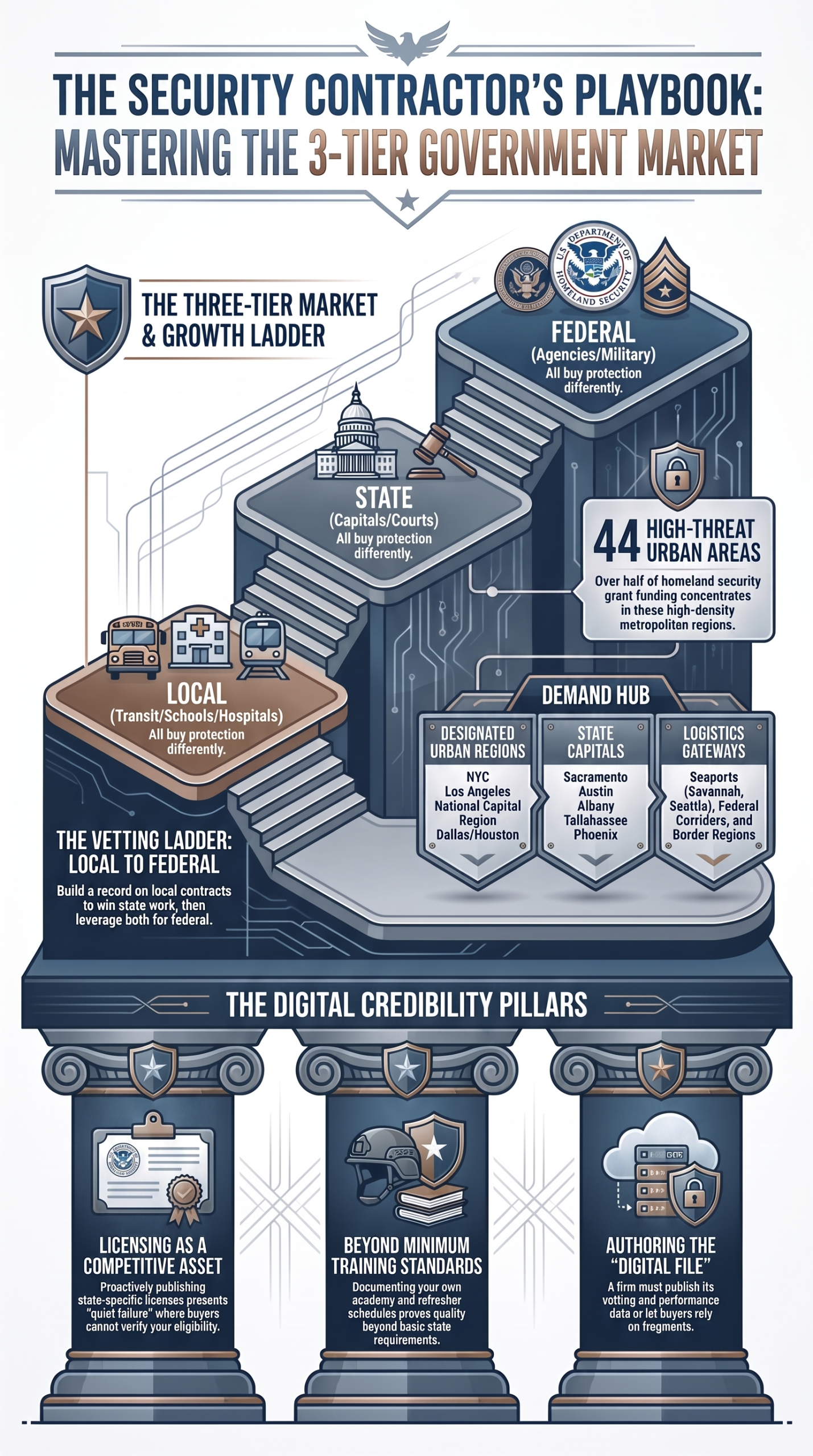
Table of Contents
- The Security and Public Safety Market Across Three Levels of Government
- Who Buys: Federal Agencies, States, Counties, and Cities
- What Security and Public Safety Contractors Provide
- How the Work Is Bought: Federal Vehicles, State Contracts, and Cooperative Purchasing
- Licensing: The Credential That Changes at Every State Line
- Training and Vetting: Who Makes It Onto Your Posts
- Operational Professionalism: The Record and the Bearing
- Where the Work Concentrates: Metro Areas, Capitals, Ports, and Borders
- The Digital Credibility Gap: Buyers Build a File on Your Firm
- The Security Contractor’s Playbook: Putting Discipline on the Record
I spent thirty years inside the federal government, across the Navy, the FBI, the Department of Homeland Security, and the National Security Agency, and I lived under the vetting, the training discipline, and the accountability that your government customers now apply to you. I know which signals tell a government security professional that a company is squared away, because I applied those standards myself. I also watched capable protective firms lose work they were entirely qualified to perform, and the reason was almost never the quality of their officers.
They lost because a buyer could not confirm where they were licensed, could not see how they train and screen the people they post, and could not find a performance record to weigh. What follows is written for the guard services company, the protective operations provider, the emergency management or response firm, the security systems integrator, and the public safety support contractor that wants to grow across federal, state, and local government work. It covers how each level buys, where the demand concentrates on the map, and the one thing that puts your licensing, training, vetting, and professionalism on the record. Let me walk through all of it.
Chapter 1. The Security and Public Safety Market Across Three Levels of Government
Most contracting sectors point at one customer. This one points at three, and a firm that understands only the federal layer is competing for a fraction of the work available to it.
At the federal level, agencies protect thousands of buildings, and much of that protection is delivered under contract rather than by government officers. The scale is substantial and the oversight is close, with audit bodies examining guard programs regularly. At the state level, every state protects a capitol complex, a court system, correctional facilities, agency offices, universities, and a public health and emergency management apparatus. At the local level, counties and cities buy protection for courthouses, jails, transit systems, airports, seaports, schools, hospitals, utilities, stadiums, and public events, along with the emergency management capability that carries a community through a hurricane, a wildfire, or a mass gathering.
Two forces have pushed demand upward across all three. Threats to soft targets and crowded places have made protection a standing budget item rather than an occasional purchase, and public agencies at every level face workforce shortages that push them toward contracted support for functions they once staffed internally. Federal spending figures are visible at public reporting sites like USASpending.gov, while state and local buying is scattered across thousands of individual procurement portals, which is precisely why being findable matters so much in this market.
Chapter 2. Who Buys: Federal Agencies, States, Counties, and Cities
Each layer of government buys protective services differently, and knowing the differences is most of the strategy.
The Federal Layer
Federal buyers include the agency that protects civilian federal facilities and screens the people entering them, the military services protecting installations, which connects this work to the broader defense and aerospace market and to the facilities and installation support contracts that often bundle guard services with base operations, and the many departments that protect their own sites, laboratories, hospitals, and ports of entry. Federal work carries the most demanding suitability and background conditions, and often the longest contract terms.
The State and Local Layers
State buyers run through general services or administration departments, state police and public safety agencies, court administrators, corrections departments, universities, and emergency management offices. Local buyers are far more numerous and far more varied: county sheriffs and courts, city purchasing departments, school districts, transit and airport authorities, port authorities, public hospital systems, and housing authorities. These buyers are smaller individually but enormous in aggregate, and they are typically easier to enter than federal work because the competition is regional rather than national. A firm that has proven itself on a county courthouse contract has built exactly the record that supports a bid for a federal building.
There is a progression worth naming, because it is how most successful firms actually grow. A company builds a record on local contracts, where the competition is regional and the entry requirements are lighter, then uses that documented performance to win state work, then carries both into federal competitions where past performance is weighted heavily. Firms that treat local work as beneath them often find they have no record to point at when a federal opportunity finally appears. The county courthouse is not a consolation prize. It is the foundation.
Chapter 3. What Security and Public Safety Contractors Provide
The category is wider than guard posts, and a firm should be precise about which parts of it it holds.
Protective Services
The core is contracted protective services: armed and unarmed officers, access control and screening, patrol, alarm response, console and dispatch operations, and executive or dignitary protection. Around it sit specialized posts, courthouse and detention security, transit and airport support, hospital and campus security, and event and crowd management for the stadiums, convention centers, and public gatherings that municipalities and authorities are responsible for protecting.
Emergency Management, Systems, and Support
A second area is emergency management and response support: planning, exercises, continuity work, emergency operations center staffing, and the surge support that follows a disaster. A third is the technology side, security systems integration covering cameras, access control, screening equipment, and the monitoring platforms behind them, which increasingly overlaps with information technology and cybersecurity as physical and digital security converge on the same networks. A fourth is training delivery, where firms run academies and qualification programs that shade into education and training work. Many firms hold several of these, and a buyer wants to see which ones plainly.
Chapter 4. How the Work Is Bought: Federal Vehicles, State Contracts, and Cooperative Purchasing
The buying mechanics differ sharply by level, and each one rewards a different kind of preparation.
Federal and State Mechanics
Federal protective work is competed through agency solicitations and multiple award vehicles, with small business set asides used heavily, and it carries the full apparatus of federal source selection: past performance evaluation, detailed technical proposals, and formal debriefings. State work typically runs through statewide term contracts awarded by a central purchasing office, which agencies across the state then order against, alongside agency specific solicitations. Winning a statewide contract is high value precisely because it converts one competition into years of ordering across many state entities.
The Local Mechanics and Cooperative Purchasing
Local buying is where most firms underestimate the opportunity. Cities, counties, districts, and authorities issue their own solicitations through their own portals, which is fragmented but also means the competitive field in any single procurement is often small and regional. The mechanism worth understanding is cooperative purchasing. A firm that wins a competitively awarded contract through a cooperative program, whether run by state purchasing officials or by a national purchasing cooperative, can often be bought from directly by other member jurisdictions without each one running its own full competition. One well run competition can therefore open the door to many buyers. Local work also carries its own compliance overlay, including state prevailing wage rules, local living wage ordinances in some cities, insurance and bonding thresholds, and residency or local hiring preferences that vary by jurisdiction.
One practical implication is that proposal effort should scale to the mechanism. A federal solicitation may demand weeks of technical writing, while a county request may ask only for a short response and a credential package. Firms that apply federal proposal habits to local work exhaust themselves, and firms that apply local habits to federal work get eliminated on responsiveness. Knowing which game is being played, and keeping a credential package ready that serves the quick responses, is what lets a smaller firm compete across all three levels without a proposal department.
Chapter 5. Licensing: The Credential That Changes at Every State Line
This is the first thing the hero of this whole effort names, and in this sector it is unlike anything in the rest of government contracting. There is no national security license.
Fifty Regimes, Not One
Private security is regulated almost entirely by state law, and the agency that enforces it differs from state to state: a state police organization in one place, a licensing board in another, a department of public safety, a department of state, or a consumer affairs office elsewhere. Some states license the company, some register the individual officer, and many do both. A handful do not regulate at the state level at all and leave licensing to cities and counties, which means a firm operating there has to satisfy municipal requirements that vary within a single state. Armed work carries a stricter regime everywhere it is permitted, with firearms training, qualification, and separate approvals layered on top of the base credential. Credentials expire on cycles that commonly run one to three years and often require refresher training to renew.
Why This Is a Competitive Asset
Reciprocity between states is limited, so a registration earned in one state generally does not authorize work in the next one. For a firm, that is either a barrier or an advantage depending on how it is handled. A company licensed in six states holds something a competitor cannot assemble quickly, because the applications, fingerprinting, background processing, and training all take time that cannot be compressed once a solicitation is live. Publishing exactly where you are licensed, in what categories, and for armed as well as unarmed work turns a compliance obligation into a qualification a buyer can verify in seconds. It also prevents the quiet failure mode in this market, which is a buyer in a state where you are licensed never learning that you are.
Chapter 6. Training and Vetting: Who Makes It Onto Your Posts
The second and third things the hero names are training and vetting, and together they answer the question every protective buyer is really asking: who exactly will be standing at my door.
The Training Pipeline
States set minimum training hours, and those minimums vary widely, with some jurisdictions requiring a single shift of instruction and others requiring a full week or more before an officer can be posted. Armed positions add firearms instruction and periodic qualification. What matters competitively is that minimums are a floor, not a standard. A firm that runs its own academy, trains beyond the state requirement, documents refresher and continuing instruction, and can show qualification schedules is presenting a different product than one that meets the minimum and stops. Post specific training matters too, since a courthouse, a transit platform, a hospital emergency department, and a federal lobby each demand different judgment, and buyers notice when a firm has thought about that.
The Vetting Machinery
Buyers evaluate the machinery as much as the people. Criminal background screening and fingerprinting, drug testing, employment and reference verification, disqualifying offense standards, and continuous evaluation after hire are the components, and federal work adds suitability determinations and, for some sites, clearance requirements. This is where a firm’s integrity is most visible, because the pressure in a labor short industry is always to post someone quickly. A company that documents its screening standards and holds them under staffing pressure is telling a buyer something important about how it will behave when a post goes unfilled at two in the morning, which is the moment that actually determines whether a contract succeeds.
Training investment also solves a second problem quietly. In a sector where staffing is the constraint, a firm with a real academy and a visible path from unarmed post to armed assignment to supervisor attracts better applicants than one offering a badge and a schedule. Officers who can see a career stay longer, and lower turnover shows up directly in the performance numbers a buyer evaluates. What reads as a training expense on the ledger is often the cheapest recruiting and retention program a security company can run.
Chapter 7. Operational Professionalism: The Record and the Bearing
The fourth thing the hero names is operational professionalism, and it is the hardest to claim and the easiest to demonstrate.
The Performance Record
Professionalism shows up in numbers before it shows up in adjectives. Post coverage and fill rates, including how often a post went uncovered and what happened when it did. Supervision ratios and how often supervisors actually visit posts. Incident documentation and report quality. Response times. Turnover, which in this industry predicts everything else, because an officer who knows a building and its people is worth several who do not. Contract engagements with real scale and duration, stating the site type, the post count, the hours covered, and the outcome. Federal buyers also carry a formal record of contractor performance that follows a firm from one competition to the next, and state and local buyers make reference calls that function the same way.
Bearing Is Part of the Product
There is a second dimension here that is specific to this sector. Buyers form an impression of your officers before they meet one, and every public signal your company sends transfers to the people standing at the post. A precise, current, disciplined presentation reinforces the professionalism you are selling. A sloppy or dated one quietly contradicts it, and in a business whose entire product is judgment under pressure, that contradiction is expensive. Command experience in your leadership, whether from law enforcement or the military, belongs on the record for the same reason, because it tells a buyer who sets the standard your officers are held to.
Chapter 8. Where the Work Concentrates: Metro Areas, Capitals, Ports, and Borders
Security demand is not spread evenly across the country. It clusters, and knowing where it clusters tells a firm where to license, where to recruit, and where to compete.
The Designated Urban Areas
The clearest map of concentrated demand is the federal grant program that funds security capability in high threat, high density urban regions. Eligibility is determined by a risk analysis across the hundred most populous metropolitan areas, and in recent years roughly forty four urban areas have been designated and funded, with the urban area track representing more than half of a homeland security grant program running near a billion dollars. What matters to a contractor is where the money lands. The state administers the award but must pass the large majority of it down to local governments in the designated region, which is then spent through local working groups on planning, equipment, training, exercises, and protection of soft targets and crowded places.
The designated regions include the largest metropolitan areas in the country: the New York City area, the Los Angeles and Long Beach region, and the National Capital Region around Washington. Texas alone carries four designated areas, the Dallas, Fort Worth, and Arlington region, the Houston area, the Austin area, and the San Antonio area, with the Dallas region having drawn well over a hundred million dollars across the life of the program. The San Francisco Bay Area operates as a designated region spanning multiple counties and dozens of jurisdictions, which is a useful model for understanding how these programs work: a single regional structure coordinating many separate buyers, each of which still contracts on its own. A firm that understands the regional structure can position itself once and reach many purchasers. Grant amounts and the designated list are set annually, so confirm the current year before building a plan around them.
Capitals, Corridors, Ports, and Borders
Beyond the designated urban regions, four other patterns concentrate demand. Every state capital is a standing security market, because a capitol complex, a supreme court, agency headquarters, and a state emergency operations center all sit in one city, which makes places like Sacramento, Austin, Tallahassee, Albany, Columbus, Harrisburg, Atlanta, Nashville, and Phoenix steady markets independent of their size. Federal facility corridors form a second pattern, concentrated around the Washington region and northern Virginia, and around metros with heavy federal and military presence such as San Diego, San Antonio, Colorado Springs, Norfolk and the Hampton Roads region, Huntsville, and Tampa. Ports and logistics gateways form a third, from Los Angeles and Long Beach to Newark, Savannah, Houston, Seattle and Tacoma, Miami, and New Orleans, each carrying maritime facility security requirements and continuous access control demand. Border regions form a fourth, with sustained federal and local activity across southern Texas, Arizona, New Mexico, and southern California, and along the northern border in Michigan, New York, and Washington. A firm that maps its licensing and recruiting against these patterns is choosing its markets deliberately rather than bidding wherever a solicitation happens to appear. The regional market pages map where federal buyers concentrate in more detail.
The practical exercise is simple, and most firms never do it. Take the states where you hold licenses, overlay the designated urban regions, the state capitals, the ports, and the federal corridors that fall inside them, and you have a target list. Then ask which adjacent state would add the most reachable demand for the cost of licensing there. That is a growth plan built on the actual geography of the work rather than on whichever solicitation happened to cross your desk this month.
Chapter 9. The Digital Credibility Gap: Buyers Build a File on Your Firm
Here is the piece most security firms are missing, and it applies at every level of government. Before an award, somebody assembles a picture of your company: licenses, training, vetting, incidents, staffing, and reputation.
Author the File
That picture gets assembled whether or not you participate in building it. If your website presents your services and jurisdictions, your licenses and permits by state, your insurance, your training standards, your screening processes, your contract performance, your staffing and supervision structure, and your codes and certifications, then you have authored the file and it says what you want it to say. If your site offers a services list and a phone number, the file gets assembled from fragments, and fragments favor whoever documented themselves better. This is amplified at the state and local level, where a small purchasing office often lacks the time to chase a vendor for basic credentials and will simply move to the firm whose information is already published.
The Messaging Problem
The deeper issue is messaging. Many security firms present themselves the way a commercial building services vendor would, leading with generic assurances about protecting what matters. A government buyer is reading for something specific: where you are licensed, how you train, how you screen, what you have protected, and who runs your company. The firm almost always has the answers, sitting in license files, training records, and post orders that were never turned into public evidence. Closing that gap is what a purpose built federal contractor website does: it presents credentials, training, vetting, and performance with the bearing your officers carry. The discipline was never the question. Whether a buyer can see it is.
Chapter 10. The Security Contractor’s Playbook: Putting Discipline on the Record
Pulling it together, here is what a security and public safety firm that wants to grow across government work should do, and where the digital piece fits.
Publish the Credentials and the Coverage Map
Start with licensing, because it is the qualification and the geography at the same time. Publish every state and jurisdiction where you are licensed, in what categories, and for armed as well as unarmed work, with your insurance and bonding posture alongside it and everything kept visibly current. Then map your service coverage to the demand patterns that matter, the designated urban regions, the state capital you already serve, the port or federal corridor in your territory, so a buyer in that market can see immediately that you are eligible and present.
Show the Pipeline and the Record
Publish your training standards and academy, your qualification and refresher schedules, and your officer screening and continuous evaluation practices, because those answer the question of who ends up on the post. Then publish the performance record: engagements with site type, post count, hours covered, duration, and outcome, along with fill rates, supervision structure, and turnover if it is a number you are proud of. Add your leadership and their command background, and finish with the codes, certifications, and vehicles that show a purchasing officer the path to buy.
Start Now
Government at every level is buying protection, states are the gatekeepers of your credentials, and the metros where demand concentrates are identifiable and reachable. A firm that pairs genuine security and public safety capability with a presence that puts its licensing, training, vetting, and professionalism on the record is positioned to win federal posts, statewide contracts, and the county and municipal work that most competitors never organize themselves to pursue. Firms across the sector directory of government work find their way in through the credentials and coverage that fit them, and a credible federal contractor website is what makes sure the file on your firm is complete before anyone else writes it.
I build the credentials, the training culture, the vetting machinery, and the performance record into a digital presence with the command bearing that makes an evaluator comfortable putting your officers on a post, whether that post is a federal building, a state capitol, or a county courthouse. If you are ready to compete across government security work, this is where it starts.
Authoritative Sources
The following sources inform the facts in this guide. Web addresses were current at the time of writing and should be verified for the latest information. Licensing rules are set by individual states and change often, and grant designations and amounts are set annually, so confirm both with the relevant authority before relying on them.
Acquisition.gov. (n.d.). Federal Acquisition Regulation. https://www.acquisition.gov/
Federal Emergency Management Agency. (n.d.). Homeland Security Grant Program and the Urban Area Security Initiative. https://www.fema.gov/
Federal Law Enforcement Training Centers. (n.d.). FLETC. https://www.fletc.gov/
Federal Protective Service. (n.d.). Protecting federal facilities. https://www.dhs.gov/
National Association of State Procurement Officials. (n.d.). State procurement and cooperative purchasing. https://www.naspo.org/
U.S. Coast Guard. (n.d.). Maritime facility security requirements. https://www.uscg.mil/
U.S. Department of Homeland Security. (n.d.). Securing soft targets and crowded places. https://www.cisa.gov/
U.S. Department of Labor. (n.d.). Service contract labor standards and wage determinations. https://www.dol.gov/
U.S. Government Accountability Office. (n.d.). Federal facility protection and contract guard oversight. https://www.gao.gov/
U.S. Small Business Administration. (n.d.). Contracting assistance programs. https://www.sba.gov/
System for Award Management. (n.d.). SAM.gov. https://sam.gov/
Contractor Performance Assessment Reporting System. (n.d.). CPARS. https://www.cpars.gov/
U.S. Department of the Treasury. (n.d.). USAspending.gov. https://www.usaspending.gov/
Explore your field in the sector directory, or browse the regional market pages to see where government buyers concentrate across the country.